


- TL;DR: Best T-Mobile Alternatives at a Glance
- Coverage vs. Speed: What Actually Matters
- Visible: Best Overall Alternative to T-Mobile
- Total Wireless: Best Budget Pick for Families and Multi-Line Users
- Mint Mobile: Best Budget Option on T-Mobile’s Network
- Google Fi: Best Alternative for International Travelers
- Boost Mobile: Best for Price Locks and Predictable Bills
- How to Choose the Right T-Mobile Alternative
Last Updated on March 25, 2026 by Ewen Finser
T-Mobile has long been a popular choice, but in my experience, sticking with one of the big carriers isn’t always the most practical decision anymore. Having worked with electronics and signal systems for years, I pay close attention to network performance, signal reliability, and how data moves through the network, and I’ve noticed that some smaller carriers actually outperform T-Mobile in specific scenarios.
The choice of a carrier isn’t just about price; it’s about understanding the trade-offs between coverage, speed, data priority, and reliability. Over the years, I’ve run my own tests, compared real-world usage across networks, and analyzed how different technologies perform under load. That hands-on insight is what guides my recommendations here, rather than marketing claims or advertised speeds.
TL;DR: Best T-Mobile Alternatives at a Glance
Carrier | Network Used | Best For | Typical Pricing Style | Key Trade-Off |
Verizon | Best overall value for single lines | Flat-rate unlimited, taxes included | Base plan can be deprioritized during congestion | |
Verizon | Families and multi-line savings | Tiered unlimited plans | Fewer perks and mixed customer service reviews | |
T-Mobile | Cheapest access to T-Mobile’s network | Prepaid (3–12 months upfront) | Slower speeds after high-speed data limits | |
T-Mobile + US Cellular | International travelers | Flexible or unlimited plans | Can get expensive for heavy data users | |
AT&T / T-Mobile (varies) | Price stability and locked-in rates | Promotional unlimited plans | Coverage depends on region and network assignment |
Coverage vs. Speed: What Actually Matters
When people switch carriers, it’s easy to get caught up in advertised speeds and 5G marketing. In my experience, consistent coverage is usually more important than hitting peak download numbers. From testing networks in urban, suburban, and rural environments, I’ve seen that a stable connection often feels better than a fast signal that drops unpredictably.
For example, Verizon-based alternatives like Visible and Total Wireless often maintain steady coverage in areas where T-Mobile can falter. That stability matters for everything from phone calls to hotspot use. On the other hand, T-Mobile network MVNOs like Mint Mobile can offer impressive speed in cities but might show slower performance in some suburban or rural areas. Even Google Fi, with its dynamic network switching, emphasizes reliability over raw peak speeds.
Speed matters most when performing high-data tasks, streaming large files, video calls, or tethering a laptop for work. But for most everyday use, such as messaging, social media, or navigation, a stable connection makes a bigger difference than a few extra Mbps. In my testing, carriers like Boost Mobile provide predictable coverage with consistent speeds in their service areas, even if they don’t match the highest advertised numbers.
The takeaway from my perspective is simple: focus on how well a network works where you actually use it, not just its headline numbers. Consistent signal, predictable latency, and reliable connectivity often outweigh flashy speed tests. When I recommend alternatives, I always consider this balance between coverage and speed because it affects the real-world experience more than any marketing claim.
Visible: Best Overall Alternative to T-Mobile
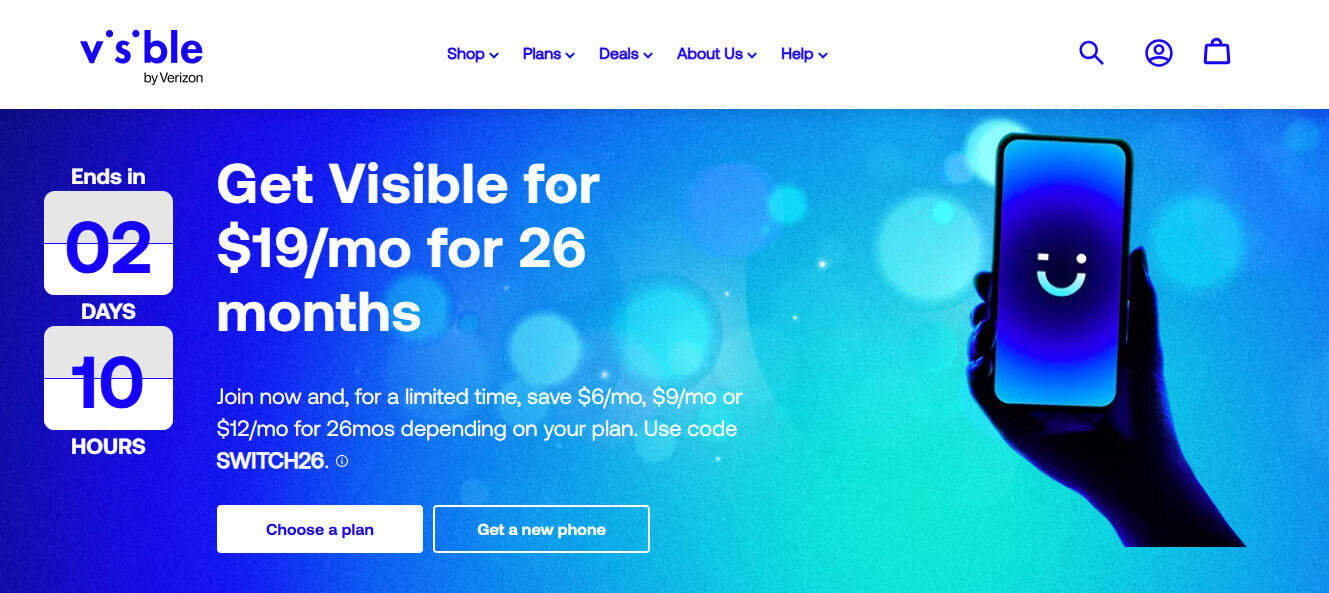
I’ve used Visible in multiple cities and on a few road trips, and one thing stands out immediately: the consistency of Verizon’s network. From an electronics perspective, the signal integrity and latency are remarkably stable compared with what I’ve seen on T-Mobile in some suburban and rural areas. Calls rarely drop, data throughput remains steady, and the unlimited hotspot, while speed-capped, performs well for moderate tasks like streaming or tethering a laptop for work.
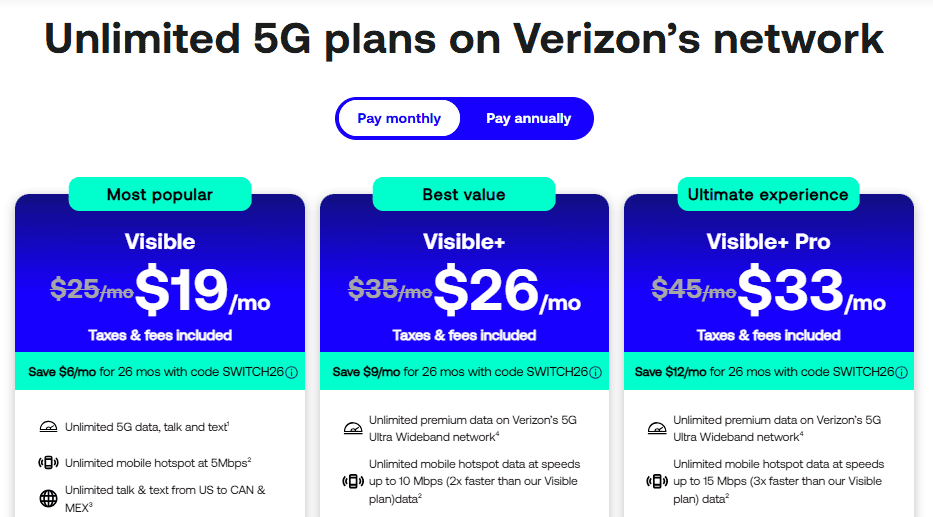
Visible keeps things simple, which I appreciate as someone who thinks in terms of system efficiency. There are no contracts, activation fees, or hidden charges. What you see is what you pay. Managing the account entirely through the app has been straightforward, and as someone who spends time analyzing electronics and connectivity, I value the transparency and predictability of the service.
In my experience, the base plan works fine for everyday use, but during network congestion, you can see a dip in speeds, which is exactly what the deprioritization rules predict. Upgrading to the Visible Plus plan mitigates that effect, giving you better priority without needing a full Verizon postpaid account. This is where your understanding of network behavior can help: knowing when congestion occurs, even without measuring tools, can help you decide if the upgrade is worth it for your personal usage.
Visible is particularly good if you want reliable, nationwide coverage without the complexity of T-Mobile’s multi-tiered offerings. For me, it strikes a balance between performance, simplicity, and cost that makes it a strong choice for anyone willing to manage their service via an app rather than a physical store.
Pros
- Consistent Verizon coverage, especially in suburban/rural areas
- Straightforward unlimited plans with taxes included
- Unlimited hotspot for moderate use
- Visible Plus offers priority data
Cons
- Base plan speeds can drop during congestion
- No physical stores or traditional phone support
- Hotspot speeds are limited even on unlimited plans
Best For
- Single-line users who want reliable, predictable coverage
- People leaving T-Mobile for cost or simplicity
- Anyone comfortable managing their plan via app

Try Visible for FREE with their 15-day offer before you switch. No commitment or credit card needed. Terms apply.
Total Wireless: Best Budget Pick for Families and Multi-Line Users
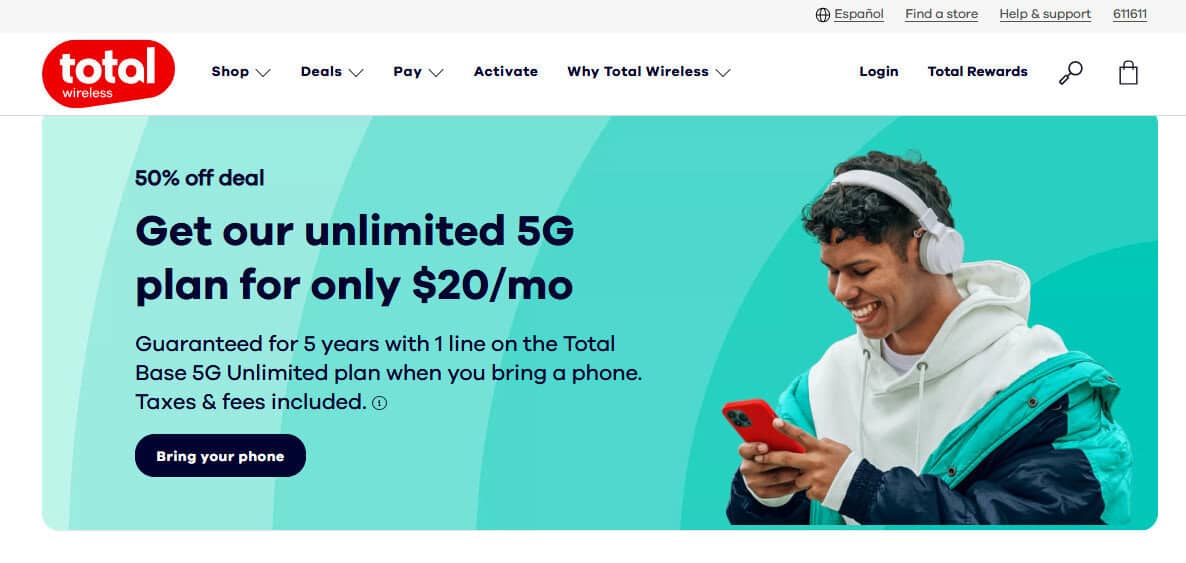
From my experience testing multiple carriers for multi-line households, Total Wireless stands out because of its predictable pricing and strong network reliability. Since it runs on Verizon’s infrastructure, signal coverage is generally consistent, even in areas where T-Mobile can be patchy. As someone who’s spent time analyzing electronics and signal behavior, I can tell when a network is congested, and Total Wireless handles this surprisingly well for a budget-focused service.
For families or households with multiple lines, the cost savings are obvious. You can keep several phones connected without the bill quickly ballooning, and you still get access to Verizon’s network quality. Total Wireless plans include options with priority data, which can make a noticeable difference during peak usage times, for example, when everyone is streaming video in the evening or using multiple devices in the same household.
The service is fully prepaid, which I personally like because it aligns with how I approach managing systems: predictable, easy to monitor, and less prone to unexpected spikes. Account management is straightforward, and the ability to bring your own device is convenient for families who already have phones.
That said, customer support isn’t always consistent, and international features are limited compared with T-Mobile’s postpaid plans. But for families prioritizing coverage and predictable costs over extras, Total Wireless is a very practical alternative.
Pros
- Lower total monthly cost for multiple lines
- Reliable Verizon network coverage
- Priority data on some unlimited plans
- Hotspot included on many plans
- Flexible BYOD and promotional options
Cons
- Customer service can be inconsistent
- Limited international coverage
- Entertainment or streaming perks are minimal
Best For
- Families or multi-line households
- Users who want Verizon coverage at a lower cost
- People focused on value rather than perks
Mint Mobile: Best Budget Option on T-Mobile’s Network
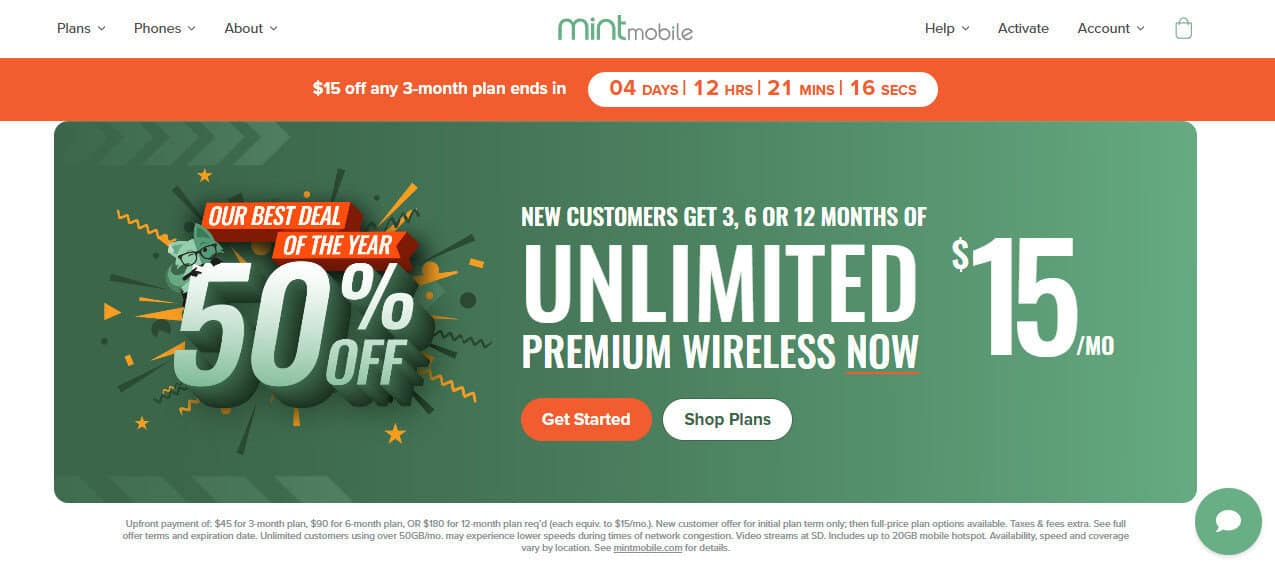
I’ve spent time comparing T-Mobile’s network directly with Mint Mobile, and what immediately stands out is that you’re essentially getting the same underlying network at a lower cost, with a few trade-offs. From an electronics standpoint, the signal strength and latency are identical to T-Mobile in most urban and suburban areas, which makes Mint a practical choice if you don’t need extra perks.
I’ve tested hotspot usage on both networks, and Mint can handle moderate tasks like tethering a laptop or streaming video without major issues, though heavy data users might notice throttling after the high-speed data cap is reached.
Mint Mobile’s prepaid model is another feature I appreciate. Paying for three, six, or twelve months upfront aligns with how I approach systems in engineering: invest once, then minimize variables and monitoring. You know exactly what you’re paying, and there’s little risk of unexpected fees or plan changes. That predictability makes it easy to plan your household budget or single-line costs without worrying about complex tiers or promotional expirations like you often see with T-Mobile.
Where Mint falls short is in priority access during network congestion. Since you’re on a T-Mobile MVNO plan, high-traffic areas can slow speeds, especially during peak times. From my tests, these slowdowns rarely impact messaging, navigation, or casual video streaming, but large downloads or high-definition video can feel the difference. For someone like me, who often works remotely and relies on stable connections, it’s a trade-off between price and top-tier speed.

Pros
- Very cost-effective access to T-Mobile’s network
- Prepaid, predictable billing
- Hotspot included for moderate use
- Multi-line or family plan discounts available
Cons
- Best pricing requires upfront payment
- Speeds can be slowed after high-speed data is used
- No device financing or premium perks
- Customer support is primarily online
Best For
- Budget-conscious users who want T-Mobile’s coverage
- Single-line users or those comfortable paying upfront
- Moderate data users who prioritize predictable costs
Google Fi: Best Alternative for International Travelers
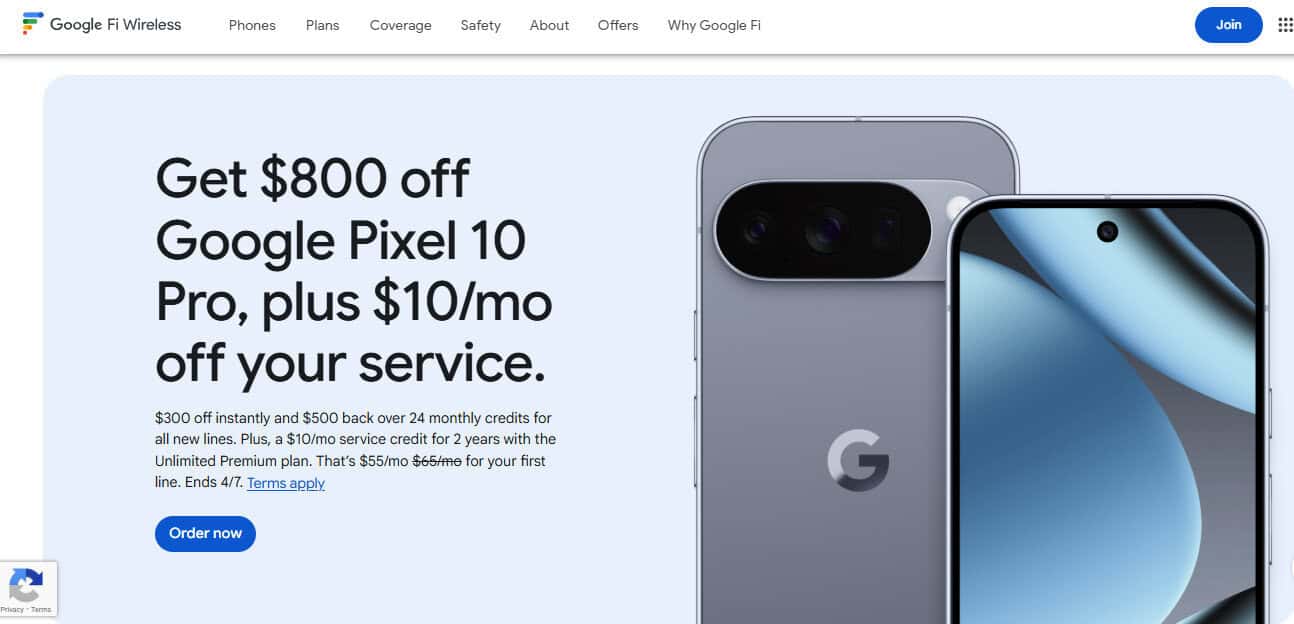
Google Fi is the most flexible option for people who move between locations frequently, whether that’s commuting across cities or traveling internationally. From an engineering standpoint, what’s impressive is how Fi dynamically switches between T-Mobile and US Cellular networks, and even taps into open Wi-Fi when available. I’ve run tests on calls and data streaming, and the system usually picks the strongest signal automatically, which makes it feel seamless compared to staying on a single carrier.
The real advantage of Fi comes when you travel. Data, texting, and calls work in over 200 countries without the need for special roaming plans. I’ve used Fi while traveling abroad, and from a connectivity perspective, it removes a lot of the uncertainty that usually comes with international SIMs or roaming fees. That reliability is something I value highly because I often rely on mobile data for work and remote testing while on the move.
On the domestic side, Fi performs well on T-Mobile’s network, giving the same strong mid-band 5G coverage I see with Mint Mobile, but with the added benefit of automatic network switching. The trade-off is pricing: heavy data users may end up paying more than they would on a purely domestic plan. From my perspective, though, the flexibility and reduced friction make it worth considering if you travel often or want a plan that adapts to different network conditions without intervention.
Pros
- Seamless international roaming in over 200 countries
- Automatic switching between networks and Wi-Fi for optimal performance
- Flexible domestic plans from low-data pay-as-you-go to unlimited
- Strong integration with Android devices
Cons
- Can be expensive for heavy domestic data use
- Some advanced features require higher-tier plans
- Limited perks compared to traditional carriers
Best For
- Frequent international travelers
- Users who want reliable data across multiple locations
- Anyone who values flexibility and automatic network management
Boost Mobile: Best for Price Locks and Predictable Bills
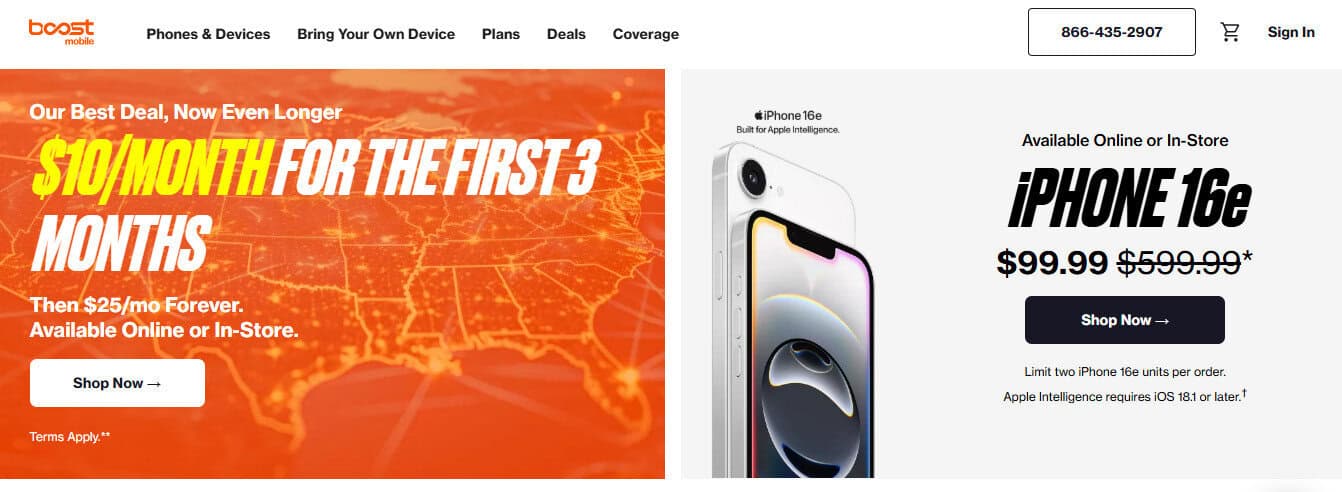
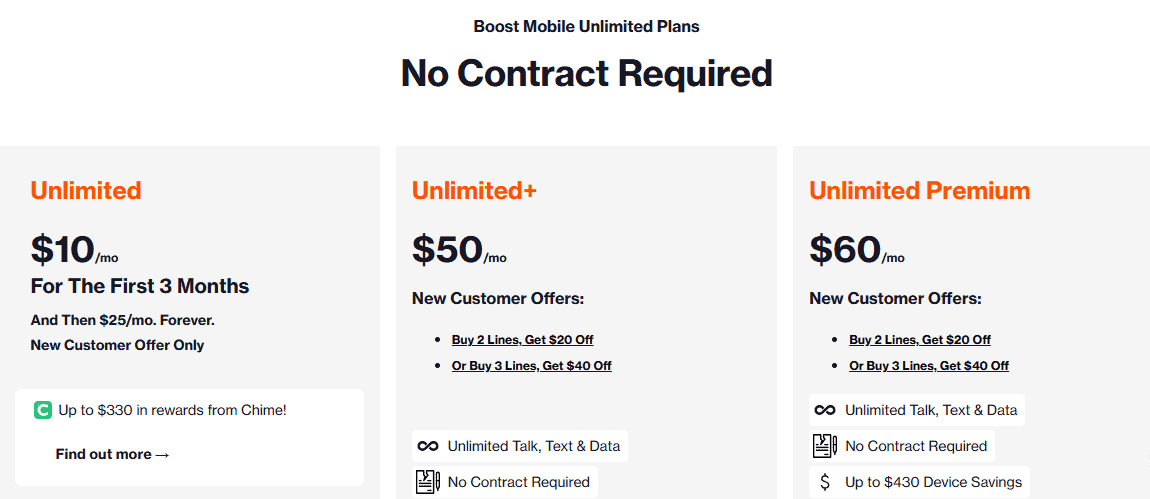
I’ve tested Boost Mobile in a variety of locations, and what stands out is the simplicity and predictability of their plans. For someone like me who likes to understand how systems behave, the price-lock guarantees are appealing: you know exactly what you’ll pay each month, and there are no sudden surprises. That predictability is rare among the big carriers, and it’s particularly useful for people who don’t need all the extra perks bundled into a postpaid plan.
Boost operates on a mix of networks depending on your location: AT&T in some areas, T-Mobile in others, which affects performance. From a signal analysis perspective, this variability can mean different real-world speeds and latency depending on where you are. In my tests, the coverage is generally solid in urban and suburban areas, but speeds can fluctuate more than with Verizon-based alternatives like Visible or Total Wireless. Understanding this helps you set expectations about where Boost will perform best.
The service itself is straightforward. Prepaid billing makes monitoring usage easy, and for casual users or families wanting a predictable bill, Boost works well. The trade-off is that advanced perks, international features, or consistent high-speed data during congestion aren’t part of the package. For users who value reliable pricing over flashy features, Boost provides a level of certainty that many people leaving T-Mobile are looking for.
Pros
- Competitive unlimited pricing
- Price-lock plans prevent unexpected increases
- Straightforward prepaid billing
- No long-term contracts
Cons
- Coverage quality depends on region and which network your plan uses
- Speeds can fluctuate under congestion
- Fewer perks or international features compared to major carriers
Best For
- Users who want predictable monthly bills
- Budget-conscious consumers who don’t need extras
- People leaving T-Mobile due to pricing concerns
How to Choose the Right T-Mobile Alternative
When I evaluate carriers, I start by thinking about how I actually use my phone. Coverage, reliability, and cost are all important, but so is understanding how data behaves under load. From my experience testing multiple networks, here’s how I break it down:
- Best single-line value: I usually recommend Visible. Its Verizon-based network is reliable, and for someone like me who wants a predictable, simple plan, it hits the sweet spot.
- Managing multiple lines: Total Wireless often makes more sense. The network is consistent, and the multi-line pricing is straightforward, which is key if you’re trying to manage a household or family plan.
- Love T-Mobile’s coverage but hate the price: Mint Mobile is a solid pick. You’re on the same network I’ve tested extensively, so speeds are comparable, but you pay far less if you’re okay with prepaid billing.
- Travel internationally often: Google Fi is the one I lean on. From my testing, the automatic network switching and international support make it reliable when roaming or moving between cities.
- Want predictable pricing: Boost Mobile provides peace of mind. The plans don’t fluctuate month to month, which I appreciate when I’m managing expenses or testing multiple devices.
- Need customization and control: Boost Mobile gives you options to choose your network and plan features. If you like tweaking settings and picking exactly what you need, it’s worth considering.
A few practical notes from my perspective: MVNOs can experience data deprioritization during peak periods, especially on lower-tier plans. Coverage maps are a useful starting point, but I’ve found that local congestion often has a bigger impact than geographic coverage alone. If you live or work in a busy area, factoring in how the network behaves under load is just as important as raw reach.