


Last Updated on October 8, 2026 by Ewen Finser
Choosing a growth marketing agency for your startup gets complicated fast. On paper, many firms say they can help with performance, retention, creative, and strategy. In practice, the differences usually show up in the operating model, the seniority of the team, the depth of channel expertise, and whether the agency is actually set up to influence revenue instead of just producing activity.
That matters even more for companies that are already past the earliest stage and looking to grow revenue. Once you have product market fit, the question is usually not whether to market at all. It is how to scale paid acquisition, improve lifecycle performance, tighten measurement, and add strategic leadership without building every function in house at once.
This guide focuses on agencies that can directly affect revenue through paid media, lifecycle marketing, conversion support, and growth leadership. It does not cover general creative shops or broad branding firms.
Before we dive into the detail, my broad recommendations are:
- NoGood is a strong fit for well-funded SaaS and fintech companies wanting to experiment.
- Right Side Up suits startups that need a flexibile growth partner that can scale with them.
- MarketerHire is an easy way to fill a personnel gap with when strategy is already defined.
- Directive suits B2B SaaS and tech companies that need clarity on ad spend.
- Tinuiti is best for enterprises that need full funnel support to drive growth through paid media.
- Wpromote suits larger tech, ecomm, and financial services companies prioritizing analytics.
- CTC is built for e-commerce businesses that need financial planning as they scale.
What Should You Look for When Comparing Growth Marketing Agencies?
Before comparing firms, it helps to know what actually matters. Here are what we consider the key factors:
Revenue-Linked Capabilities
A growth agency should influence the full path from acquisition to retention. That usually includes paid media, lifecycle or CRM, landing page or conversion rate optimization support, analytics, and strategic planning. Startups in particular have high revenue potential across a broad spectrum of touchpoints. If an agency only handles campaign execution and does not touch retention or conversion, it may leave important growth opportunities on the table.
Team Structure and Seniority
Some agencies work with fixed teams. Others offer embedded fractional talent or more flexible staffing. If you need both strategy and execution, this difference matters. A rigid structure can slow you down, while a flexible model can adjust as priorities change.
Lifecycle Depth
Lifecycle is often underrepresented in agency offerings. For companies trying to improve payback periods and customer lifetime value, email, SMS, and CRM are not secondary channels. They are core growth drivers. An agency that handles acquisition but ignores retention will leave real revenue on the table.
Measurement and Decision Support
Strong reporting and attribution matter just as much as execution. Without clear visibility into what is driving revenue for your startup, it becomes hard to scale efficiently or make confident budget decisions. Look for agencies that tie reporting to business outcomes, not just campaign metrics.
Fit by Business Stage
Some agencies are built for early experimentation. Others are designed for scaling companies. After product market fit, the focus usually shifts to efficiency, repeatability, and more structured growth systems. An agency that thrives in scrappy, early stage environments may not have the depth needed when you are optimizing a larger, more complex funnel.
What Does a Benchmark Growth Agency Look Like?
Before comparing specific firms, it helps to have a clear picture of what a well rounded growth agency should offer.
A strong benchmark agency is not limited to one function. It usually combines strategy, paid acquisition, lifecycle marketing, analytics, and conversion support. The goal is not just to run campaigns, but to influence how revenue is generated and scaled across the full customer journey.
Another key trait is flexibility. Growth rarely follows a fixed structure, especially after product market fit. A good agency should be able to support different needs over time, whether that means strategic guidance, channel execution, or filling specific skill gaps. This can come from dedicated teams, embedded specialists, or a mix of both.
It is also important to look at cross channel coordination. Paid media, lifecycle, and analytics should not operate in isolation. Agencies that connect these functions usually provide more consistent insights and clearer decision making support.
One more thing: experience across different business models can help. Agencies that have worked with a mix of DTC, SaaS, and other digital businesses are more likely to recognize common growth constraints and adjust their approach. While industry specialization can be valuable, exposure to different growth environments often leads to more practical and transferable strategies.
NoGood
Overview
NoGood is a growth marketing agency founded in New York in 2017, focused on performance, lifecycle marketing, and experimentation across the funnel. It works with SaaS, healthcare, fintech, B2B, and consumer brands. Clients include Anthropic, Amazon Web Services, MongoDB, Oura, and TikTok. The agency structures engagements as monthly retainers, with an average retainer above $20,000 per month.
Strengths
NoGood emphasizes high velocity testing and cross channel optimization. It integrates paid media, SEO, content, conversion rate optimization, and lifecycle into a unified squad structure built around each client’s specific challenges. Its 84 percent client retention rate reflects consistent execution rather than one time wins. The agency also has strong depth in lifecycle and product led growth, which is relevant for SaaS companies managing complex acquisition and expansion revenue.
Limitations
NoGood is probably not the best fit for very early-stage companies or teams working with a tighter budget. Its pricing puts it more in the premium agency category, so it makes the most sense when there is already enough spend and structure to support that level of partnership. Because it works across several industries, fit may also depend on the specific team you get and how much experience they have in your category.
Best Fit
Well funded growth stage companies in SaaS, fintech, or consumer categories that want a modern growth agency with a strong experimentation culture and lifecycle depth.
Right Side Up
Overview
Right Side Up is a growth marketing partner built for companies that need both strategic leadership and execution across paid acquisition, lifecycle marketing, and analytics. It operates as a marketplace of premium marketing talent with no long term contracts, which allows clients to scale resources up or down based on current priorities.
Strengths
Its main strength is flexibility. Companies can use it for fractional CMO support, embedded specialists, or full agency support depending on where the gaps are. It also covers most revenue driving functions in one model, including paid search, paid social, offline channels like podcast and TV, ecommerce, lifecycle, and analytics. It’s even launched AI services to help companies optimize their AI processes. One of my clients reported saving nearly 70 percent on media management fees after moving from a traditional PPC agency to Right Side Up.
Limitations
Pricing is not publicly listed, which makes it harder to evaluate cost without an initial conversation. The breadth of services also means companies need internal clarity on priorities before engaging. Otherwise, the scope could drift.
Best Fit
Startups past the product–market fit stage and growth stage companies that need a flexible, cross functional growth partner without committing to a traditional agency contract.
MarketerHire

Overview
MarketerHire is a marketplace that connects companies with pre-vetted freelance marketers across paid media, lifecycle, SEO, and content. It is not a traditional agency and does not operate as a unified team. Companies can identify and hire individual specialists quickly without going through a full agency procurement process.
Strengths
It is fast and flexible. Companies can fill specific execution gaps quickly without committing to a full agency relationship. This can be useful when internal strategy is already defined and the need is tactical coverage in a specific channel. In this case, bringing in a freelancer could be the quickest solution.
Limitations
Because it relies on individual freelancers, there is no built in coordination across channels or centralized strategic leadership. Quality varies by individual and you need to do manage the freelancer yourself once they’re with you. The outcome depends heavily on the specific marketer placed rather than a system, team methodology, or shared accountability.
Best Fit
Teams that already have a clear growth strategy and need to plug in execution support quickly. MarketerHire is better suited for coverage gaps than for companies looking for a fully integrated growth partner with cross functional ownership.
Directive
Overview
Directive is a B2B performance marketing agency focused on SaaS and technology companies. Its methodology centers on what it calls Customer Generation, which focuses on qualified pipeline and revenue instead of marketing qualified leads. The agency has served over 420 B2B brands and says it has influenced more than one billion dollars in client revenue.
Strengths
Directive aligns paid media, CRO, and revenue operations in a way that works well for companies with complex sales cycles. It connects campaign activity to pipeline metrics instead of surface level engagement, which gives B2B marketing and sales teams a clearer view of where spend is actually driving results. If the link between paid acquisition and revenue growth is a current gap in your startup’s processes, they can help you address that.
Limitations
It is built specifically for B2B SaaS and technology, which means it may not be the right fit for ecommerce or direct to consumer brands. Companies outside the SaaS space may find the methodology needs some adjustment.
Best Fit
B2B SaaS companies looking for a growth partner that connects paid acquisition directly to pipeline and revenue outcomes instead of volume based metrics.
Tinuiti
Overview
Tinuiti is a large independent performance marketing agency with capabilities across paid search, paid social, streaming TV, commerce media, email and SMS, and analytics. Its proprietary measurement platform, Bliss Point by Tinuiti, is designed to help clients understand where media spend drives growth and where it creates waste. Standout clients include Adobe, Shopify, Walmart, Meta, and TikTok.
Strengths
Tinuiti offers scale, strong media execution across competitive channels, and a more developed measurement setup than most agencies. In 2025, it expanded its work with private equity backed companies by connecting marketing performance directly to financial outcomes. The agency also combines paid and creative execution, which reduces friction between media buying and ad production.
Limitations
Tinuiti is built for companies managing meaningful ad budgets and established processes. Smaller teams or earlier stage brands may find the engagement model more complex than needed and the cost structure harder to justify at lower spend levels.
Best Fit
Mid market and enterprise brands that need full funnel performance support at scale, especially in retail, commerce, or technology categories where paid media is a primary growth lever.
Wpromote

Overview
Wpromote is a performance marketing agency founded in 2001, offering services across paid search, paid social, SEO, content, and analytics. It serves clients including Adobe, Intuit, and TransUnion, and works across ecommerce, technology, and financial services.
Strengths
Wpromote brings together paid media, analytics, and creative in one model, which helps keep things consistent across channels. It uses structured experimentation frameworks to guide testing and optimization, and its reporting focuses on efficiency metrics instead of surface level activity. The agency has a strong reputation for managing large, complex media programs in competitive markets.
Limitations
Like Tinuiti, the model is built for companies with larger budgets and more established internal processes. Smaller teams may find the setup more complex than they need at their current stage.
Best Fit
Growth stage and enterprise companies that want a structured performance partner with strong coverage across paid channels and analytics, especially in technology, ecommerce, and financial services.
Common Thread Collective
Overview
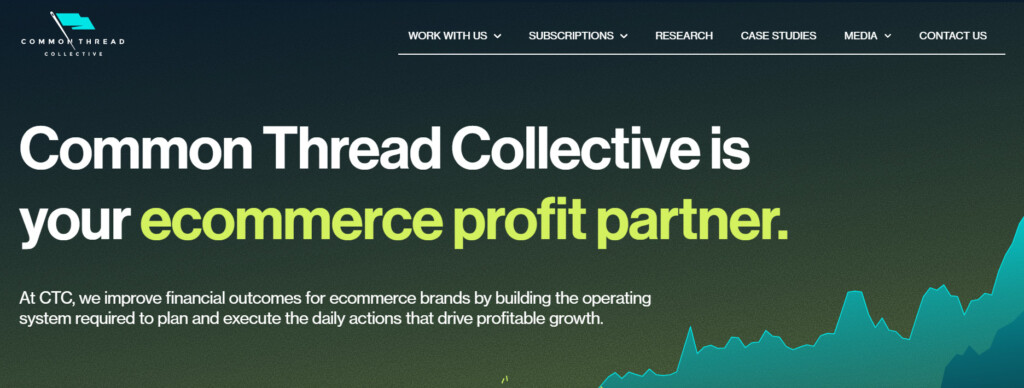
Common Thread Collective (CTC) is an ecommerce growth agency founded in 2012.. It focuses on DTC brands doing between $10 million and $100 million in annual online revenue. Its services span paid acquisition, email and SMS, creative strategy, financial planning, and proprietary data tools.
Strengths
Common Thread Collective stands out for its focus on profitable scale rather than growth for its own sake. It combines performance marketing with financial planning and proprietary data tools to help brands understand how revenue growth connects to margin outcomes. Its model covers acquisition and retention together, which is important for DTC brands managing high customer acquisition costs. CTC also produces a public DTC industry index and podcast that reflect real domain expertise.
Limitations
Common Thread Collective is built specifically for ecommerce and does not serve SaaS, B2B, or other non DTC verticals. Brands outside that category will likely find the methodology is not directly applicable.
Best Fit
Established ecommerce and DTC brands in the $10 million to $100 million revenue range that want to grow profitably, with a partner that connects marketing activity to financial outcomes instead of just top line growth.
How to Compare These Agencies in Practice
Start by identifying your main growth constraint. If acquisition costs are rising, focus on paid media and creative capabilities. If retention is weak, prioritize lifecycle depth. If internal leadership is missing, look for agencies that offer strategic support, not just execution.
Next, compare what the agency can do with what your internal team already handles. Paying an agency for work you can already do in house adds cost without adding leverage. Then evaluate the engagement model itself. Some companies benefit from a full service agency relationship. Others need flexible or fractional support that can scale as priorities change. The model should match how your team actually works, not how the agency prefers to sell.
Look at pricing beyond the monthly cost. Consider how much senior involvement you get, how reporting is structured, and whether the contract allows you to adjust as needs change. Agencies with unclear pricing or long minimum commitments can limit flexibility at the wrong time.
Finally, treat a short pilot as standard practice, not an exception. A defined initial engagement, even four to eight weeks, will show how the agency thinks, communicates, prioritizes, and responds when things are not working. That insight is usually more valuable than any sales call.
Final Take
There is rarely a single perfect growth agency for any startup looking to grow revenue. The better decision comes from matching the agency to your current stage, team structure, and growth challenges.
NoGood fits growth stage companies that want high velocity experimentation with strong lifecycle depth.
Right Side Up combines strategy, execution, and staffing in one model with no long term lock in so you can scale as you grow.
MarketerHire works well for quickly filling execution gaps when strategy is already set and all you need is a person to execute.
Directive is a stronger choice for B2B SaaS companies focused on pipeline and revenue alignment.
Tinuiti and Wpromote are better suited for companies managing larger media budgets that need scale and structure.
Common Thread Collective is designed specifically for ecommerce brands pursuing profitable scale in the $10 million to $100 million range.
In most cases, the most effective choice is not the most comprehensive option. It is the one that fits how your team works today and supports where you are trying to go in the next twelve to eighteen months. Choosing a partner that matches your current stage will usually outperform choosing the most feature rich agency in the market.