


- The Bottom Line Up Front
- Why SaaS Companies Outgrow Basic Affiliate Tools
- Everflow: Best Overall for SaaS Revenue Visibility
- PartnerStack: Best for SaaS Ecosystem and Co-Sell Programs
- Impact: Best for Enterprise-Scale Partnerships
- TUNE: Best for Technical Teams That Want Full Control
- Affise: Good for Performance-Heavy Programs
- Awin: Best for Publisher Network Reach
- CAKE: Best for Lead Distribution
- How to Choose the Right Platform for Your SaaS Program
Last Updated on March 25, 2026 by Ewen Finser
If you have run a SaaS affiliate program, you already know that most affiliate software was not built for you. Many of these platforms were designed for one-time purchases, short buying cycles, and simple last-click tracking. That approach does not work well for SaaS, where you deal with free trials, upgrades, renewals, and customers who may take months to convert.
The good news is that the market has improved. There are now platforms that understand the SaaS revenue model and try to support it properly. Still, you need to evaluate them carefully. Not every platform that says it supports recurring revenue actually handles it in a meaningful way.
I reviewed the major platforms with specific SaaS needs in mind. I focused on subscription tracking, multi-touch attribution, CRM integrations, and what happens after the first signup. Here is what I found.
The Bottom Line Up Front
If you want to track partner-driven revenue across the full customer lifecycle, Everflow is one of the most complete platforms available right now. It combines full-funnel attribution, recurring revenue tracking, CRM integrations, partner management, and automated payouts in one system. Most tools do not offer all of that in a single place. Still, the right choice depends on what your company actually needs.
For example, PartnerStack works very well for SaaS ecosystems and co-sell programs. It is especially strong for companies building structured B2B partner channels at scale. TUNE, on the other hand, is better suited for technical teams that want deep customization and control over their tracking logic. Awin, Affise, and CAKE each focus more on specific performance marketing or lead generation use cases rather than full SaaS subscription lifecycle management.
Here is a quick overview of how they compare.
Platform | Recurring Revenue Tracking | Attribution Depth | CRM Integration | Payout Automation | Best For |
Strong | Full-funnel, multi-touch | Strong | Built-in | Scaling SaaS partner programs | |
Strong | Sourced vs. influenced | Strong | Built-in | SaaS ecosystem and co-sell | |
Strong | Enterprise-grade | Enterprise-grade | Built-in | Global enterprise partnerships | |
Good | Customizable | API-driven | Built-in | Technical teams needing control | |
Good | Performance-focused | Available | Built-in | Performance marketing programs | |
Moderate | Network-based | Available | Built-in | Publisher network reach | |
Limited SaaS-native | Lead-centric | Available | Built-in | Lead distribution and call-based |
Why SaaS Companies Outgrow Basic Affiliate Tools

If you are selling a physical product with a one-time checkout, most affiliate platforms work fine. An affiliate sends a click, the customer buys, and the commission is paid. With SaaS, things do not work like a normal online store because customers often pay monthly or yearly, which means revenue comes in over time. The partner who first brought that customer to you might not get credit even if the customer upgrades six months later. That’s not all; if you only track the last click before someone signs up, then you will give all the credit to whoever shows up at the very end. So, the partner who actually created the demand at the beginning, like content creators, integration partners, or newsletter sponsors, will be underpaid. Meanwhile, coupon sites that appear right before someone signs up get too much credit. That distorts the whole picture of who is really driving growth. For SaaS companies that optimize around MRR and LTV, this is a real problem because you would be rewarding the wrong behavior and making investment decisions based on incomplete data.
When I look at affiliate platforms for SaaS, I focus on five things:
- How they handle recurring billing
- How deep their attribution goes beyond last click
- Whether they connect to your CRM in a meaningful way
- How payout automation works at scale
- Whether you get a unified reporting view across all of it
Everflow: Best Overall for SaaS Revenue Visibility
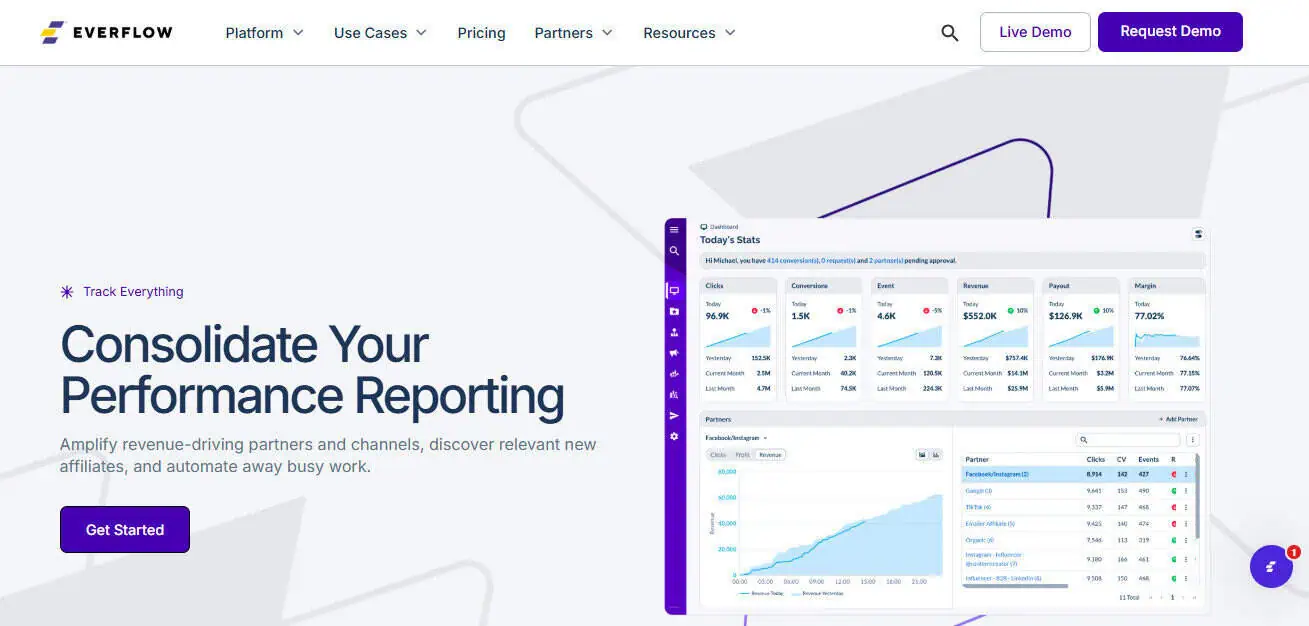
Everflow is one of the more advanced partner marketing platforms available today. It’s designed to handle full-funnel attribution and recurring revenue tracking in one system. Many growing SaaS companies use it because it connects tracking, reporting, and payouts in a single place. What makes Everflow especially useful for SaaS companies is how deeply it tracks customer activity. It does not just track the first signup. It follows the full customer journey. That includes things like pricing page visits, newsletter signups, and webinar registrations before someone even starts a trial. After the customer signs up, it keeps tracking renewals, upgrades, and subscription expansions. All of that revenue is connected back to the original partner who brought the customer in. Everflow says this deeper tracking can reveal 30–70% more revenue than basic last-click tracking models.
For B2B SaaS teams, Everflow’s integrations with HubSpot and Salesforce are very valuable. Instead of paying partners only for signups, you can reward them when leads turn into real sales opportunities and paying customers. This encourages partners to focus on quality leads, not just large numbers of low-quality trials.
Everything is managed in one place. Tracking, reporting, analytics, partner management, and payouts are all inside a single dashboard. This helps avoid reporting errors that happen when using multiple tools. Everflow Pay also automates partner payments within the platform, which makes managing payouts across different countries and currencies much easier.
That said, the platform can be complex to set up. It may be more than a very early-stage SaaS startup needs. But for growing companies that want clear, reliable data about partner-driven revenue, Everflow stands out as a strong option.
- Pros: Full customer journey tracking, strong recurring revenue tracking, all-in-one platform, good CRM integrations, and white-label options.
- Cons: More complex than simpler tools, may be too advanced for early-stage startups.
Best for: Mid-sized and enterprise SaaS companies that want complete visibility into partner-driven revenue across the entire customer lifecycle.
PartnerStack: Best for SaaS Ecosystem and Co-Sell Programs
PartnerStack was built specifically for B2B SaaS, and that is clear when you use it. If your growth plan focuses on building a partner ecosystem with affiliates, referral partners, and resellers, PartnerStack feels like a good fit. It also has its own partner marketplace, where many B2B-focused partners are already looking for SaaS products to promote. This can help you find quality partners faster.
The platform supports recurring commissions, which is important for SaaS. It also connects with CRM tools so you can tell the difference between revenue a partner directly sourced and revenue they influenced. That matters in SaaS, where sales cycles are longer and attribution can get complex. Onboarding and payout processes are automated and easy to manage. However, PartnerStack is more focused on the traditional SaaS referral and reseller model. If you want to manage a mix of affiliates, influencers, and media buyers all in one place, or if you need very detailed tracking for different placements and partner types, you might find it limiting.
- Pros: Built for SaaS, strong partner marketplace, solid support for recurring commissions, clean workflows for referral and reseller programs.
- Cons: Less flexible for mixed partner models, limited tracking customization compared to more attribution-focused platforms.
Best for: SaaS companies that want to build a structured partner ecosystem with affiliates, referrals, and resellers.
Impact: Best for Enterprise-Scale Partnerships
Impact is built for large companies that run complex, global partner programs. If you are a big SaaS company working with affiliates, influencers, strategic partners, and brand alliances across different regions, Impact has the systems to manage it. Its tracking and attribution tools are very advanced. It also offers strong contract management and compliance features. The platform can support many different types of partnerships in one place, which smaller tools often cannot handle.
The downside is that it is a heavy platform. Pricing is custom, onboarding can be complex, and the feature set can feel overwhelming for mid-sized teams. It usually works best when you have a dedicated partnerships team and the time and budget to set it up properly. If you are a smaller SaaS company without that structure, it may be more than you actually need.
- Pros: Deep enterprise-level attribution, strong global infrastructure, supports many partner types, solid compliance tools.
- Cons: Complex setup and pricing, may be too advanced for mid-sized teams without dedicated partnership staff.
Best for: Enterprise SaaS companies running large, multi-channel, global partner programs.
TUNE: Best for Technical Teams That Want Full Control
TUNE is built with a strong technical focus. It is an API-first platform, which means it is designed for teams that want to build their own tracking and attribution systems instead of using a standard setup. It is used by ad networks and agencies as well as brands, which shows how flexible it is.
For SaaS companies that have engineering support and a clear idea of how they want attribution to work, TUNE can be a good option. You can customize it to fit your exact needs. However, that flexibility also means more setup work. If you do not have developers or technical resources to configure it properly, you may not get the full benefit.
- Pros: Very customizable, API-first structure, good for building custom tracking systems.
- Cons: Requires strong technical setup, not ideal for teams without developer support.
Best for: SaaS companies with technical teams that want full control over attribution and tracking logic.
Affise: Good for Performance-Heavy Programs
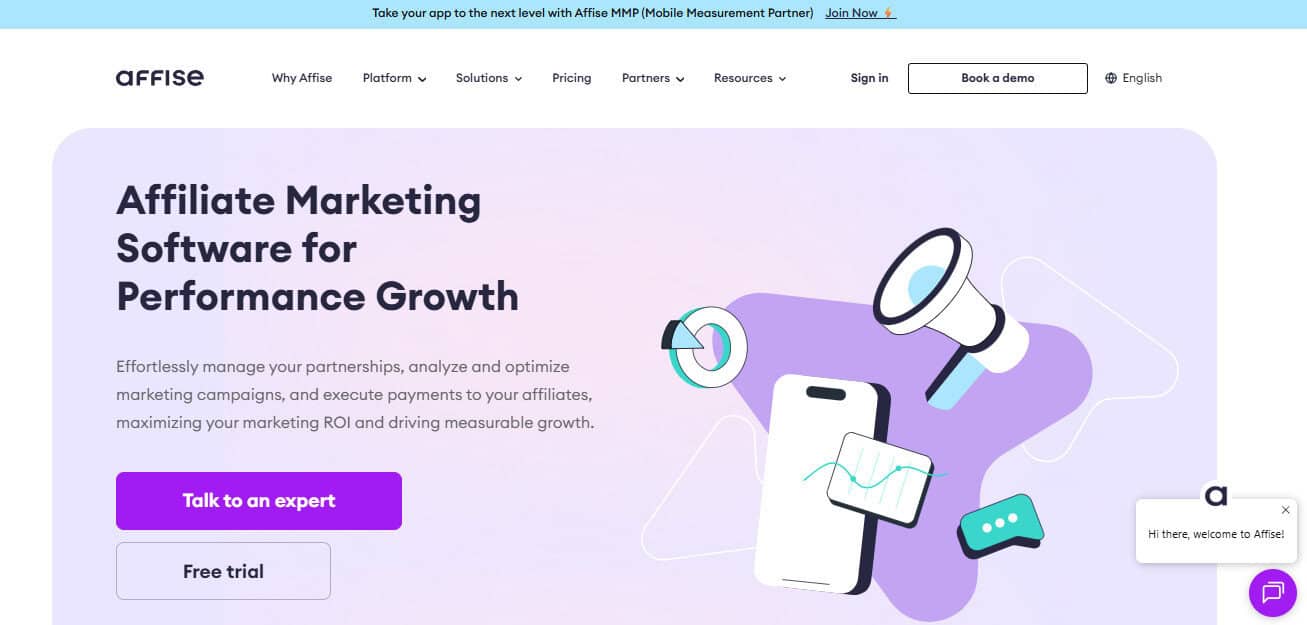
Affise comes from the performance marketing world and works well for SaaS companies that run large affiliate or performance campaigns alongside their partner programs. Its campaign management tools are strong, and it offers solid traffic optimization and automation features. For teams focused on performance-driven workflows, it does the job well.
However, Affise is not built specifically around SaaS subscription tracking. If your main focus is recurring revenue attribution and tracking the full subscription lifecycle, platforms like Everflow or PartnerStack may feel more aligned with your needs. Still, if you run a hybrid model that combines performance marketing with partner programs, Affise is a solid option.
- Pros: Strong performance marketing features, good automation, scalable campaign management.
- Cons: Not designed specifically for SaaS subscription tracking.
Best for: SaaS companies that run large performance marketing campaigns alongside their partner channels.
Awin: Best for Publisher Network Reach
After ShareASale fully merged into Awin in 2025, Awin became one of the largest global affiliate networks. It now connects advertisers with more than 250k active publishers across many industries. If your goal is to quickly reach a large number of publishers, Awin offers strong network access.
For SaaS companies, it is important to understand that Awin operates as a network. This means you are working inside its system rather than fully owning direct partner relationships. Its tracking and subscription-level attribution are not as advanced as platforms built specifically for SaaS partner management. Because of that, Awin works better as part of a broader affiliate strategy instead of being the main platform for a serious SaaS partner program.
- Pros: Large global publisher network, wide reach, easy access to many affiliates.
- Cons: Limited direct partner ownership, not built specifically for SaaS subscription tracking.
Best for: SaaS brands that want broad publisher exposure as one part of a multi-channel affiliate strategy.
CAKE: Best for Lead Distribution
CAKE focuses on lead distribution, call tracking, and complex traffic routing. It is built for businesses that rely heavily on lead generation. If your acquisition model depends on inbound calls or form submissions, CAKE can handle that well.
However, it is not designed for managing subscription lifecycles or detailed SaaS partner attribution. Most SaaS companies need strong recurring revenue tracking and full customer journey visibility, which are not CAKE’s main strengths.
If you run a SaaS product where calls or form fills are the main conversion events, CAKE is worth considering. For most SaaS affiliate or partner programs, though, it is probably not the right fit.
- Pros: Strong lead routing and call tracking, good for complex traffic management.
- Cons: Not built for subscription lifecycle tracking, limited SaaS-focused attribution features.
Best for: SaaS companies with lead generation models where call or form tracking is essential.
How to Choose the Right Platform for Your SaaS Program
The right platform depends on how mature your partner program is and what you actually need to measure.
If you are just starting out and running a simple referral program with basic link tracking and commission payouts, a lighter tool is usually enough. You can move to a more advanced platform later as your program grows. But if you already care about things like renewal revenue, upgrades, CRM alignment, and which partners drive long-term value instead of just trial signups, then you need a platform built for that level of tracking.
For most SaaS companies that are seriously investing in partner programs, the decision often comes down to Everflow or PartnerStack. Everflow offers deeper attribution and combines tracking, analytics, and payouts in one system. PartnerStack offers a stronger built-in partner network and smoother co-sell workflows, especially for B2B partner ecosystems. Both handle recurring revenue well. The main difference is how much control and flexibility you need in attribution and cross-channel tracking.
At the enterprise level, Impact becomes a strong option for companies running large global programs. If your team is highly technical and wants to build custom tracking logic, TUNE is worth considering.
The most important thing is making sure your attribution model matches your revenue model. If you only measure the first conversion, you risk optimizing for short-term results instead of long-term revenue. Over time, that mismatch can hurt the growth of your partner program.