


Last Updated on February 24, 2026 by Ewen Finser
I’ve seen incredible products get buried on page five while something average racks up sales like it’s printing money. It’s brutal, but that’s Amazon. The marketplace doesn’t care how good your product is, but how well it sells.
A lot of sellers still treat ranking like a merit system. That’s perfect if you think that nailing the copy and tweaking a keyword or two is enough for the algorithm to spot you. But Amazon’s multi-trillion-dollar engine isn’t that sentimental. It decides based on user behavior, not your effort. Every click, add-to-cart, or conversion is a data point that either pushes your Amazon listing up or shoves you down.
The main idea hasn’t changed: conversion velocity, click-through rate, availability, and pricing all feed Amazon’s A9 (and now A10) algorithms. While A9 focused on sales velocity and conversions for ranking priority, A10 focuses on relevance, seller authority, and trustworthiness.
Basic keyword matching was important with A9, but rich content and accurate keywords matter more with the A10 algorithm update. The listings that sell more, faster, and with fewer stock issues get rewarded with better visibility – simple as that! Reviews reinforce the cycle by providing credibility that multiplies future sales.
In my opinion, this is why most mid-level sellers plateau. They’ve optimized their listings to look right, but not to perform. They think they’re done once the title and images are optimized, when in reality, that’s just the ticket to compete. The real thing starts once you feed Amazon consistent proof that your product deserves attention.
And that’s the theme here: performance beats polish—every single time.
Getting “Clicks” Starts Before You Ever Get Traffic

If your title, thumbnail, and review count don’t stop the consumer thumb, the rest doesn’t matter. That tiny preview in the search results decides your fate before anyone even knows what you’re selling. I’ve seen sellers spend weeks polishing A+ content while ignoring the first three seconds that actually decide whether anyone clicks.
Amazon’s algorithm is sensitive to that, too. Click-through rate (CTR) is one of the most underrated ranking signals. A listing that earns more clicks than expected for its position will almost always go up the rankings.
Try the scroll test: open your category page, squint at the results, and ask yourself honestly, would you click yours?
The 2025 title update changed the rules:
- 200-character limit
- No repeated keywords
- Clearer weighting for readability
And honestly, good. I’d rather have a tight, readable title that converts than one written for bots. A scannable title tells shoppers you understand that simplicity beats clutter.
Images are just as important. With Amazon now merging visuals from multiple sellers on shared listings, low-quality photos can literally get replaced. They now require:
- One product-only photo
- One lifestyle photo
- One context or scale image
If you don’t pay attention to this, you risk losing control over how your product appears.
Here’s my rule of thumb: polished renders look fake; lifestyle photos sell reality. To put it simply: show your product being used, not floating in empty space.
If your title and main image can’t earn a click without a discount tag or coupon badge, you don’t have an optimization problem; you have an attention problem, and no algorithm in the world will save you from that.
The Anatomy of a Listing that Converts

Every great listing I’ve seen has one thing in common: it has a ton of micro-trust signals. Gimmicks and manipulative copy are a thing of the past. What works now is a believable experience that makes the shopper feel safe clicking Add to Cart.
Set the tone, and sales will follow. Your bullets, title, and description should sound like they belong to the same brand. I’ve seen too many listings where the bullets read like they were written by a copywriter, the description by an engineer, and the images by someone who’s never seen the product. That disconnect kills trust. Keep your voice consistent – confident but human.
Write Bullets that Hook
In my experience, the best-performing listings treat the first line of each bullet as a headline because it sells the outcome, not the feature. The second line explains how it delivers that outcome.
Example:
Stays cold for 24 hours – thanks to double-wall vacuum insulation and food-grade stainless steel.
That’s how you write for skimmers. You hook with results, then justify them in one breath.
Don’t Overdesign Your A+ Content
Next up: Enhanced Brand Content (or A+ Content, if you’re brand-registered). It’s tempting to go wild with graphics, icons, carousels, but don’t confuse visuals for persuasion. Most sellers overdecorate instead of communicating. A+ should enhance your story, not bury it under a ton of colorful bells and whistles.
Keep Your Backend Clean
And yes, backend keywords still need to be on point. It’s where you can hide long-tails, misspellings, or Spanish terms without cluttering the front-end. But keep it clean with space-separated intent and no commas or repetition. Amazon’s algorithm is smarter than it used to be; stuffing is just wasted space.
The emotional logic is simple: buyers skim, not study. Your job is to reward the scroll and to make sure every flick of the thumb reveals something useful, reassuring, or persuasive. The moment they have to think too hard, you’ve already lost them.
Momentum is the New SEO

At some point, you’ll run into the same issue every other serious Amazon seller has: everything is tuned to perfection, from titles to reviews, and yet your ranking is still kind of… disappointing. That’s not a product problem. It’s a signal problem.
As I’ve mentioned, Amazon’s algorithm doesn’t care how long you’ve been optimizing. Clicks, sales, and engagement within short time windows seem to be what trigger the A9 and A10 algorithms the most. When that pattern goes away, so does your visibility on the platform. Conversely, when it spikes, the algorithm starts “lovin’ ya” the way you’re used to.
That’s what I mean when I say that the momentum is the new SEO. You don’t “rank” your way up anymore. You, instead, feed your listing consistent velocity, and you do it with traffic, conversions, and external signals that keep telling Amazon: people want this, now.
Here’s where external amplification can give you a bit of a tailwind. I’ve watched brands throw thousands into in-platform ads while ignoring the creator and affiliate ecosystem right outside Amazon’s walls. Those external clicks (when qualified) can help immensely because they trigger incremental sales.
When you’ve done everything right and your listing still plateaus, that’s a problem with the signal I’ve mentioned, not with the product itself. At that point, the next logical move is to test CPC campaigns. Two tools I’ve seen work well are Perpetua and Levanta.
Perpetua can run sponsored ad campaigns that automate bid adjustments in real time and optimize for conversion velocity, which can work well if you like to control your ad mix better. Its granular reporting makes it easy to compare performance so you can scale only what’s profitable, and you can quickly identify which keywords and placements deliver the strongest cost-per-click efficiency.
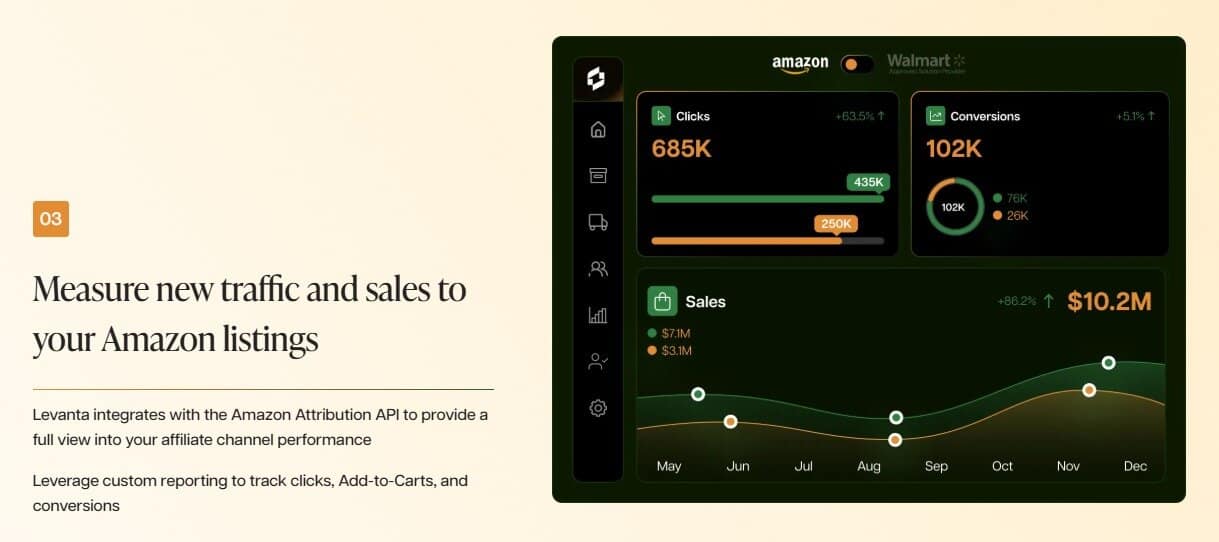
Levanta runs on a Cost-Per-Click model that complements your existing CPA setup, and you can reward creators for qualified traffic instead of paying only when someone buys. You control the budget, set your bids, and tweak in real time, and you can also connect it directly into Amazon’s API so campaigns synchronize automatically with marketplace performance without any duct-taped spreadsheets or manual attribution.
In my opinion, that’s where the whole game is heading. Amazon’s algorithm feeds on velocity, and if you learn how to fuel that with the right tools, you’ll end up running the marketplace.

Levanta assembled this report to help digital merchants navigate the new AI-shaped buying journey. Discover why creators now drive the clicks AI can’t and how to turn that into revenue.
Building Credibility that Compounds (reviews, brand registry, and trust loops)
Besides tracking what you sell, Amazon’s algorithm tracks how reliably you sell. That’s why review velocity (the rate at which new reviews come in) is pretty much as important as conversion velocity. When reviews appear organically and often, Amazon reads it as proof that customers are satisfied with your product.
Some sellers think too much about their star rating and miss the bigger picture. A sudden spike of perfect fives looks a bit too good to be true, both to shoppers and to Amazon’s AI. I’d rather have fifty honest four-stars than a page of suspicious five-stars because Amazon can sense this almost immediately. So, a steady flow of credible feedback > streak of perfection.
The best way to build that loop is simple:
- Keep post-purchase emails short and human.
- Give customers a private outlet for complaints before they go public.
- Use Amazon Vine early because those reviews carry more weight.
Once traction is established, do your best to protect it! Brand Registry is a must if you’ve started scaling. It gives A+ Content, Sponsored Brand ads, and, most importantly, counterfeit protection. Tons of sellers have lost momentum because knockoffs hijacked their listings before they could react.
Credibility compounds. Every verified review, response, and a clean brand page adds to the trust that future shoppers (and the algorithm) pick up on.
Pricing, Inventory, and Iteration
If there’s one thing most sellers forget, it’s that Amazon doesn’t like stillness. Every listing eventually fades if you stop working on it.
Price, stock, and tests; those three things tell Amazon whether you’re awake or not, so let’s talk a bit about them.
Pricing
I’ve watched listings lose rank over a twenty-cent difference. Competitors tweak, you don’t, and end up kicked out of the Featured Offer. Not because your product’s worse, but because your price looked unattractive. That’s why Automate Pricing exists. It’s not groundbreaking, but it keeps your SKUs competitive without you running after every undercutter.
Inventory
Run out once, and the algorithm will punish you like you broke a rule. I don’t care how beautiful your A+ page is; if it’s unavailable, it’s not worth a cent. That’s why I check FBA Restock like people check the weather. It looks at sales velocity, seasonality, lead times, basically all the stuff you swear you’ll “get around to.” Don’t. Do it now.
Iteration
Testing is where serious sellers separate from hobbyists. The Manage Your Experiments tool lets you A/B test titles, images, and A+ layouts, and it’s shocking how few people use it. One better-performing thumbnail can improve conversions by 10–20%, yet most sellers never even check.
In my opinion, iteration is the moat nobody talks about. The tiny tweaks like price adjustments, stock discipline and A/B data, keep your listing alive. Don’t forget: if your listing stands still, your rank won’t.
Final Thoughts: Win the Long Game
Every listing that looks like it “blew up overnight” usually belongs to someone who’s been testing, tweaking, and reinvesting for months. Long-term wins aren’t a result of hacks; data tracking, price refining, and giving the algorithm constant proof that your offer deserves to be seen are the best “hack” you can hope to find.
“Overnight success takes years of hard work and dedication.”
You can’t fix what you don’t measure, and you can’t grow what you don’t occasionally break. So, don’t be afraid to experiment!