

Last Updated on November 11, 2026 by The Digital Merchant Team
Online shopping is supposed to make life easier. And most of the time, it does. Until you find yourself comparing 47 nearly identical products, reading reviews from people who have surprisingly strong feelings about packaging (it’s me, I’m people), and trying to figure out whether the thing you’re about to buy will actually do what you need it to do.
For online retailers, those moments of uncertainty can mean lost sales. A customer might be ready to buy, but if they can’t find the right information or figure out which product is best for them, there’s a good chance they’ll leave and look somewhere else. That’s where AI shopping assistants come in. These tools help shoppers find products, compare options, and make purchasing decisions without digging through endless product ratings or waiting for a customer service response.
And unlike the chatbots of a few years ago, which seemed determined to misunderstand even the simplest questions, today’s AI shopping assistants are much better at helping. But they don’t all work the same way, and the differences are pretty important when you’re the business paying for one.
What is an Online / AI Shopping Assistant?
An online or AI shopping assistant is a tool that helps customers find and purchase products using conversational artificial intelligence. Think of it as the online version of a knowledgeable salesperson who can answer questions and make recommendations without following you around the store asking if you need anything every three minutes.
Traditional ecommerce websites rely on navigation menus, search bars, filters, and product descriptions. Those things are important, but they also assume customers already have a pretty good idea of what they’re looking for. An AI shopping assistant lets customers describe what they need in their own words and uses information from the store’s product catalog to suggest relevant options.
For example, instead of spending an hour comparing running shoes, someone could ask, “I need comfortable shoes for walking all day, I have wide feet, and I don’t want to spend more than $120.” The assistant can narrow down the selection, ask follow up questions, and recommend products that fit. Depending on the platform, it may also answer questions about sizing, inventory, shipping, and compatibility or help customers add products to their carts.
The catch is that AI is only as helpful as the information it’s working with. If a store’s product descriptions are incomplete or its inventory isn’t updated, the assistant isn’t going to magically fix those problems. It might answer more confidently, but that doesn’t necessarily mean it’ll answer correctly.
Four AI Shopping Assistants for Online Stores Compared
There are quite a few AI shopping assistants available, and sorting through them can start to feel a lot like the online shopping experience they’re supposed to improve. Here are four worth considering if your goal is to help customers find products and turn more browsing sessions into purchases:
AI shopping assistant | Best for | Key feature | Pricing approach |
Seel Sales Agent | Retailers focused on measurable sales outcomes | Product recommendations on-site and after checkout | 3% per attributed successful purchase (7-day window) |
Gorgias Shopping Assistant | Shopify retailers combining sales and support | Context-aware recommendations | Plans from $10 to $900/month based on ticket volume; AI Agent costs extra |
Rep AI | Shopify stores wanting proactive sales conversations | Guided product discovery | From $12/month, 14-day free trial |
Tidio Lyro | Stores needing shopping assistance and support | Product recommendations and chat support | Free plan available; Lyro AI from $32.50/month |
1.Seel Sales Agent: Best for Performance-Based Pricing
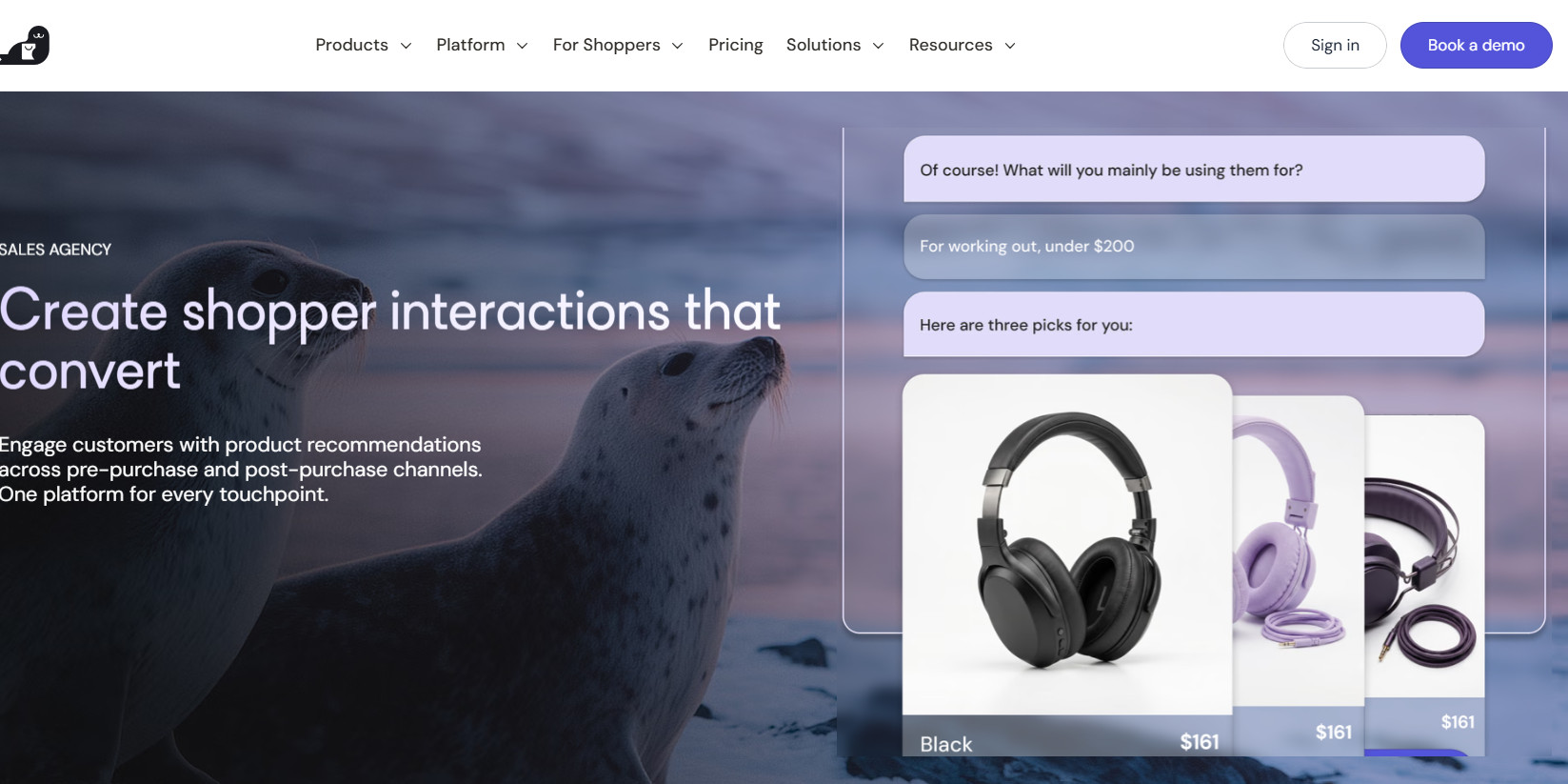
Seel works with over 5,000 online stores. It’s mostly known for handling returns and delivery problems, but it also has an AI shopping assistant. Instead of charging merchants simply because a customer chatted with an AI assistant, its Sales Agent uses a pricing model tied to successful purchases.
Part of Seel’s broader AI Agent Workforce, the Sales Agent helps customers find products, answer purchasing questions, and move toward checkout. It uses product catalog information to make recommendations and can help shoppers complete purchases directly within the conversation, reducing the need to bounce between multiple product pages.
The big difference is the pricing. Seel charges 3% per successful product purchase, with a seven-day attribution window. Let’s say someone is shopping for a winter jacket but isn’t sure which style is warm enough, or whether the sizing runs small. They ask the Sales Agent a few questions, receive a recommendation, and purchase a $150 jacket. Assuming that purchase qualifies under Seel’s attribution rules, the merchant pays $4.50.
If that same customer asks six questions, decides they hate every jacket on the website, and leaves without making a qualified purchase, those conversations don’t trigger the Sales Agent’s purchase-based fee. For retailers watching their margins, that’s a big deal. Seel also offers separate post-purchase protection products covering eligible delivery issues, returns, and extended warranties. Those services aren’t included in the Sales Agent’s 3% fee, but they may interest businesses looking to address customer concerns beyond the initial purchase.
What to consider: An attributed purchase isn’t necessarily a sale that wouldn’t have happened otherwise. Merchants should understand Seel’s attribution rules and evaluate how the fee affects their margins.
Best for: Ecommerce retailers looking for AI-powered product recommendations with pricing tied to successful purchases rather than conversation volume.
2.Gorgias Shopping Assistant: Best for Combining Sales and Customer Support

Gorgias is a customer support tool made for online stores, especially Shopify stores. It pulls all of a store’s customer messages, like emails, live chats, and social media comments, into one inbox so the team can answer them in one place. Its Shopping Assistant is built on top of that support system so rather than treating sales and customer service as separate activities, Gorgias brings product recommendations into its broader AI Agent platform.
The assistant can answer questions about sizing, availability, and compatibility while using available browsing history, cart contents, and customer information to make relevant recommendations. If someone has spent the last 20 minutes comparing three handbags, for example, the assistant can use that context to help narrow down the options.
It also lets retailers decide how pushy the assistant should be. A store can keep it more helpful and informative, or let it suggest more products. Which is a good thing, because nobody wants to ask if a shirt comes in petite and then get pushed to buy three matching accessories.
Gorgias uses subscription and conversation-based pricing for its helpdesk and AI tools, so businesses should consider the cost of the full system rather than looking at shopping assistance in isolation.
What to consider: Gorgias makes sense for Shopify retailers already using its support tools. Businesses looking exclusively for a sales assistant should consider whether they need the additional functionality.
Best for: Shopify stores that want to connect product recommendations with customer service conversations.
3.Rep AI: Best for Proactive Shopping Assistance

Rep AI’s shopping assistance works slightly differently. Instead of relying entirely on customers to initiate conversations, the platform can proactively engage shoppers based on their behavior and help guide them through purchasing decisions.
This is helpful because shoppers aren’t always going to ask for help. Sometimes they just open 12 browser tabs, compare the same products repeatedly, and eventually give up because they’ve thoroughly confused themselves. Not that I’ve ever done that!
Rep AI’s Product Finder helps customers narrow things down by asking them questions or letting them search for products. For example, someone shopping for skincare might know they want a moisturizer but have no idea which ingredients or formulas are right for them. The assistant can ask what they’re looking for and suggest products from the store.
The platform also supports shopping-cart interactions, including adding and removing products or adjusting quantities within the conversation. This is a big help for retailers with larger catalogs where customers frequently need help comparing similar items.
What to consider: Rep AI is primarily focused on Shopify ecommerce. Merchants should review its plan-based pricing and available features against their traffic and expected sales volume.
Best for: Stores that want proactive engagement and guided product discovery, particularly for larger or more complicated catalogs.
4.Tidio Lyro: Best for Shopping Assistance and Chat Support

Tidio combines AI shopping assistance with customer service tools through its Lyro AI Agent. The assistant can answer questions, recommend products, and help customers navigate an online store, while also handling routine support inquiries.
Lyro can use catalog information to recommend products and display product cards directly in conversations. With supported integrations, customers may also add items to their carts without leaving the chat.
Consider someone shopping for a birthday gift who has only managed to narrow it down to “something for a person who likes cooking.” Instead of scrolling through everything from measuring cups to espresso machines, they can answer a few questions about budget and interests and receive more relevant suggestions.
For smaller stores, combining shopping assistance with customer service can be really handy. Rather than investing in separate tools, retailers can use one system to help customers with purchasing decisions and routine questions about orders or store policies.
What to consider: Tidio offers free entry options and paid AI plans, but available features depend on the plan and ecommerce integrations. Make sure the shopping and cart functions you need are supported.
Best for: Small to midsize retailers looking for shopping assistance alongside AI-powered chat and customer support.
How Much Do AI Shopping Assistants Cost?
AI shopping assistants use several pricing models, which can make comparisons tricky. Some charge monthly subscriptions, others charge based on conversation volume, and some connect their fees directly to successful purchases.
With subscription pricing, merchants pay for access regardless of how many purchases the assistant influences. Conversation-based pricing ties costs to usage, which can be better for stores combining sales and support automation, although expenses may increase as more customers interact with the tool.
Then there’s performance-based pricing, which works differently. With Seel Sales Agent, for example, a retailer pays 3% on qualifying attributed purchases. If the assistant is credited with $10,000 in eligible purchase revenue during a month, the fee would be $300.
Paying per sale isn’t always cheaper. A store with lots of sales might save money with a flat monthly fee, while another store might rather pay only when someone buys. It also depends on your profit margins. A 3% fee hits very differently on a product with a 60% margin than on one where you barely make a profit.
To see what it will really cost you, compare the full price to what your store brings in now. Don’t just go with the lowest monthly price you see.
What Should Online Stores Look for in an AI Shopping Assistant?

Before choosing a platform, figure out what you need it to accomplish. Buying software first and figuring out what problem it solves afterward isn’t generally a great strategy. A few things to think about:
- Product information: recommendations should reflect accurate descriptions, specifications, and inventory. An assistant enthusiastically recommending something that’s been out of stock for six months isn’t particularly useful.
- Customer intent: the tool should understand everyday questions, not just exact product names, and ask for clarification when needed.
- Ecommerce integration: make sure the features you want work with your store’s platform.
- Pricing transparency: understand subscription costs, conversation limits, purchase attribution, and any additional fees.
- Recommendation controls: retailers would be able to guide recommendations and prevent inaccurate promises about discounts or policies.
- Performance measurement: look at assisted purchases, conversion rates, average order value, gross profit, and customer satisfaction rather than simply counting conversations.
It’s also worth trying to figure out where customers get stuck. If they’re constantly asking about sizing or compatibility, a product-focused assistant might be valuable. If your team spends most of its day answering shipping and return questions, broader customer support automation is probably the better bet.
Are AI Shopping Assistants Worth It for Ecommerce Businesses?
For stores where customers regularly need help making buying decisions, it might be time to try an AI shopping assistant. That doesn’t mean every online retailer needs one though, a store selling a handful of straightforward products might not see enough value to justify the expense, while a retailer with a large catalog or complicated products could benefit considerably.
The four tools we looked at do a lot of the same things, but each one has its own strength:
- Seel Sales Agent only charges you when the assistant helps make a sale, not every time someone chats with it.
- Gorgias mixes shopping help with customer support.
- Rep AI reaches out to shoppers first and helps them find the right product.
- Tidio Lyro suggests products and also answers basic customer questions.
In the end, you don’t need an overcomplicated chatbot. You just need one that helps people find the right product, get answers, and check out. Online shopping should be easy. It shouldn’t take 15 open tabs, an afternoon of research, and a spreadsheet just to decide which jacket to buy.