


- Aircall vs. Talkdesk: At a Glance
- What is Aircall?
- What is Talkdesk?
- Aircall vs Talkdesk: Pricing and Plan Structure
- Aircall vs Talkdesk: CRM and Helpdesk Integrations
- Aircall vs Talkdesk: Ease of Setup
- Aircall vs Talkdesk: AI Features
- Aircall vs Talkdesk: Support Quality
- Aircall vs Talkdesk: Which One to Choose?
Last Updated on October 7, 2026 by The Digital Merchant Team
If you take a quick moment to look through the websites of Aircall and Talkdesk, you’d be forgiven for thinking that they’re competing for the same type of customer.
After all, both are cloud-based business phone solutions and have advanced AI features. You’ll also find Aircall and Talkdesk featuring prominently in the shortlist of any sales or support team that’s currently evaluating its phone stack. But the overlap between the two is actually mostly superficial.
Talkdesk is a full enterprise contact center platform whereas Aircall is more a focused, CRM-first solution for teams that want to move fast. If you’re already on the shortlist stage with both these solutions, then this guide is for you.
We’ll walk you through exactly where they’re similar, where they differ, and how to choose the one that best meets your team’s needs.
Aircall vs. Talkdesk: At a Glance
Best for | SMB and mid-market sales and support teams, including UK teams. | Mid-size to large enterprise contact centers |
Starting price | $30/user/month (billed annually) | $85/user/month (billed triennially) |
AI features | Add-on from $9/user/month | CXA built into the platform. Advanced features vary by tier |
CRM integrations | 250+ native, deep bidirectional sync. Salesforce CTI integration on ‘Professional’ plan | 60+ contact center software integrations via AppConnect; Salesforce integration is a paid add-on |
Setup time | Typically within 24 hours | Talkdesk Express within 24 hours. (Enterprise deployments take longer) |
Contract | Monthly or annual | Typically 3-year contract required |
Uptime SLA | 99.95% | |
G2 rating | 4.4/5 (1,605 reviews) | 4.4/5 (2,508 reviews) |
Minimum seats | 3 | Not publicly specified |
What is Aircall?
Aircall was launched in Paris in 2014. Today, it serves more than 22,000 businesses in over 110 countries. UK teams get a London office too, and Aircall is registered with the ICO under UK GDPR.
Its main focus is sales and support teams that run their daily operations through a CRM. Voice, SMS, WhatsApp, and AI tools can live in one workspace. The platform also supports deep bidirectional integrations to HubSpot, Salesforce, Zendesk, Pipedrive, and more.
Aircall emphasizes simplicity. Its main pitch is to help you to get your voice layer as smart and connected as the rest of your stack, without needing an IT project to do it.
That emphasis on easy setup and deep CRM integration makes for Aircall’s biggest competitive advantage for SMB and mid-market buyers.
Read our Full Aircall Review here!
What is Talkdesk?
Talkdesk was founded in 2011. Since then, it’s grown into a full enterprise contact center platform, which positions itself under the banner of “Customer Experience Automation”, or CXA.
The platform can handle omnichannel communications across voice, email, chat, SMS, and social, alongside workforce management. It also supports quality analytics and has been increasingly integrating more powerful AI features in recent years.
While there’s an “Express” version for up to 25 seats, Talkdesk is mainly built for scale. It even has industry-specific “Experience Clouds” for healthcare, financial services, retail, and other regulated verticals. This shows that the platform’s primarily designed for a customer base with large teams with complex compliance requirements who have the IT resources to handle onboarding and implementation.
Aircall vs Talkdesk: Pricing and Plan Structure
Aircall
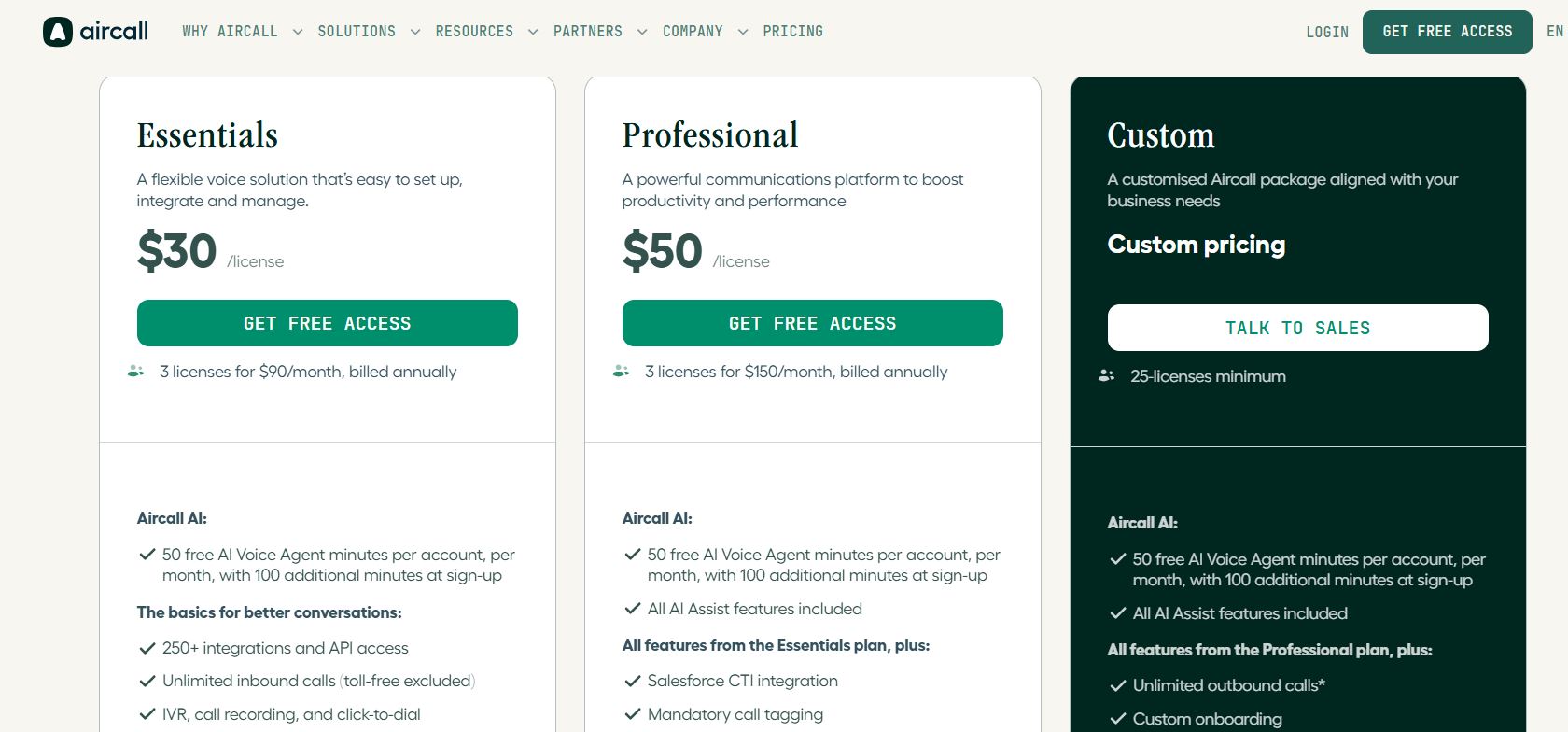
The platform has a dedicated pricing page and lays out charges clearly, though by default monthly prices are pro-rated, assuming subscribers pay annually.
The lowest-cost “Essentials” plan costs $30/license/month (paid annually). The ‘Professional’ plan costs $50/license/month, once again assuming annual billing. This includes features like Power Dialer, advanced analytics, Live Monitoring, unlimited domestic outbound calls, and Salesforce CTI integration.
“Professional Plans” also include “AI Assist”: this can also be purchased as an add-on for “Essentials” subscribers for an extra $9 per month. The “AI Assist Pro” add-on costs $49 per month, and includes extra features like live prompts and transcriptions, custom call summaries, and playbook CRM logging.
All subscriptions include 50 free “AI Voice Agent” minutes (with a 100-minute bonus on sign up). This includes features like autonomous handling of frequent questions, and live transfer to human beings with context. After you’ve run through your free minutes, extra time is billed on a pay as you go basis from $0.19/minute.
Talkdesk
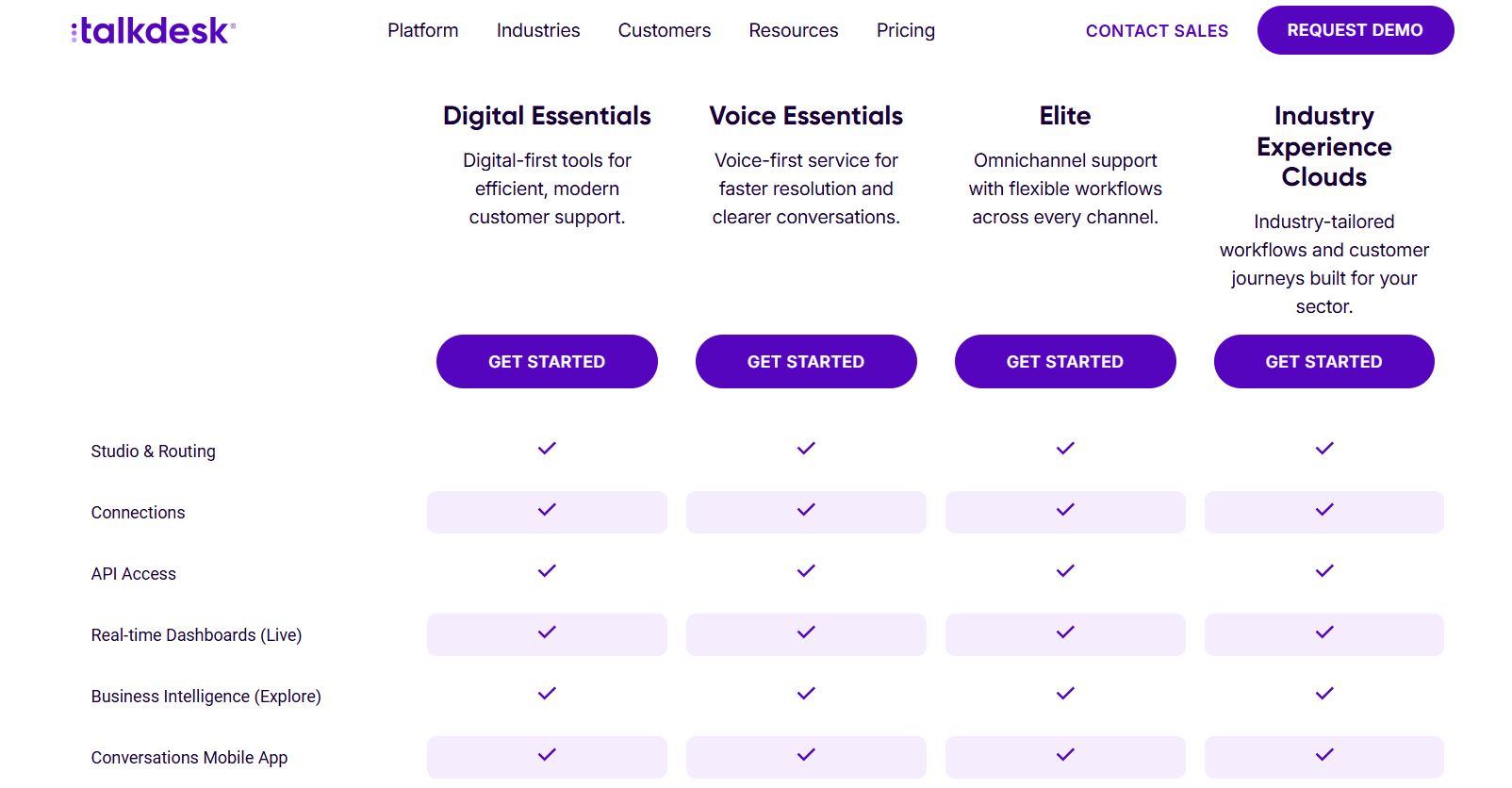
Pricing begins at $85 per user per month for Talkdesk’s “Digital Essentials” plan. As the name suggests, this covers digital-only channels like chat, SMS, and social media, but not voice.
The “Voice Essentials” plan starts at $105/user/month. It includes call features like voice support, speech recognition, and voicemail transcription.
The Talkdesk CX Cloud “Elite” plan offers true omnichannel, by combining voice and digital. It includes features like performance and workforce management. Subscriptions start at $165 per month.
However, these prices come with a major caveat: most plans require subscribers to sign up for three years, instead of just paying month-to-month with no ongoing commitment. This means, for instance, that a 20 agent team on the ‘Elite’ plan would cost $3,300 per month before any implementation fees or add-ons.
In fairness, Talkdesk also offers an Express plan aimed at small US and Canadian businesses with under 50 employees, which includes 25 licenses at $25 per user per month. Subscribers can sign up on a “pay as you go” basis but the plan has limited functionality when compared to mainstream Talkdesk plans.
Winner: Aircall
The pricing gap between Aircall and Talkdesk for SMBs and mid-market teams is substantial here. Aircall’s pricing is also clearer, and doesn’t lock subscribers into triennial (three-year) contracts. This makes it a better choice for teams that want to control costs and scale.
Aircall vs Talkdesk: CRM and Helpdesk Integrations
Aircall
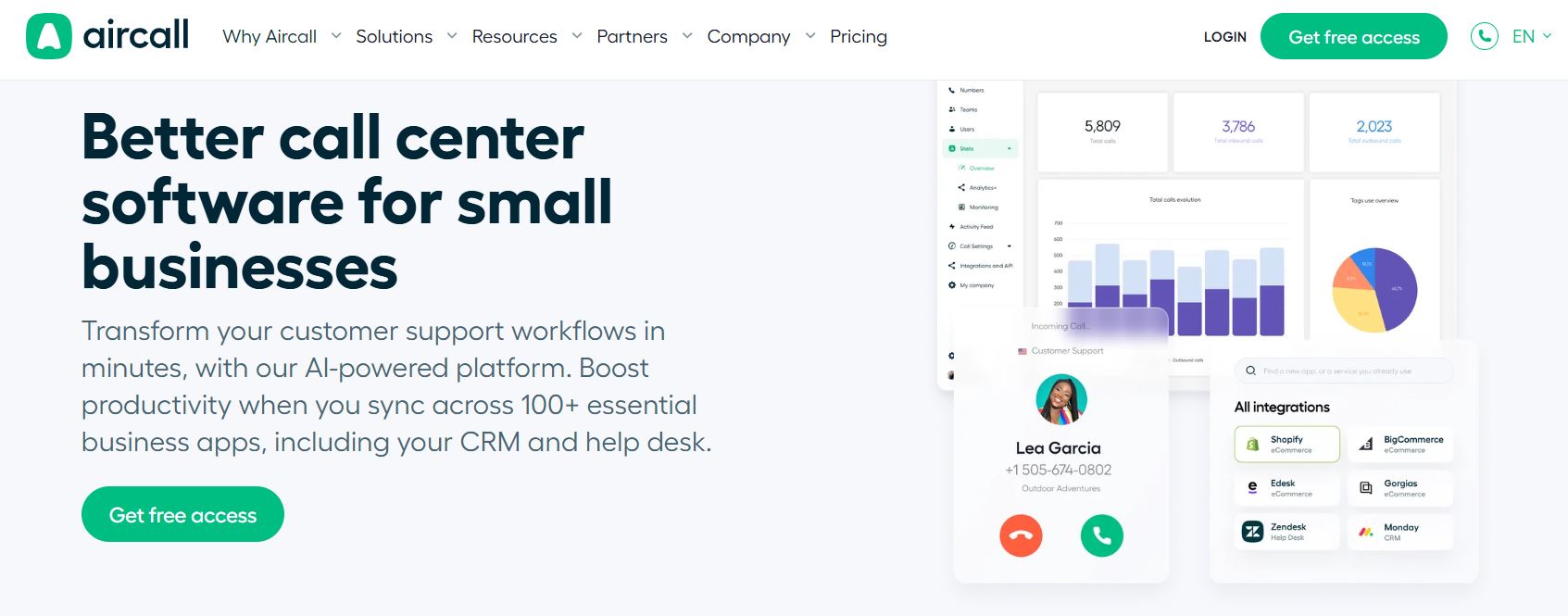
This area is what makes Aircall stand out for sales and support teams relative to other business phone solutions. The platform can connect to over 250 tools, including HubSpot, Salesforce, Zendesk, Pipedrive, Intercom, Shopify, monday.com, and Microsoft Teams.
Integrations are generally bidirectional and deep. Calls can log automatically to sales records. AI and call summaries sync easily to CRMs, and reps can easily view full contact history inside their CRM interface before answering a call.
Full Salesforce CTI integration is only included on the “Professional” plan. However, HubSpot, Zendesk, and most other major CRM and help desk connections are available for the lowest-cost “Essentials” plan. For teams that live inside a CRM all day, this is the closest thing Aircall has to a definitive selling point.
Talkdesk
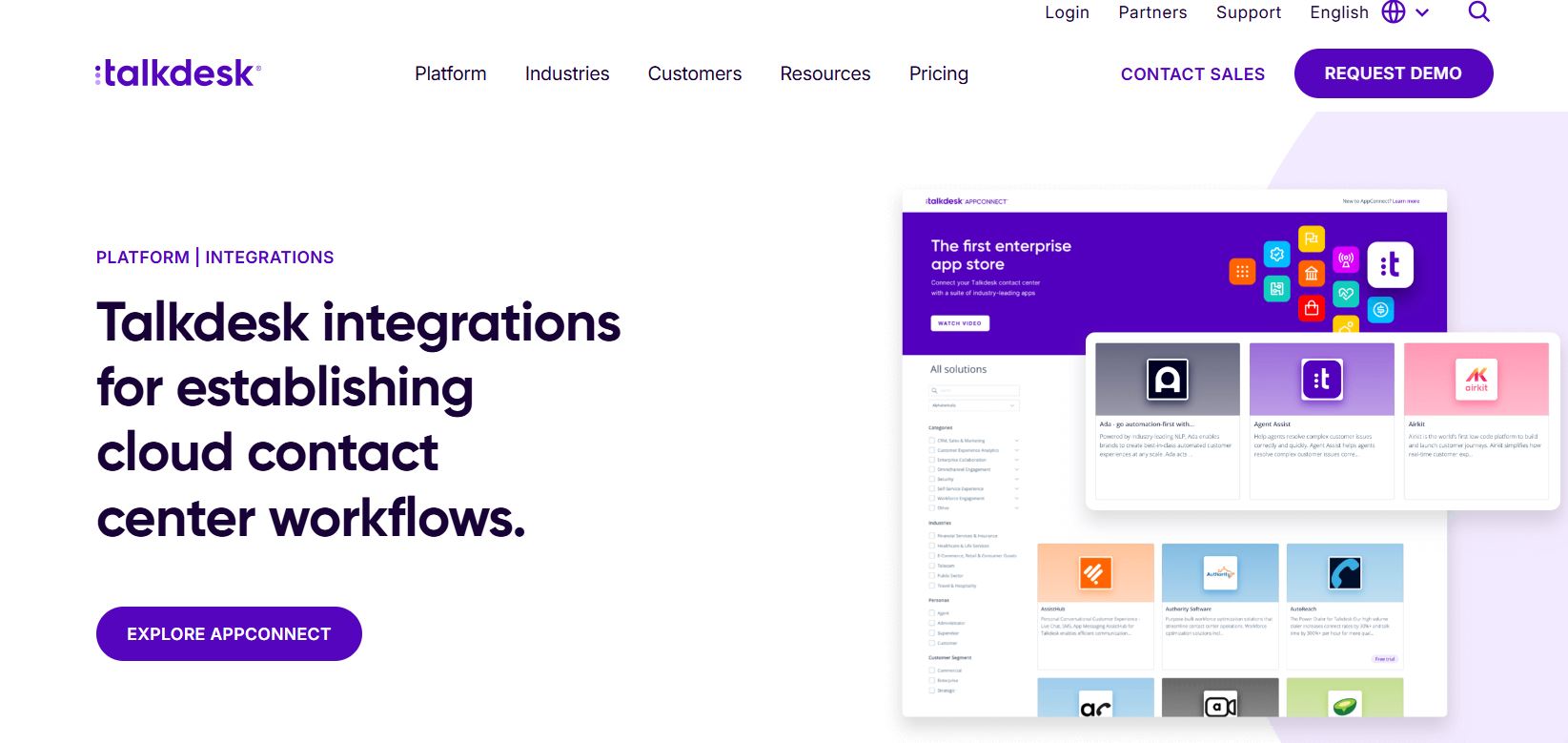
The platform can connect to 60+ integrations via its AppConnect marketplace. Salesforce is the deepest, and one of the most prominently featured in Talkdesk’s marketing materials.
In October 2025, Talkdesk announced that it planned to move its CRM integrations to a “managed seats model”. This means that Salesforce and other key CRM integrations are now separately subscribed add-ons rather than included features.
This includes “Talkdesk for Salesforce” and “Talkdesk for Salesforce Voice.” For teams using other CRMs, integration depth is generally narrower than Aircall’s. For example, HubSpot integration is available via third-party connectors rather than a native first-party build. This brings in more complexity and potential concerns around sync reliability.
Winner: Aircall
Any team that’s running HubSpot, Zendesk, Pipedrive, or any of the broader ecosystem of SMB-oriented CRM and help desk tools, will find that Aircall’s native integrations are deeper and wider. Normally, you don’t have to pay extra for integrations, with the exception of Salesforce CTI integration, which is only available on the “Professional” plan.
Aircall vs Talkdesk: Ease of Setup
Aircall
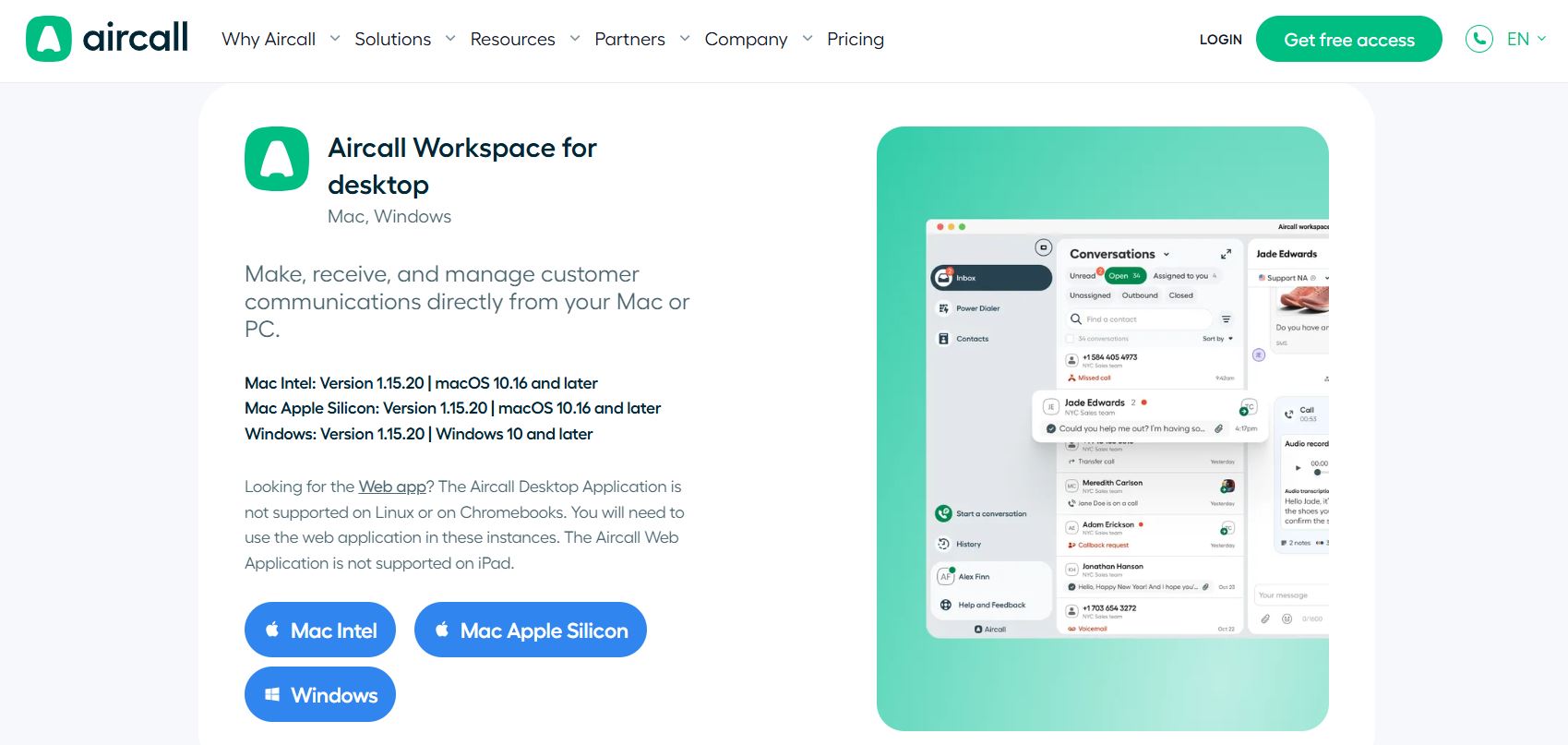
The platform is clearly designed for easy setups. The admin dashboard is intuitive and allows for easy configuration of aspects like Numbers, IVRs, teams, and call routing.
The “Smartflows” editor is a visual drag-and-drop tool that allows people with little programming experience to build call flows. Most teams have a live number and correctly configured call routing within 24 hours. There’s no hardware to install, and there’s generally no requirement for an SMB to have a dedicated IT team for easy deployment.
Talkdesk
If you take the time to read Talkdesk’s marketing materials, you’ll find claims that it can enable “new customers’ contact centers at a lightning-fast speed.”
However, during our research for this guide, we discovered reviews that claimed longer implementation times of around two to four weeks for standard deployments. (With the exception of Talkdesk Express)
Assuming 2-4 weeks, as a baseline, it may take even longer to introduce multi-site, multi-country, or regulated industry setups. This is likely why Talkdesk has a dedicated “professional services” team with certified partners to handle the implementation process.
While that may have its uses, it’s likely to be overkill for, say, a 25-person sales team that wants to start taking calls this week.
Winner: Aircall
For SMBs that need to be operational quickly, Aircall’s faster implementation is a crucial advantage.
Aircall vs Talkdesk: AI Features
Aircall
Depending on your subscription and platform configuration, Aircall can cover the full call lifecycle.
For instance, “AI Assist” is available as part of the “Professional” plan or for $9/user/month as an add-on for “Essentials” subscribers. It includes post-call summaries, sentiment analysis, key topic tagging, action items, and call scoring.
The “AI Assist Pro” add-on costs $49/user/month, and adds live transcription, real-time coaching prompts, embedded sales playbooks built around frameworks like BANT, MEDDIC, or SPICED, and Contact Insights, which surfaces the last 12 customer interactions before a rep picks up.
“AI Voice Agent” (billed on a pay-as-you-go basis) can handle inbound and outbound calls autonomously in 23 languages. The agent can also qualify leads, answer FAQs, book appointments, and hand off calls to reps with full context when necessary.
Aircall’s AI tools are well integrated with its CRM connections. Call insights and summaries can land in the contact record automatically rather than sitting in a separate analytics silo that no one checks. UK finance brokerage Astmoor Finance is a good example: with AI Assist Pro, reviewing a 20-minute sales call went from listening to the full recording to reading a transcript in about five minutes.
Talkdesk
Talkdesk has invested heavily in AI via its “CXA” platform. As of early 2026, it placed #20 on G2’s Best Agentic AI Software Products list out of 1,392 products in the category.
There’s an Autopilot virtual agent, which can self-service interactions across voice and digital channels. Talkdesk’s “QM Assist” can also automate quality management with AI-driven interaction scoring.
Talkdesk Navigator provides intent-based routing based on natural language inputs to reduce reliance on traditional IVR menus.
The platform also began previewing “Automation Flows” in early 2026. This is an orchestration engine for automating workflows across backend systems. The above-mentioned “Autopilot” agent also now supports email.
In March 2026, Talkdesk also announced its “CXA Operations Center”. This provides centralized management of human and AI agents, and includes real-time monitoring and pre-deployment AI agent evaluation.
Winner: Talkdesk
The platform is a better choice for enterprise breadth, particularly those organizations that need to run omnichannel contact centers, that have complex automation and workforce management needs.
Aircall may be a better option for sales and support teams that need AI to be tightly embedded in their CRM workflows without any major enterprise overhead.
Aircall vs Talkdesk: Support Quality
Aircall
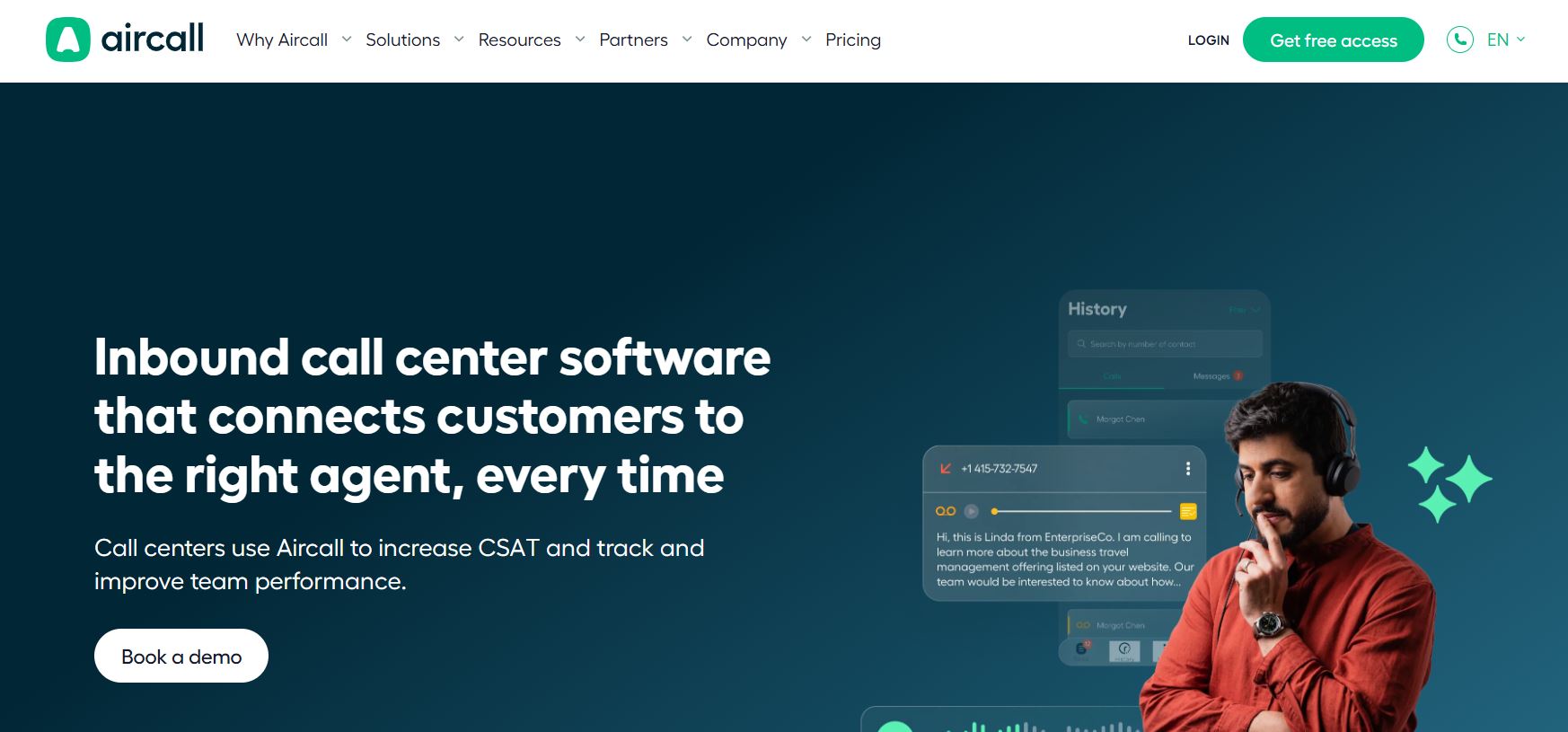
The platform’s G2 rating currently sits at 4.4 stars out of 5, based on over 1600 reviews. Both onboarding and customer support for Aircall consistently come up as strengths. Uk teams also have a London office and local team to call on, so help doesn’t depend on US business hours.
There’s a free 7-day trial, with no credit card required, which suggests that Aircall itself is confident that users will have a good experience with onboarding.
However, some user reviews have flagged response time inconsistencies at the support level, particularly for the lower-tier “Essentials” plan.
Talkdesk
Talkdesk matches Aircall’s G2 score at 4.4 out of 5, but has a much larger review base of over 2,500.
However, its Trustpilot score (1.5/5 based on over 870 reviews) isn’t nearly as impressive. Certain complaints surround difficulties with cancelling contracts (including one user who believed they were donating to a dog rescue service being unable to end their inadvertent subscription).
There are also complaints surrounding difficulties reaching support and getting issues resolved in a timely fashion.
This said, Talkdesk does claim a 15-minute response target for urgent tickets. There are also ‘Premium Care‘ packages with dedicated support teams and priority phone number access. This suggests the support infrastructure is there for those willing to pay for enterprise-level tiers.
Winner: It’s a Tie
Aircall definitely wins on the SMB and mid-market segment. However, Talkdesk’s enterprise support structure may serve large accounts well. Just be mindful of any negative reviews on reputable sites like Trustpilot around billing and reliability before signing up for a three-year contract.
Aircall vs Talkdesk: Which One to Choose?
If you’ve read through this guide, by now you’ll have a clear understanding that these two platforms are aimed at different buyers. This makes comparisons easier than with many other business phone solutions.
You should choose Aircall if:
- Your team is in a CRM most of the day, or all day.
- Most of your communications consist of sales and support calls.
- You want a focused tool that can deploy in hours, instead of potentially taking weeks.
- You don’t have a dedicated IT team to help with onboarding and can’t hire one.
- You prefer more flexible billing i.e. monthly or annually.
- You’re a UK team that wants local support behind the product. Aircall’s call center software page has the details.
Admittedly, there are also trade-offs. Aircall doesn’t come with built-in video or team messaging. Depending on your subscription and your organization’s requirements, certain AI features may also cost extra.
But for the specific workflows around which Aircall is designed, its speed, CRM integration depth, and clear pricing are hard to beat.
You should choose Talkdesk if:
- You’re already running a large enterprise contact center with omnichannel requirements.
- Your organization has regulated industry compliance requirements and you can afford one of Talkdesk’s “Industry Experience Clouds” plans.
- You have complex workforce management needs.
Talkdesk’s AI tooling is strong and the platform’s mature. While onboarding and support have received mixed reviews, enterprise customers with deep enough pockets can hire dedicated teams to assist with these.
Just go in with a clear understanding of the total cost of a three-year contract and the implementation timeline before you sign up.
Whatever platform you choose, you should also read independent reviews and take advantage of free trials to test them with real call data before subscribing.