


- What Tech Companies Actually Need from Accounting Software
- The 4 Best Accounting Software for Tech Companies: The Ones That Get It Right
- QuickBooks Online: The Ubiquitous, Capable Choice
- Xero: Cleaner Interface, Same Core Limitations
- Zeni: Purpose-Built for Tech Startups, but Dependent on QBO
- Digits: Tech-Forward Accounting with AI Baked In
- How to Choose the Best Accounting Software for Tech Companies
Last Updated on April 28, 2026 by Ewen Finser
Most accounting software was built for a business that sells physical things or billable hours. The financial questions those businesses ask are relatively stable: Did we make money this month? Are our invoices paid? What do we owe in taxes?
Tech companies (particularly venture-backed startups) are asking an entirely different set of questions: How many months of runway do we have left? What’s our current burn rate, and how does it change if we hire two engineers next quarter? Can we pull a board-ready P&L before our investor call on Thursday?
These are critical operational questions that aren’t easily answered by traditional accounting software, which is why accounting tech needs to be fundamentally different from what works for a dental practice or a boutique retail store.
With that in mind, let’s go over what tech companies actually need out of their accounting software and the top four brands getting it right.
What Tech Companies Actually Need from Accounting Software

Traditional businesses (law firms, restaurants, retail shops) are primarily focused on profitability, tax compliance, and maintaining healthy cash flow from operations. Their accounting needs center on reconciling revenue against expenses, staying current on payables and receivables, and generating the standard reports their accountants and tax preparers require. For these companies, a monthly or even quarterly close cycle is perfectly adequate because the core financial picture doesn’t shift dramatically week to week.
Tech executives, on the other hand, are more focused on:
- Real-time burn and runway visibility: For a company spending investor capital, yesterday’s data isn’t good enough. Founders and CFOs need to know their cash position today, not after a month-end close that lasts two to three weeks.
- Native fintech integrations: The modern startup finance stack doesn’t run through Chase and a corporate Amex; it runs through Mercury for banking, Ramp or Brex for expense management, and Stripe for revenue. These platforms have rich transaction metadata that can automate the majority of categorization work (when properly ingested). Native and optimized integrations are critical here; connections built through screen-scrapers and third-party aggregators break constantly and leave out crucial context.
- Automated categorization at volume: A SaaS company processing thousands of transactions per month (subscriptions, contractor payments, cloud infrastructure invoices, ad spend) can’t afford to have a bookkeeper manually reviewing each line. The categorization needs to happen in the background, accurately, and learn from errors/corrections over time.
- Investor-grade reporting: Board decks, due diligence packages, and Series A data rooms require reports formatted in ways that general-purpose accounting software doesn’t produce natively. GAAP-compliant financials, revenue recognition schedules, and burn-versus-budget analysis shouldn’t require exporting to a spreadsheet and rebuilding from scratch every month.
- FP&A capability alongside bookkeeping: Bookkeeping records what happened, while financial planning answers what will happen. Tech companies need both — ideally from the same data source, so the actuals and the forecasts aren’t living in different systems with a reconciliation problem between them.
The 4 Best Accounting Software for Tech Companies: The Ones That Get It Right
QuickBooks Online: The Ubiquitous, Capable Choice
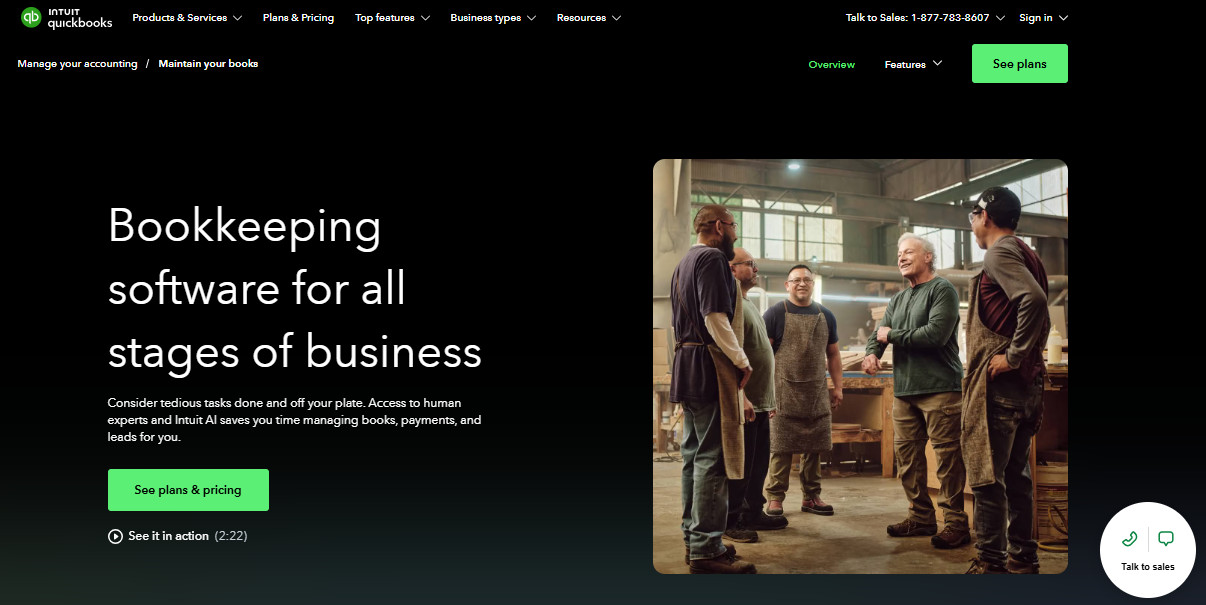
QuickBooks Online is where most startups land by default — usually because their accountant already uses it. It’s a capable, mature platform with a vast ecosystem of integrations and a bookkeeper workforce that knows it cold.
Although it’s more than capable, it’s not quite the cream of the crop for tech companies. Its integration with the modern fintech stack (Mercury, Ramp, Brex) relies on third-party connectors that frequently lose their feeds and require manual intervention to fix, startup metrics like burn rate and runway have to be calculated outside the system, and the reporting is functional but not investor-ready without custom work.
Additionally, the month-end close in QBO typically takes one to three weeks, which means founders are often making decisions based on old data. This makes sense, as the platform was designed for businesses where that lag is acceptable. But for a startup where the burn rate might shift materially week over week, it’s a blind spot.
To its credit, QuickBooks Online is not standing still. Intuit has invested heavily in the platform over the past two years, shipping AI-powered bank feeds with meaningfully better categorization accuracy, three purpose-built AI agents for accounting, payments, and financial analysis, and a fully redesigned interface that consolidates workflows that used to require multiple screens. Plus, its new app partner program speaks to a more serious commitment to third-party integration quality.
So QuickBooks Online remains a reasonable choice if your accounting firm is deeply embedded in it and you have a finance team with bandwidth to compensate for its gaps. As a standalone solution for a fast-moving tech company, it’s got some work to do.
Pros:
- Massive accountant and bookkeeper ecosystem
- Thousands of third-party integrations available
- Battle-tested, stable, rarely goes down
- Familiar to almost every finance hire
Cons:
- Fintech connections break constantly
- No native burn or runway tracking
- Month-end close takes weeks
- Investor-ready reports require manual rebuilding
Xero: Cleaner Interface, Same Core Limitations
Xero built its reputation on being the more elegant, user-friendly alternative to QuickBooks, and that reputation is largely deserved. Its interface is cleaner, its bank reconciliation workflow is smoother, and it has strong adoption in markets outside the U.S.
For tech founders evaluating accounting software, Xero’s appeal is real but narrow. It integrates with Stripe and PayPal reasonably well, and its reporting is more flexible than QBO’s out of the box.
In many ways, tech companies are actually better positioned than most to get real value out of Xero. The platform’s API is genuinely open and well-documented, which means a tech team can easily build custom integrations, pull financial data into internal dashboards, and automate workflows that a non-technical business would need a third-party tool to handle. Plus, Stripe is a first-class integration, not an afterthought, which matters when subscription revenue is your primary income source.
However, real-time dashboards for burn and runway aren’t native to Xero and require third-party add-ons or manual workarounds. The connections to Mercury and Ramp go through aggregators rather than direct APIs, with the same data quality and reliability problems that plague QBO. Investor-ready reporting requires template customization or exports to other tools.
Still, it’s better than QuickBooks in the ways that matter to people who spend time inside accounting software every day: cleaner reconciliation, more flexible reporting, and a more thoughtful user experience throughout. For a lean startup where the founder or a single finance hire is doing most of the work themselves, that friction reduction is worth a lot. Plus, the unlimited user model means every engineer, founder, and advisor can have eyes on the numbers without a seat licensing conversation every time the team grows.
Pros:
- Cleaner interface than QuickBooks
- More flexible reporting out of the box
- Strong outside the U.S.
- Very good Stripe integration
Cons:
- Same core limitations as QuickBooks
- No native startup financial metrics
- Aggregator-based fintech connections, not direct APIs
- Investor reporting still requires workarounds
Zeni: Purpose-Built for Tech Startups, but Dependent on QBO
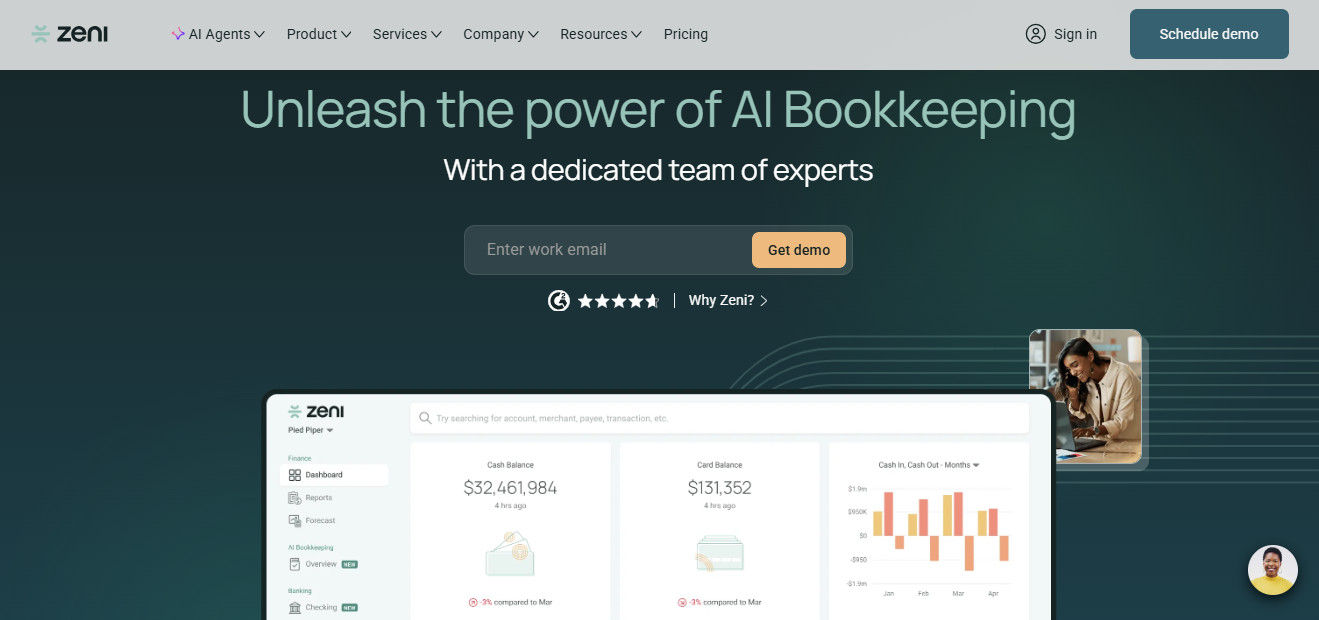
Zeni is explicitly designed for tech startups. Rather than being a software tool you configure yourself, it’s a hybrid model: AI-powered bookkeeping automation backed by a dedicated team of CPAs, controllers, and bookkeepers. The dashboard updates daily, giving founders visibility into burn rate, runway, and cash position without waiting for a month-end close.
The integrations are meaningfully better than QBO or Xero for the startup stack. Mercury, Rippling, and Stripe connect and flow automatically. Transaction categorization is largely automated, and the AI learns from corrections over time. The reporting is designed with startups in mind, and metrics like burn rate projections are native features, not afterthoughts.
The downside is that Zeni requires the underlying ledger to live in QuickBooks Online Plus. For many companies, that’s fine — it means your accountant can access the data in a familiar environment. For others, it introduces a dependency they weren’t expecting and creates a layer of complexity between the platform they’re using and where their numbers actually live.
Overall, it’s a strong choice for startups that want a managed, full-service approach to accounting with daily visibility. It just depends on whether the QBO dependency is negligible or a major hurdle for you.
Pros:
- Daily cash and burn visibility
- Dedicated CPA team included
- AI learns from categorization corrections
- Built with startup metrics in mind
Cons:
- Requires QuickBooks Plus underneath
- Managed model means less direct control
- Pricing reflects the full-service model
Digits: Tech-Forward Accounting with AI Baked In
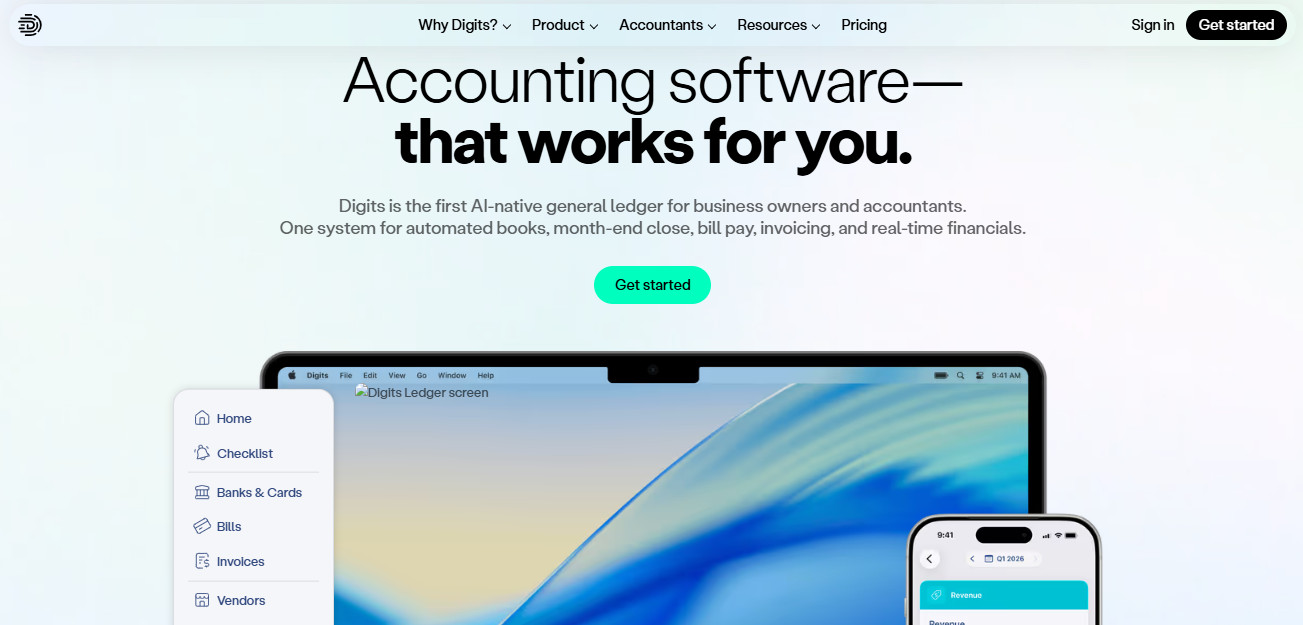
Digits is another software built with tech startups in mind. Its main value proposition is an autonomous general ledger that was built with AI from the start, rather than being tacked on at the end. Where conventional accounting tools add new capabilities as features (more buttons, more settings, more steps), Digits adds capabilities as AI agents that run entire workflows autonomously and pause only when human judgment is required.
Trained on more than billions of dollars in small-business transactions, Digits’ AI was developed in-house, not assembled from general-purpose LLMs. As a result, it automates the vast majority of bookkeeping workflows with a high degree of accuracy. Real-time dashboards for cash flow, burn rate, and runway are native features, not bolted-on additions. Actuals and forecasts live in the same system, pulling from the same source of truth. And its integrations with Mercury, Ramp, Stripe, and other fintech-native platforms are direct API connections.
These conveniences come with a few downsides. For one, because Digits runs on a proprietary general ledger rather than QuickBooks or another industry-standard backend, your financial data lives in their system. If you need to switch, migrating your books is a materially harder problem than it would be with a QBO-backed tool. There’s also the simple fact that Digits is a young company in a market dominated by platforms with decades of infrastructure behind them — the accountant ecosystem around it is thin, and the product is still building out the depth that QuickBooks has accumulated through years of edge cases and enterprise demands.
But overall, Digits is the most compelling option on this list for a tech startup that wants accounting software designed around the way it actually operates. If your books are clean, your business model is straightforward, and you’re comfortable with a younger platform that’s still building out its ecosystem, the tradeoffs are easy to accept.
Pros:
- Automates most bookkeeping workflows
- Native burn, runway, and cash dashboards
- FP&A and bookkeeping pulling from the same source of truth
- Direct API connections to Mercury, Ramp, and Stripe
Cons:
- Proprietary ledger makes migration difficult
- Thin accountant ecosystem outside the platform
- Young company that’s less battle-tested than legacy platforms
How to Choose the Best Accounting Software for Tech Companies
Picking the best accounting software tends to come down to one question: Are you willing to work around your accounting software, or do you want software that works for you?
QuickBooks and Xero are great picks if your accounting firm is already embedded in one of them and your finance needs are relatively straightforward. They’re mature, well-supported platforms with massive user communities and extensive add-on ecosystems.
Zeni is a compelling choice if you want managed, full-service accounting with startup-aware dashboards (and you don’t mind the QuickBooks backend dependency). The dedicated CPA team is a genuine differentiator for founders who prefer a human layer to a more automation-centered workflow.
Digits is the right answer if you want an accounting infrastructure designed from scratch for the way tech companies operate, with real-time visibility, native fintech integrations, AI-native automation, and reporting that speaks directly to the questions your investors and board are going to ask.