


Last Updated on May 8, 2026 by Ewen Finser
M&A advisors and business brokers are both intermediaries: they help owners sell companies by packaging the opportunity, finding and screening buyers, managing negotiations, and coordinating the transaction through due diligence and closing.
So, what’s the difference between the two, and which one is likely to be more suitable for your proposed business sale? Here’s all you need to know before deciding on an M&A Advisor vs Business Broker
Business Brokers vs. M&A Advisors: Key Differences
Deal Size
Deal size is perhaps the most reliable differentiator between brokers and M&A advisors, because it tends to drive everything else: how buyers evaluate risk, what due diligence looks like, which documents are expected, and how fees are structured.
There’s no rule regarding the deal sizes taken on by different types of firms; typically, though, business brokers work on deals in the <$2mn segment (“Main Street” sales), while M&A advisors sell companies valued in the seven-, eight- and nine-figure ranges.
However, as I’ll cover later in the article, there are some brokerages that deal with bigger sales as well.
Target Market
If you’re selling a local or owner-operated company, you’ll be more likely to end up dealing with a business broker than an M&A advisor. The latter tend to focus more on sales of bigger companies with institutional-grade reporting expectations.
It’s worth noting that digital businesses sit at the boundary here. They can be small enough to be brokered like a Main Street deal, or large enough to justify an M&A-advisor process, and many specialist “online business brokerages” operate in that overlap.
This all matters because of the approach the firm in question uses for outreach. Brokers tend to “list and screen,” while M&A advisors use a more targeted outreach process, going through their contact books for potentially suitable buyers.
This approach is related to the differences in average deal size discussed above. As deals get larger, they become more inaccessible to small or individual buyers; private equity funds and other institutional investors take over. Entities like these generally prefer to operate via direct outreach.
Valuation Methodology
Valuation methodology is also related to deal size.
Companies with less than ~$5mn in annual revenue are usually valued using the Seller’s Discretionary Earnings (SDE) framework. Your SDE is a measure of your company’s free cash flow, and is calculated by adding together your pre-tax income, your owner salary, depreciation and amortization figures, and discretionary and non-recurring expenses.
Bigger companies are more often valued using the EBITDA (Earnings Before Interest, Tax, Depreciation, and Amortization) metric. Standard in corporate finance settings, it’s more useful than SDE when ownership compensation and discretionary personal expenses are not the central variable.
So, brokers are more likely to value your business using a multiple of SDE, while M&A advisors will generally use a multiple of EBITDA. The specific multiple used will depend on various factors, but it will generally sit between 2-5x.
Fee Structures

Business brokers are commonly paid via a success-based commission; if your business sells for $1mn, for example, your broker might take a 15% cut ($150,000, in this case).
As deals get larger, it’s common to see tiered percentage schedules, where marginal commission rates decline at higher transaction values. If the commission on the first $1mn is 15%, the commission on the next $1mn might be 10%, for example.
M&A advisory fees are often less transparent to outsiders because they are usually negotiated engagement-by-engagement, but third-party surveys provide useful benchmarks. The Firmex M&A Fee Guide gives a “most common engagement letter” example, including:
- An up-front, one-time work fee of $15k–$25k, which is deducted from the eventual success fee if the business sells.
- A success fee with a minimum, generally using a fee schedule that decreases as deal value rises.
Success fees range from 4%–6% for $5mn–$10mn deals, 2%–4% for $20mn–$50m, and 1%–2% for $100mn–$150mn.
Process and Deliverables
The sale process is where the experiential difference is most tangible.
Business brokers typically work as intermediaries, while M&A advisors tend to run a more structured sell-side process. One key example of this is the confidential information memorandum (CIM), which is a comprehensive marketing document used to market the business to prospective buyers.
In professionalized middle-market processes, the advisor typically coordinates the preparation of sale materials, builds a buyer list, and conducts targeted outreach designed to create competitive tension.
Many online-business brokerages now look operationally similar to M&A advisors: they use secure deal rooms, create detailed sale materials, and manage buyer interactions end-to-end.
On average, though, business broker processes tend to be lighter-weight, faster to initiate, and more standardized for smaller deals. M&A advisors take a more bespoke approach, which can be useful when due diligence requirements and structural complexity are more intense.
Marketing Strategy/Confidentiality
Confidentiality is not exclusive to either model, but the default approach to marketing can differ.
In many Main Street transactions, the sale may be marketed broadly, and in some cases listings are visible to the public (with varying levels of anonymity). In more formal M&A processes, early-stage outreach frequently uses a “teaser” and requires a non-disclosure agreement (NDA) before the release of a CIM or detailed financials.
Deal Structures and Closing Processes
As deal size increases, complex structures become more common. So, M&A advisors are more likely to structure deals involving earn-outs, retained equity, and other such mechanisms.
Business brokers are more likely to see straightforward asset deals and seller-financing dynamics in smaller transactions, because many buyers are individuals using personal capital and bank lending where available.
The same principle applies to closing processes. M&A advisors are more likely to offer assistance with complex due diligence and negotiation strategies.
Leading Firms in Each Category
As I’ve noted, the boundary between business brokers and M&A advisors can be blurry. This is especially true when it comes to sales of online businesses, where many “brokers” deliver M&A-advisor style processes, and some firms brand as “online M&A” while still operating on a brokerage-style success-fee basis.
Business Brokers
Quiet Light

This is a specialist online business brokerage focused on buying and selling profitable online businesses; its listings span everything from five-figure investments up to eight-figure acquisitions.
For sellers, it positions itself as a success-based advisor using a tiered brokerage fee schedule (10% of the first $1m, stepping down to 3% above $8m) and states that it waives various upfront fees such as valuation, retainer/work fees, documentation drafts and other service fees in its published guide.
Quiet Light excels with middle market digital exits: established e-commerce, Amazon FBA, SaaS and content businesses where buyers expect operator-grade diligence but the deal size is still often within the $2mn–$25mn range.
Empire Flippers

Empire Flippers is a curated online marketplace/brokerage with a published success-fee schedule and an explicit, blended commission calculator. Its current published structure includes a $10k minimum commission up to a threshold, a 15% band for much of the sub-$700k range, 8% on value between $700k and $5m, and 2.5% above $5m. Its “how it works” materials emphasise promoting listings to buyers, filtering out tyre-kickers, and helping negotiate and transfer the business.
Website Closers

This is a brokerage focused on technology, internet, and digital business models (e-commerce, Amazon FBA, SaaS, digital marketing firms and more) and marketed as a full-service intermediary for digital exits. It generally works on bigger deals than the average broker, doing a lot of business on eight-figure sales.
It generates revenue using a success-fee model. It publishes typical commission ranges by deal size on its website, but doesn’t provide a universally binding fee schedule.
Leading M&A Advisory Firms
Houlihan Lokey
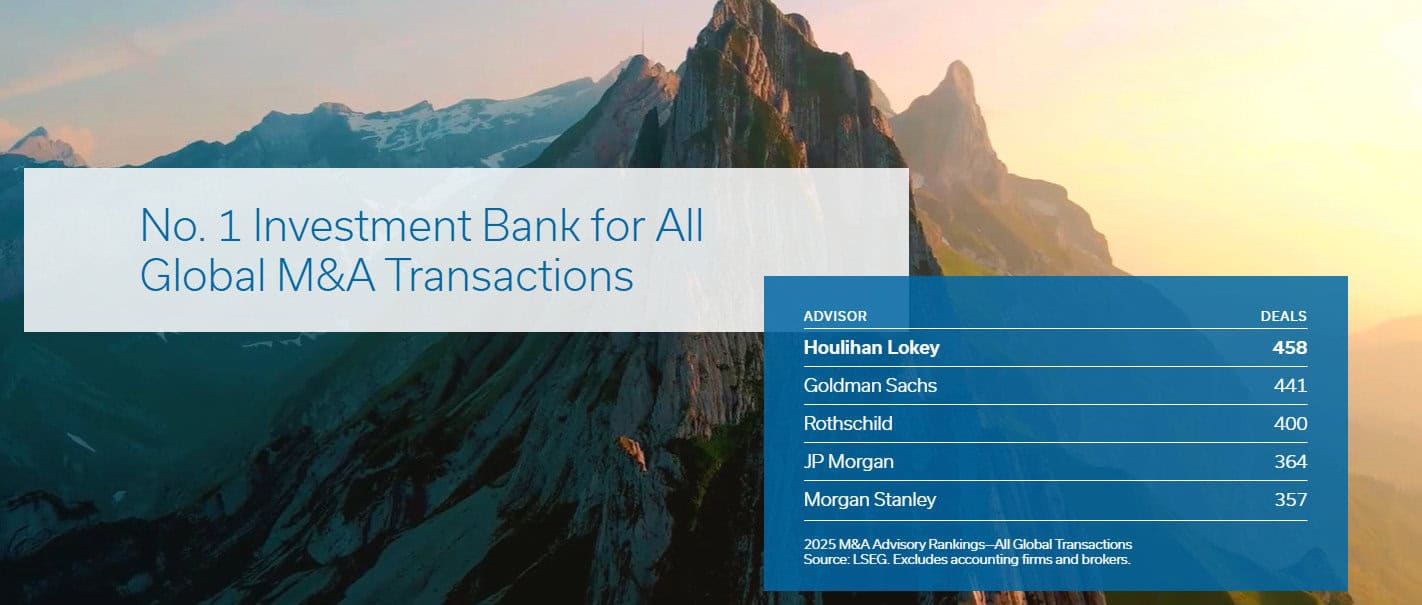
Houlihan Lokey is one of the largest global M&A advisory firms focused on the middle market, with offices across North America, Europe, and Asia. The firm is particularly well known for its expertise in complex transactions, including cross-border deals, restructurings, and industry-specific advisory work.
Its client base typically includes mid- to large-cap companies, private equity firms, and institutional investors seeking deals ranging from tens of millions to several billion dollars.
Lincoln International

Lincoln International is a global investment banking advisory firm that specializes in middle-market M&A transactions, capital advisory, and valuation services. The firm works closely with private equity sponsors, founder-owned businesses, and large corporates across sectors such as technology, healthcare, industrials, and consumer products.
With offices in major financial centers worldwide, Lincoln International is known for running competitive auction processes designed to attract both strategic and financial buyers. Its transactions often fall in the $50 million to $1 billion range.
Oaklins

Oaklins is a global network of independent M&A advisory firms that collaborate across more than 40 countries to execute cross-border deals.
Unlike many centralized investment banks, Oaklins operates through local partner firms that combine regional market expertise with access to an international buyer network. The firm focuses primarily on mid-market transactions and has strong sector specialization across industries such as technology, manufacturing, healthcare, and consumer goods. This structure allows Oaklins to help privately owned companies connect with international strategic buyers and private equity investors that might otherwise be difficult to reach.
Which Route Is Right for You?

A good decision framework is to start with a seller profile rather than a firm label.
If your business is likely to trade as a Main Street deal (up to around $2m enterprise value), you are often in business broker territory. This segment is dominated by individual buyers, and it commonly includes businesses like personal services and restaurants. The primary value a broker provides in these cases is running a structured but pragmatic process: packaging the business, maintaining confidentiality, screening buyers, and keeping the transaction moving while you keep on top of the day-to-day of your company.
If your business is in the lower middle market ($2m–$50m enterprise value), the choice is more situational. This range includes both individual buyers and institutional buyers (including private equity firms), and it is also where valuation conventions shift from SDE to EBITDA. The more institutional your buyer universe is, the more you’ll benefit from an M&A-advisor style process: a tight narrative, professional sale materials (often a CIM), and targeted outreach designed to create competitive tension will all be of major benefit to you here.
If you have a digital business (SaaS, e-commerce, Amazon FBA, content/media), consider specialist online brokerages, such as Quiet Light. These companies often require specialist due diligence (traffic attribution, platform risk, cohort/retention metrics, ad account stability, seller dependency, and operational transferability).
Whatever level your business is at, the most important thing is to pick an intermediary you can trust.