


Last Updated on February 20, 2026 by Ewen Finser
FTC Disclaimer: We do make money from this blog and may receive compensation for this work in the form of commissions, fees and complimentary product access. Review our full FTC disclosure here.
When most people think about cutting shipping costs, they think about cheaper labels.
That’s part of it. But in practice, the biggest savings usually come from removing inefficiencies in your business such as bad carrier choices, manual human mistakes, slow workflows, and lack of visibility.
A shipping API helps with all of that.
Instead of someone manually choosing shipping options for every order, your systems make those decisions automatically, every single time. That consistency is where you find real savings. Plus, you keep your customers happy.
In this article, I’ll break down the four main ways a shipping API reduces costs in the real world, using my favorite API, Shippo, as the main example, since it’s one of the few tools that balances API power with day-to-day usability.
Who Is a Shipping API Best For (vs a Web-Based Shipping Platform)?

A web app and a shipping API solve slightly different problems and are aimed at slightly different people or team members.
The web app helps people ship and manage orders.
The API helps your systems ship and manage orders.
A Web App Is Best If:
- You’re shipping low to moderate volume, for example 50-3000 orders per month in one person teams, or less than 10,000 orders per month if you have an operations team
- Shipping decisions, such as packaging sizes, are simple and don’t change often
- You’re happy sometimes manually choosing carriers and services
- Occasional mistakes don’t have a big financial impact
- You mainly ship products from marketplaces like Amazon or pre-built systems like Shopify or WooCommerce
A Shipping API Is Best If:
- You’re shipping hundreds or thousands of orders per month
- You have a custom built ecommerce system, with custom back end and multiple integrations
- Multiple people are touching fulfilment, e.g., multiple warehouses, brick and mortar stores, ops teams, finance team
- You want every order shipped the same way, every time (regardless of where it is currently stored)
- Manual checks and “quick decisions” are eating time, e.g., human sign off on larger packages
- Re-ships, corrections, or customs errors are costing money, more often
- You want to scale shipping without scaling headcount
With an API, shipping stops being something your team decides and it becomes something your systems carry out. Web apps have automations too, but an API takes all the decision making away from humans and integrates directly into complex ecommerce systems.
TL:DR How Does a Shipping API Save You Money?
Using a shipping API (like the one from Shippo) saves money by:
- Automatically choosing the cheapest valid shipping option for every order
- Reducing manual labour by removing repetitive shipping decisions
- Preventing costly mistakes like wrong services, bad addresses, or missing customs forms
- Making shipping rules consistent, even as order volume grows
- Cutting re-ships, refunds, and support tickets caused by fulfilment errors
- Letting you scale fulfilment without adding headcount
- Giving visibility into shipping costs so you can optimize over time
The biggest savings usually don’t come from cheaper labels, they come from fewer mistakes and less manual work, at scale.
Now you understand when you might need, or not need, a shipping API, let’s look in a bit more detail at how they can reduce shipping cost.
- Choosing the Cheapest Shipping Option Automatically
One of the biggest ways a shipping API reduces costs is by removing guesswork from carrier selection.
Instead of someone manually comparing options (or defaulting to whatever they used last time), a shipping API checks available services for every single shipment, automatically.
In general, this means:
- Multiple carriers are compared in real time
- Only services that meet your delivery rules are considered
- The lowest-cost valid option can be selected automatically
Using a tool like Shippo as an example, the API can compare rates from major carriers like USPS, UPS, FedEx, DHL, and regional providers, then apply your predefined rules before choosing a service.
This avoids very common forms of overpaying, such as:
- Paying for Priority when First Class would arrive in the same timeframe
- Using express services unnecessarily for nearby zones
- Defaulting to a single carrier even when another is cheaper for that destination
When this is implemented properly, the savings don’t usually come from one dramatic change. They come from small, consistent improvements applied to every order, which adds up quickly once you’re shipping at scale.
With a web app, while there are automations which take the decisions away from a person, someone often has to remember to compare rates. Whereas with an API, the comparison happens automatically on every shipment.
- Introducing More Automation (Less Manual Work = Lower Operational Cost)

Labour is one of the most expensive parts of shipping, even if it doesn’t show up neatly as a “shipping cost” line item.
A shipping API reduces costs by removing human decision-making from repetitive shipping tasks.
The rules you set for the automations are often very similar to the rules you see in the web app.
For example, with Shippo’s web app, this usually looks like simple IF / THEN logic applied automatically:
- IF weight < 2 lb THEN use USPS First Class
- IF destination is international THEN use DHL Express
- IF SKU is fragile THEN force a specific carrier or service
- IF order value > X THEN add signature confirmation
However, with an API, the automations are coded in by a developer, and you have full control over automations, rather than being restricted by what automations a web app offers.
Once these rules are set, the API applies them instantly when an order is created.
That saves money by:
- Reducing time spent per order
- Making it easier to delegate fulfilment to junior staff
- Avoiding delays caused by people double-checking decisions
- Preventing expensive “fix it later” shipping changes
- Giving you full control over automations
This is where shipping APIs start to quite quickly outperform web apps.
- Reducing Errors (Mistakes Are Expensive)
Shipping mistakes cost more than people expect.
Wrong service. Wrong carrier. Missing customs forms. Incorrect address formatting. Each one creates knock-on costs:
- Re-shipping orders
- Paying surcharges or correction fees
- Customer support time
- Refunds or replacements
- Lost customer trust
- Wasted inventory
A shipping API reduces these costs by enforcing rules automatically.
With Shippo’s API and automation setup:
- Addresses are validated before labels are created
- Customs forms are generated automatically for international orders
- HS codes and shipment details are reused consistently
- The same order can always ship the same way
Mistakes won’t go away entirely, but the human element of mistakes can be reduced drastically.
Without automation, more orders usually means more errors. With a shipping API, higher volume doesn’t automatically mean higher risk.
- Improving Analytics
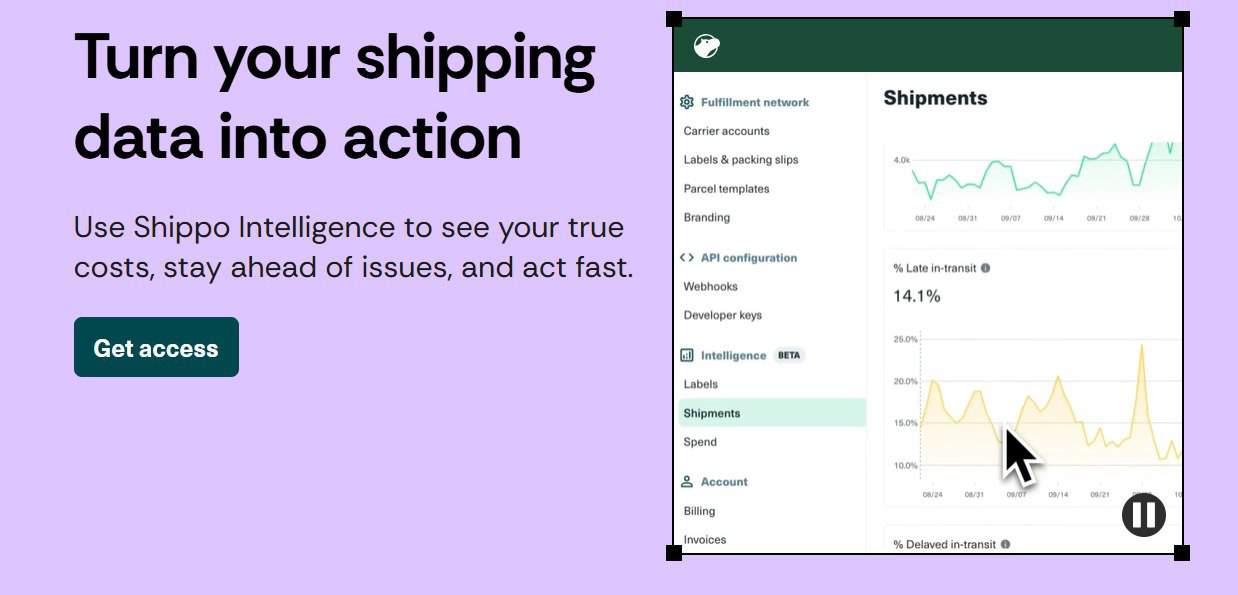
Shipping analytics help you understand where things are going well, or not so well! Shipping web apps often give great analytics, but they are limited by the functionality of their platform.
A shipping API gives you actual shipping data, directly from the system.
Instead of guessing, you can see:
- Average shipping cost per order
- Which carriers are costing you the most
- How often you’re using premium shipping services
- Cost differences by destination, weight, or product type
- Performance by product, destination, warehouse
Once you know where you are performing well and where things can be improved, you can make smart business decisions, like adjusting automations, moving stock location, repricing items, negotiating better rates, and finding better services.
Shipping costs rarely drop because of one big decision. They drop because you make lots of small adjustments over time.
Real-World Cost Examples: API vs. Web Apps
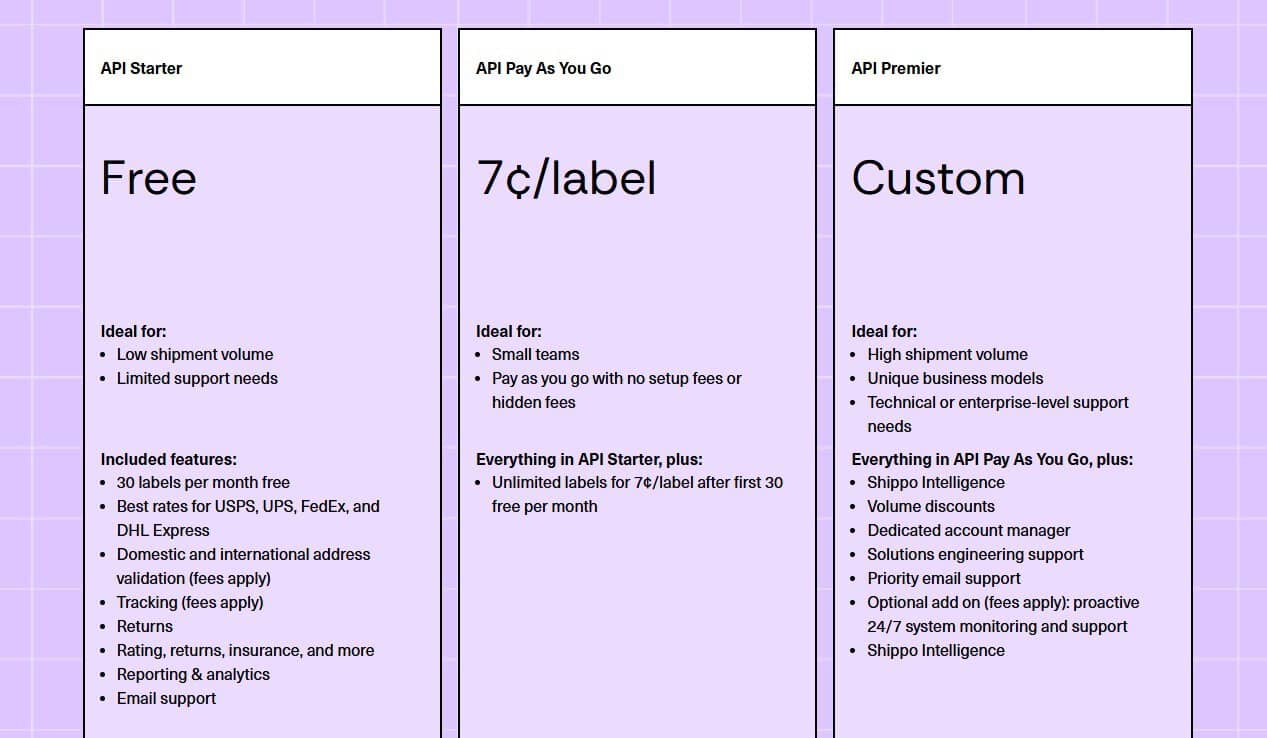
Let’s walk through a few realistic scenarios, using Shippo’s API as an example. Shippo’s API pricing is usage-based, so costs scale directly with volume and complexity, whereas the web app has set pricing per month.
API costs:
- Labels: $0.07 per label (first 30 free)
- Tracking updates: $0.02 per tracking event
- Rate generation: $0.01 per rate request
- Address validation:
- US: $0.02
- Non-US: $0.08
- Insurance: percentage of declared value + shipping (optional)
Example 1: Small Brand (200 Orders / Month)
Web App Workflow
- Plan: $17/month (up to 200 labels)
- Fulfilment: manual decisions + light automation
- Time per order: ~2 minutes
Roughly:
- 200 × 2 minutes ≈ 6.5 hours/month
- Labour at $20/hour ≈ $130
Total operational cost:
$17 software + $130 labour = $147/month
API Workflow
- Labels: ~170 billable × $0.07 ≈ $12
- Tracking + rate checks + address validation (light use): ≈ $10–15
- Total API usage: ≈ $25–30/month
- Reduced handling time: ~30 seconds per order
- Labour ≈ $34
Total operational cost:
~$30 API + $34 labour = ~$64/month
Is the API worth it here?
Probably not.
At ~200 orders/month, most teams don’t have complex workflows or custom systems yet. You’ll also likely need some developer setup to use the API properly, which quickly outweighs the savings. For this stage, the web app is cheaper, much simpler, and lower risk.
Example 2: Growing Brand (2,000 Orders / Month)
Web Workflow
- $71/month plan
- Multiple people shipping
- Manual checks to avoid mistakes
Conservatively:
- 2,000 × 1.5 minutes = 50 hours/month
- Labour ≈ $1,000
Total:
$71 software + $1,000 labour = $1,071/month
API Workflow
Approximate API usage:
- Labels: 2,000 × $0.07 = $140
- Tracking: ≈ $40
- Rates + address validation: ≈ $30–50
- Total API usage: ≈ $210–230/month
Reduced handling time:
- ~30 seconds/order = 16.5 hours
- Labour ≈ $330
Total:
~$225 API + $330 labour = ~$555/month
Savings: ~$460/month
Annual impact: ~$5,500+
Is the API worth it here?
Maybe, if you’re noticing a lot of shipping mistakes, or costs are getting out of hand.
At this level, you’re at a tipping point. There are cost savings with the API here, but you need to factor in dev costs. If you don’t have a custom system, I would say that at this level you should still remain with the web app. There is less chance of a big mistake happening, as all the automations are set within Shippo itself, rather than a developer.
Example 3: High-Volume Brand (10,000 Orders / Month)
At this level, shipping is no longer a task, it is the major moving part of your business.
Web Workflow
Even with good staff:
- 1 minute per order = 167 hours/month
- Labour ≈ $3,300+
- Plus re-ships, support tickets, and corrections
- Monthly software cost $179
Real-world cost often ends up north of $4,000/month.
API Workflow
Approximate API usage:
- Labels: 10,000 × $0.07 = $700
- Tracking events: ≈ $200
- Rates + address validation: ≈ $150–200
- Total API usage: ≈ $1,050–1,100/month
Handling time:
- ~10–15 seconds/order
- ~40 hours/month
- Labour ≈ $800
Total:
~$1,100 API + $800 labour = ~$1,900/month
Savings: $2,000+ per month
Annual impact: $24,000+
Is the API worth it here?
Usually, yes.
At this scale, consistency matters more than simplicity. APIs reduce mistakes, make costs predictable, and let you scale without constantly hiring fulfillment staff. Plus the savings here are often the same as a salary for a new hire, meaning you can pay your team more, build more efficient warehouse machinery or hire a new person.
Why Shipping APIs Make More Sense as You Scale
The main thing to remember is the API doesn’t replace the web app. With the API, you still get access to the web tool and the ops team can sometimes make changes without the need for a developer. However, it reduces human error and speeds up decision making.
Once rules live in the API:
- The cheapest valid service is always chosen
- International shipments always include the right paperwork
- Staff don’t need shipping knowledge
- Mistakes don’t scale with volume
The main question to answer isn’t, “Why is a shipping API cheaper?” The question you should be asking is “How can a shipping API save me money, reduce errors, and be more scalable?”
For low volume, the web app is absolutely fine, in fact I would recommend it for most businesses. For growing brands, the API can become one of your highest-ROI tools.
Wrap up
A shipping API doesn’t magically unlock cheaper postage. What it does is remove inefficiency at scale.
If you’re shipping enough volume that mistakes, manual work, or inconsistent decisions are costing real money, then a shipping API is one of the most reliable ways to bring those costs down. By making shipping boring, consistent, and automatic.