


Last Updated on February 16, 2026 by Ewen Finser
Personally, I feel that searching for fractional marketing agencies has reached a point where it’s become confusing and harder than it should be. Most teams currently aren’t really debating whether marketing matters, they are aware it does. In most cases, they’re debating how to staff without over hiring, burning budget, or ending up locked into another agency relationship that looks good on a deck but under delivers in reality.
I will say, fractional marketing has matured a lot over the last few years. I feel like it’s no longer a scrappy workaround for a stopgap between hires. For many companies, especially the mid stage and scaling teams, it’s becoming the default way to access senior expertise without committing to permanent headcount too early.
That said, not all fractional marketing agencies are built the same. It may or may not be shocking to know that some are essentially staffing firms with a marketing label. Some are agencies trying to sound flexible. Others are genuinely designed to integrate with modern marketing orgs.
Why Look for a Fractional Marketing Agency?
A lot of companies end up here after realizing the old options don’t fit anymore. Full-time hires feel risky when priorities are changing. Agencies feel expensive and inflexible. Freelancers feel hit or miss.
Fractional talent sits in the middle, but it only works when the structure is right. The appeal isn’t just cost savings, it’s access. Access to people who’ve already done the job, already seen the mistakes, and don’t need months to ramp up.
What’s changed over the last few years is that senior marketers are more open to fractional work, and companies are more comfortable designing teams that aren’t built entirely around permanent headcount. That’s why the quality gap between platforms matters so much. The difference between a senior fractional operator and a junior contractor labeled as “fractional” is night and day.
The Top Fractional Marketing Agencies in 2026
Here are some of the strongest fractional agencies going into 2026, including who they work best for, where they shine, and where they can fall short.
Right Side Up
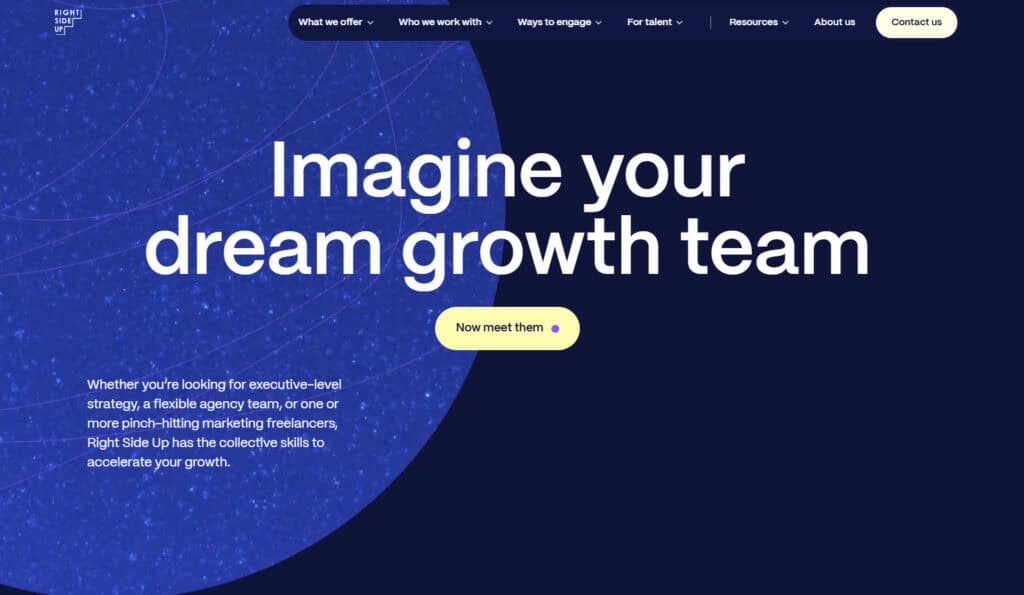
Best for teams that need senior marketers who can plug fast and operate with autonomy.
Right side up has become one of the most recognizable names in fractional marketing, and that’s largely because they didn’t try to reinvent themselves as an “agency.” Their core promise is simple (and actually refreshing, in my opinion). Strong marketing orgs are built around great full-time leaders, supported by the right mix of fractional talent and agency execution. RSU works best when a company already has some understanding around what they’re trying to accomplish but needs experienced marketers to help execute, scale, or stabilize specific functions.
Their talent pool skews senior. These are people who have already done the work inside high-growth companies and don’t need to be taught how to operate in complex environments. One of the biggest advantages of Right Side Up is speed. They are known for matching talent in days, not months. That matters when a channel is underperforming, a key hire falls through, or an internal leader goes on leave.
They also offer real flexibility. Contracts are not designed to trap you, hours can scale up or down, and teams can evolve as needs change. However, where RSU may not be the right fit is for very early stage teams that need a lot of foundational hand holding. If you don’t yet have internal marketing leadership or understanding around ownership, then senior fractional talent can feel expensive or underutilized. RSU assumes you want experienced operators, not generalist learning on the job.
Pros:
- Strong Senior Level Talent
- Fast deployment and matching
- Flexible engagement models
- Feels like an extension of in house teams
Cons:
- Higher cost than execution focused agencies
- Not ideal for pre product or very early stage startups
- Less focused on junior or purely tactic roles
Chief Outsiders

Best for companies looking specifically for Fractional CMOs.
Chief Outsiders has carved out a very specific niche. They focused on providing fractional CMOs, often for mid market companies that need strategic leadership without committing to a fulltime executive. If your primary gap is top-level marketing strategy, positioning, or leadership alignment, Chief Outsiders can be a strong option. Their CMOs tend to have deep experience and are often brought in during periods of transition, growth, or restructuring.
Where the model can feel limiting is execution. Chief Outsiders is not designed to provide full stack marketing support. You’re typically hiring a senior leader, not a team. That means you’ll still need internal resources or external partners to actually carry out the strategy. This works well for companies that already have execution capacity but lack strategic direction. It’s less effective if you’re hoping one fractional leader will magically fix systematic execution issues.
Pros:
- Experienced senior marketing leadership
- Strong for the strategy, positioning, and org alignment
- Clear focus on executive level impact
Cons
- Limited execution support
- Can feel expensive if execution gaps remain
- Less flexible if needs shift beyond leadership
Growth Collective
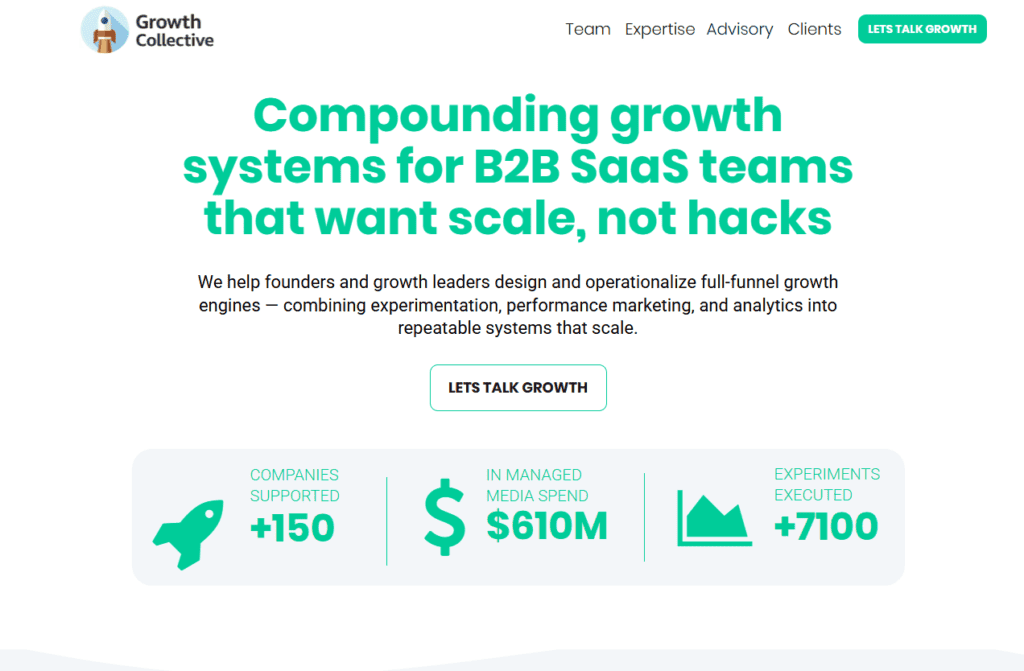
This one is best for startups and growth stage companies needing flexible specialists.
Growth Collective operates more like a curated freelancer network with an emphasis on growth marketing roles. It can be a good option for companies that want access to specialists across channels like paid media, CRO, and analytics without hiring full time. The strength of Growth Collective is variety. You can find specialists across many disciplines, and the barrier to entry is lower than premium platforms. For teams with strong internal leadership who can manage contractors effectively, this can work well.
The downside is consistency. Seniority and quality can vary depending on who you’re matched with. You’ll often need to be more involved in onboarding, managing, and quality control with more tightly curated platforms.
Pros
- Broad range of growth specialist
- More accessible pricing
- Good for teams comfortable managing contractors
Cons
- Inconsistent seniority levels
- Requires more hands on management
- Less strategic oversight baked in
Toptal Marketing
Best for companies with budget flexibility and very specific needs.
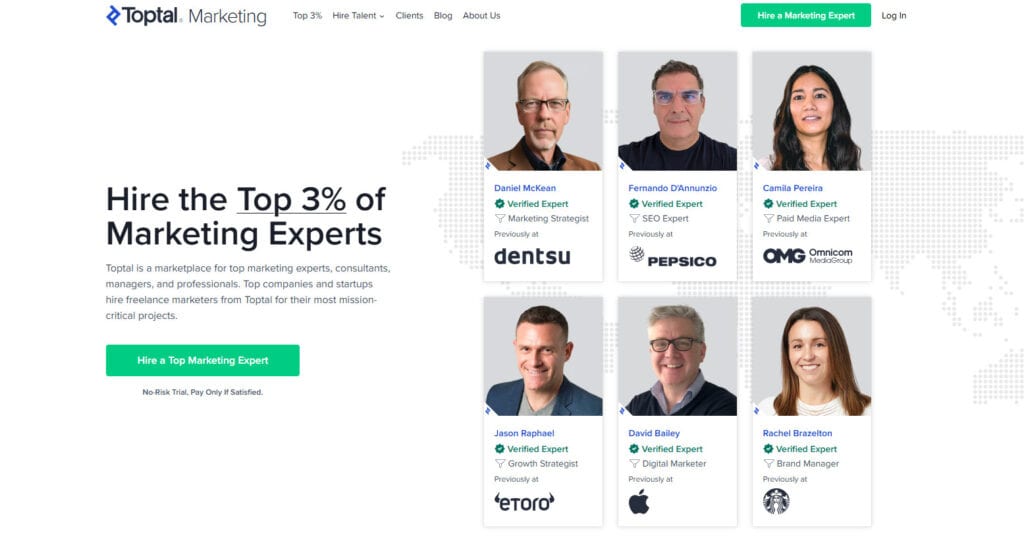
Toptal is often associated with engineering talent, but they do offer marketing professionals as well. Their brand is built around elite vetting and premium pricing. In theory, this ensures quality. In practice, the experience can vary depending on role and match. Toptal tends to work best when you have a very specific, high stakes need and are willing to pay for access to a tightly controlled talent pool. The tradeoff is flexibility. Engagements can feel rigid, and cost can add up quickly. For companies experimenting with channels or needing adaptive support, this can feel restrictive.
Pros
- Strong vetting process
- Access to high caliber talent
- Good for clearly defined, critical roles
Cons
- High cost
- Less flexible engagement structure
- Marketing talent depth can be uneven
Cleverly Positioned Fractional Agencies to Watch
Beyond the large players, there’s also a growing wave of boutique fractional agencies focused on specific niches, like B2B demand gen, SaaS lifecycle, or ecommerce performance. These can be excellent fits if your needs align tightly with your expertise.The key with boutique firms is diligence. Ask who is actually doing the work, how senior they are, and how flexible the engagement really is. Some are genuinely fractional, others are agencies using the label.
So How Do You Actually Choose the Right Fractional Marketing Agency in 2026?
The biggest mistake companies make is choosing a fractional agency based on brand reputation alone. The right choice depends less on who is “top rated” and more on how your organization actually functions.
Ask yourself a few honest questions:
- Do we need a strategy, execution, or both?
- Do we have internal leadership capable of managing senior external talent?
- How clear are our goals and ownership today?
- Do we need speed and flexibility, or long term stability?
If you need senior marketers who can integrate quickly, operate independently, and flex with your needs, Right Side Up continues to stand out as one of the strongest options in 2026. Their model is built for modern marketing teams that value quality, honesty and adaptability over rigid agency structures. If your primary gap is executive leadership, a fractional CMO firm like Chief Outsiders may make more sense. If you need specialists and are comfortable managing them closely, curated networks like Growth Collective can work. And if budget is secondary to pedigree platforms like Toptal may fit specific use cases.
One thing that trips people up with fractional talent is expectation mismatch. Fractional doesn’t mean part time employee with full time availability. It also doesn’t mean plug and play magic.
The best fractional marketers are opinionated, efficient, and focused. They’re not there to fill time or attend every meeting. They’re there to own a slice of the work and move it forward. When teams expect constant availability or unlimited scope, frustration builds fast on both sides.
On the flip side, some companies underutilize fractional talent. They hire someone senior, then only hand off tactical tasks or wait weeks between decisions. At that point, you’re paying for experience you’re not actually using.
The fractional marketing agencies that work best tend to help set these expectations upfront, both with the client and the talent. That framing alone can make or break the engagement.
If you’re debating whether fractional talent makes sense, the question isn’t “can this person do the work,” it’s “are we ready to work this way.”
Fractional talent works best when you need speed, specialization, or temporary coverage. It works poorly when you’re hoping to outsource decision making or avoid hard internal conversations.
In my experience, fractional marketing is not a shortcut. It’s a tool. When used thoughtfully, it can unlock speed, expertise and flexibility that full-time hiring alone often cannot. When used poorly, it can create just as much friction as it solves. I think the best agencies understand that distinction, the rest just sell the idea.