


- 1. BlueCotton – Best for Quality Control + Real Human Support
- 2. Printful – Best for Easy Automation
- 3. Gelato – Best for Global Fulfillment
- 4. ShipMonk - Best for Scaling Brands Without Order Minimums
- 5. ShipBob – Best for Established Brands Scaling Inventory
- Merch Fulfillment at a Glance
- Who Should Choose What?
Last Updated on March 12, 2026 by Ewen Finser
Whether you’re just starting a merch line, or you’ve been running one for some time, chances are you already know that the company you choose can either become a dream collaboration or a long nightmare. If you’re still struggling to figure out who to partner with, here’s a list of merch fulfillment companies who know what they’re doing…
But First: What Actually Matters in Merch Fulfillment?
Your merch is a reflection of your brand, so naturally, you want it to be high-quality just as much as you want customers to feel at ease ordering it. This means that, when you’re trying to choose a fulfillment company, you want to keep a few things in mind:
• Print quality consistency – Not just how well the work is done, but also how much control the company has over product quality. Is the work done in-house, or using third-party vendors?
• Shipping speed and reliability – Will you get your order on time, every time?
• Customer service – Who’s going to be there when things go wrong? How hard is it to fix problems with your order?
• Upfront costs vs. true long-term margins – Do you need stock, and how much does that stock cost you?
• Customization options – How much freedom do you have when it comes to design?
• Scalability and repeatability – What if you need big orders? What if you need regular orders?
While it’s definitely important for you to think about upfront costs, I recommend finding the place where “achievable price” and “best quality” intersect, as this is how you’re going to ensure that your brand is represented by the best-looking merchandise possible.
With that in mind, let’s take a look at a few companies who can help you get your name out there.
1. BlueCotton – Best for Quality Control + Real Human Support

Pros
BlueCotton is widely trusted in the industry because of their “human first” philosophy. Their customer service is always human, and the department is based in the same building as production, which means they are able to answer fulfillment questions quickly. In my own experience, they treat you as if they’re happy to help regardless of the size of the order or the number of questions, and that can make the difference between an easy experience and a bad one.
The quality of work is maintained throughout the process, and they offer design assistance and reviews to ensure that everything comes out looking exactly how you’d like it to. They also boast a nine-point inspection process that is applied to every order that passes through their facility. Orders can be large or small, and the company is used to repeat orders, making them perfect for anyone who needs sizable merch orders filled correctly and easily. They guarantee their delivery dates, so you’ll always know when to expect your order’s arrival.
Cons
BlueCotton is mainly focused on high-quality printing and embroidery, so they’re best for companies who want to handle their own shipping and logistics. Their catalogue, while sufficient for most cases, isn’t the largest when it comes to non-apparel products, so if you need signs or swag beyond the usual pens and drinkware, you might not find it here.
There is also a downside to that all-human customer service: they have to run human hours. So if you need help with your order at night or on weekends, you’ll have to wait until someone is in the office to help you.
2. Printful – Best for Easy Automation

Pros
Printful is one of the biggest names out there for people who need a print-on-demand option for their merch. Not only does Printful integrate easily with online storefronts like Shopify, Etsy, and Woocommerce, but it’s easily run, almost to the point of being a “set-it-and-forget-it” operation.
Printful is often the choice for influencers and content creators specifically because it doesn’t require housing inventory. Customers make their order, and Printful handles everything from fulfillment of the order to shipping it. The shop owner themselves has to do very little, if anything at all.
Printful also has a massive catalog to choose from; on their own website they invite you to choose from almost 500 different items to design and sell. Just about any order can be completed, as Printful and Printify merged in 2024 and now have Printful’s five locations and Printify’s 85 third-party vendors to get the job done.
Cons:
Printful is largely made for those who want easy, online merchandise management, and so customer support isn’t going to be anywhere near as specialized. It’s largely ticket-based, and they do not offer any assistance with design.
Speaking of design, branding choices are extremely limited when it comes to packaging. You can add packing slips and some custom labels, but otherwise, you don’t get to put your name on much.
It should also be noted that the cost per-item generally tends to be higher than others in the industry, which can affect margins if the customer isn’t careful.
3. Gelato – Best for Global Fulfillment
Pros
Gelato is print-on-demand for anyone who is expecting international orders.
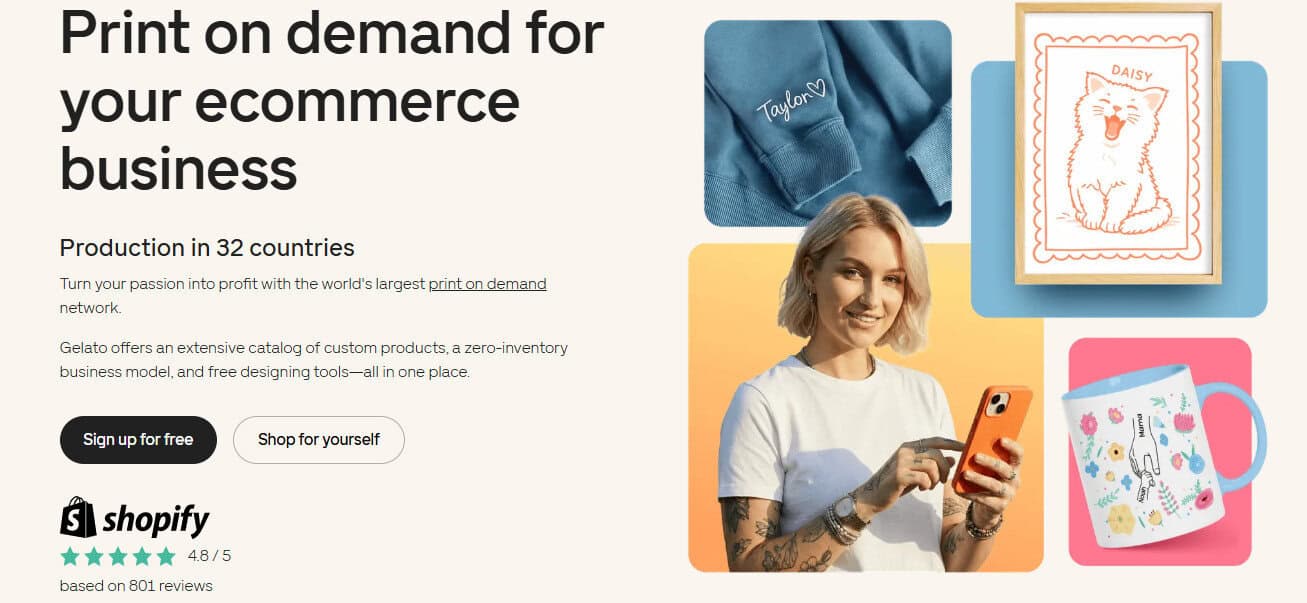
While the other companies on this list can help with international orders if asked, Gelato specifically prides themselves on maintaining a strong, 32-country network of fulfillment partners who can handle orders just about anywhere in the world. They also integrate beautifully with all of the usual online storefronts, which makes them perfect for anyone who needs to serve customers across the globe.
Gelato’s catalog is very large, and they don’t mandate a minimum order, which also makes this the perfect company for anyone who wants to test out a new design or product type without trapping themselves into purchasing inventory.
Cons
The biggest problem with using Gelato is the lack of direct quality control. As they use a wide network of third-party vendors, there isn’t as much of a close eye kept on the final product. This is also why delivery dates can’t be guaranteed.
Should something go wrong, much like Printful, customer service is largely ticket-based. It is possible to speak to the support team via chat 24/7, but the entire process can feel impersonal either way.
4. ShipMonk – Best for Scaling Brands Without Order Minimums
Pros
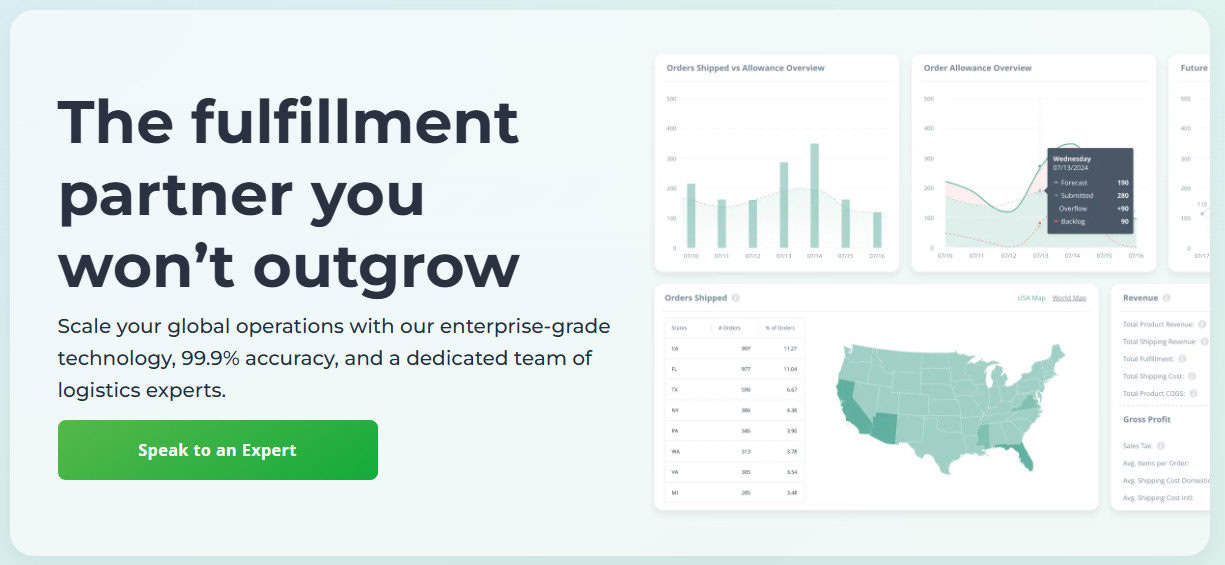
If you already have the merch but don’t want to deal with logistics, then you’re looking for a 3PL (third-party logistics provider). If you haven’t heard the term before, a 3PL is a company who handles storage, shipping, and logistics for products that are already made, making them the ideal choice for anyone who already has their fabrication down, but needs help getting the products out to the customers.
ShipMonk is a solid choice, but especially for anyone who’s thinking of scaling their business.
ShipMonk’s warehouses will handle storage, picking, packing, and shipping of all orders, regardless of size. There are no minimums, which means that, even if you’re just starting to sell merch, you can still use their services. They integrate with e-commerce platforms like eBay, Shopify, and WooCommerce.
You’ll also find a number of capabilities through ShipMonk that you often won’t find elsewhere. They offer solutions for the fulfillment of subscription boxes and crowdfunding campaigns, as well as a number of apparel-specific capabilities like alterations and laser engraving. They also offer custom packaging options, so your merch can show up looking like your merch.
Despite the global reach, ShipMonk also prides itself on “mom and pop style” customer service, meaning you get a human when you call.
Cons
Despite the lack of a minimum order, ShipMonk is clearly focused on businesses that are already moving decent volume. Pricing is only communicated once you’ve requested a quote. They’re also primarily US-focused, so if you’re wanting global logistics, this won’t be the company for you.
ShipMonk does have a lower number of facilities than some of their competitors, which can make orders with rush ordering a challenge.
You also are unable to contact support in any way other than by phone call unless you already have an account with ShipMonk, so you’ll need to make do with their help articles if you have any passing questions.
5. ShipBob – Best for Established Brands Scaling Inventory
Pros
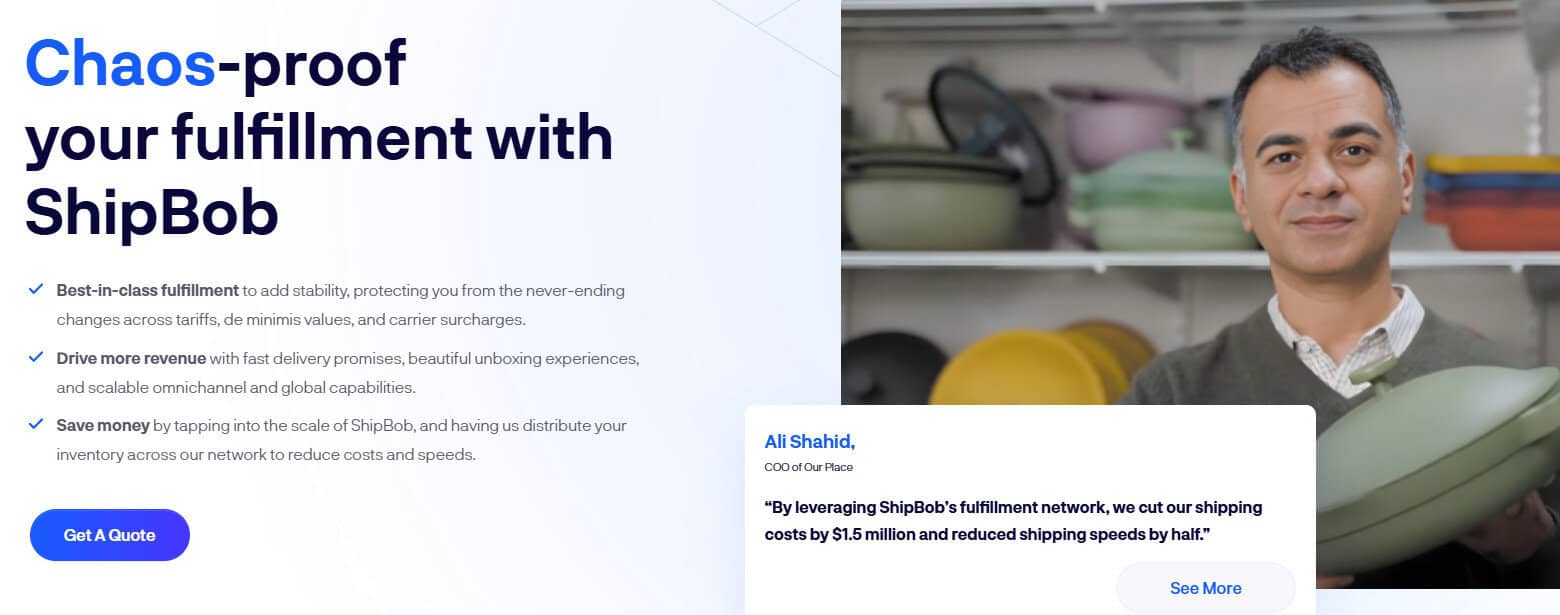
As another 3PL, ShipBob won’t make your merch, but they’ll ship it just about anywhere. They have over 70 fulfillment centers – more than 60 in the United States, and more than 10 across six countries – which means they can offer faster and cheaper shipping in most cases. In fact, they’re one of the few 3PL’s of its size to offer same-day processing on orders placed before noon.
There are over 75 different platforms to integrate ShipBob with, including the usual Shopify and WooCommerce, social media like TikTok, and even big box stores like WalMart. Users are often able to set things up and start selling in about 30 seconds. Once the orders are made, customers can customize their orders easily with everything from custom boxes to branded tracking pages.
ShipBob is ultimately for a company that is working on scaling their operations. They offer the usual customer-based logistics, but also deal in retail dropshipping and freight management, and you can easily find out how much everything will cost on their website.
ShipBob is one of the Best of the Best when it comes to merch logistics, so if you’re ready to move large orders globally, this is going to be the company for you.
Cons
If you’re not ready to move big orders, a pro very quickly becomes a con with ShipBob. Customers are required to move a minimum of 400 orders a month in the US and 1,000 order a month in Europe, plus a $275 per month minimum fulfillment fee and a $975 onboarding fee to even get started. If sales aren’t regular, this is going to be a non-starter.
Customer service is available only by submitting a ticket or by 24/7 chat, and the lack of personal attention leaves some customers to feel as if it’s hard to get ahold of anyone for help.
While the storage can be a blessing when product is moving, things can get difficult when it isn’t: ShipBob charges high storage costs for large inventory, and stock that isn’t moving. This can be a real thorn in your side if you sell seasonal merch.
Merch Fulfillment at a Glance
BlueCotton | Printful | Gelato | ShipMonk | ShipBob | |
Printing? | ✅ | ✅ | ✅ | 🆇 | 🆇 |
Shipping? | ✅ | 🆇 | 🆇 | ✅ | ✅ |
Need to hold Inventory? | 🆇 | 🆇 | 🆇 | ✅ | ✅ |
E-Commerce Integration? | 🆇 | ✅ | ✅ | ✅ | ✅ |
Customer Service | Chat, email, phone | Chat, contact form | Chat, contact form | Phone, Contact Form (without account) | Chat, contact form |
Scalability | 50,000 sq ft facility that easily handles large and repeat orders | 5 locations, 85 3rd party vendors, can handle large orders | 32-country network, handles international orders | No shipment minimum; mainly US based | Can ship internationally, handles large orders and freight |
Who Should Choose What?

If you’re still unsure of which company makes the most sense for you, let’s simplify it further.
I’d suggest either Printful or Gelato for brand-new creators, or anyone who needs to test a new design before full release. If you’re looking for hands-on quality control and support, look no further than BlueCotton. If your brand already has the product but needs help shipping out a larger volume per month, you’ll want to work with a 3PL like ShipBob or ShipMonk. If your merch is needed to outfit or service a large event or a corporation, BlueCotton is the best choice for that as well.
Above all, make sure that you choose the company that ensures that your merchandise reflects the quality of your brand. Even if the upfront price is low, the cost of a bad product is always higher than any good business can afford.