


- Why Clear, Transparent Messaging Matters
- Factors That Drive Price Increases
- Price Increase, Strategic Planning, and Internal Alignment
- Price Increase Communication Best Practices
- Creating Effective Price Increase Communications
- How to Choose the Best Tools and Channels for Your Pricing Change Announcements
- Managing Customer Feedback & Measuring Impact
- My Closing Thoughts on Communication Around Pricing Increases
Last Updated on January 23, 2026 by Ewen Finser
Pricing increases are an inevitability. In order to maintain product or service innovation and quality, pricing adjustments will need to take place. Although this can be daunting to initiate, especially if you’ve not had to increase pricing before, there are best practices you can follow to make this a less uncomfortable process for customers or users.
If you’ve ever had an experience where you’ve suddenly been charged a higher amount for a service or product than you’re used to, you know it can be frustrating and confusing and lead to an instant feeling of mistrust. This is the exact reason why organizations should follow clear steps to avoid negative customer experiences.
Without clear communications and setting expectations, businesses can expect adverse consequences such as customer churn, backlash, sudden queries, and potentially reputational damage. The best way to avoid this is by making use of tools or technology that help create clear, structured communications that are distributed in a way that ensures the right updates are reaching the right people.
I personally make use of purpose-built platforms to handle all communications as a way to ensure that I send out professional, clear announcements. They also give me additional functionality to understand how customers have engaged with these updates.
I’ll break down how to do this and some of the best practices to follow in this step-by-step guide to help you navigate this tricky process.
Why Clear, Transparent Messaging Matters

Let’s dive into some key areas you should consider and why they matter. Understanding the context will help drive strategic decisions on how communications should look and how they should be executed.
- Customer experience: The customer experience and perception should be considered first. Pricing adjustments can be challenging to accept, and for some customers, this can be a negative experience that can be met with some resistance. Ensuring this process is positive will lead to an overall better experience and customer perception of the organization.
- Reputation: Businesses should quantify the impact of not communicating changes effectively and should avoid any reason that may lead to reputational damage.
- Operational impact: When sudden changes occur without notice, customers are likely to call, email, or lodge large numbers of complaints or queries that can burden teams. With a clear, early communication plan, customers are less likely to reach out with questions or escalations, and therefore, will have a higher probability of retention.
With a centralized location for questions, information, or FAQs, customers can be pointed to the relevant resources or notices easily. Additional centralized resources also help take pressure off internal teams to create disparate messaging or ad hoc communications.
Factors That Drive Price Increases

Pricing increases are inevitable for any business to thrive and stay ahead of the curve. As a new business or individual that has not had to increase pricing before, consider planning ahead for this. Here are some common considerations to increase pricing or plan a price increase in the future.
- Competitor or market shifts:
Every year, we see new tech, services, or products, and in a world where everyone wants the “latest,” businesses should plan to stay ahead of the times. The process of maintaining market shifts can be costly and is likely to result in pricing adjustments annually. - Product enhancement or service offerings:
Innovation or product shifts can be costly as product or raw material prices increase globally. They may also require additional resources such as research and development. These can all lead to additional expenditure to stay ahead. - Increased operational costs:
Most businesses already know that salaries account for one of the highest (if not the highest) overheads. With annual increases and overall running cost increases, organizations will need to factor in pricing adjustments to avoid running at a loss. - Support, security, and compliance factors:
As times shift, a stronger focus on overall compliance, security, and support must be maintained. This can range from needing to acquire premium support features, running annual security and compliance audits, and upskilling teams to maintain a certain level of certification standards.
These are just a few of the more common reasons why costs can increase annually. This context is important to consider and outline, as this will drive your messaging and communication framework later on in this guide.
Price Increase, Strategic Planning, and Internal Alignment

With any significant adjustment, businesses need to first align internally before making sudden changes. The price increase strategy is an essential factor and needs to be carefully planned and executed with internal buy-in to ensure success.
Here are some high-level areas that should be covered during internal discussions and alignment at this phase.
- Clearly define what is changing and when: Internal teams will need to assess which areas, services, or products will be affected. Everyone should understand the precise pricing tables or tiers should, and you should also outline which users, segments, or customers may be affected. The timelines for changes need to be defined, and at this stage, should involve a high-level plan for when notices around pricing changes should go out.
- Outline the communication plan: Although this can seem overwhelming, it is one of the best drivers to ensure successful pricing increases. Customers should understand what changes will happen and how they will benefit from this. It’s critical to ensure that the messaging helps show that this is not only an essential step, but that this will also deliver more value to them.
- Team alignment and ownership: Internal departments need to be identified, and clear owners of relevant activities should be assigned. Most organizations should involve key stakeholders from support, sales, marketing, finance, and product teams to ensure that all business areas are covered and internally aligned with the business goals.
- Create the full communication strategy and execution plan:
At this stage, the initial plan needs to be fleshed out and additional execution strategies put in place, including:
- Communication channels identified: Clearly define the channels that will be used to distribute notifications. Consider if email only will be sufficient or if you will require additional methods such as website updates, in-app notifications, help site creation, FAQs sections, or announcement pages.
- Timelines and goal dates: Decide if all products or services will be affected on the same date. Lead times should be agreed to, and if any segmentation (perhaps by pricing tier or customer groups) needs to be considered.
- Communication channels identified: Clearly define the channels that will be used to distribute notifications. Consider if email only will be sufficient or if you will require additional methods such as website updates, in-app notifications, help site creation, FAQs sections, or announcement pages.
Price Increase Communication Best Practices
If you’re new to this, it can be hard to define a starting point. Here are some of my recommendations for where to start and what best practices you should keep in mind.

1. Start With Reasons for Change
- Transparency is absolutely critical here – Briefly explain the reason for the pricing change and why it is necessary.
- Explain clearly and honestly – avoid any technical jargon or vague reasoning. Customers want to understand precise reasons, not just fluff around “inflation,” for example.
2. Show How This Benefits the Customer and What Alternative Options There Are
- Explain what benefits and value will be derived from the increase in pricing. What additional features or services are customers likely to experience after the price increase?
- Break down how this benefits customers in the short and long term. This helps users see the value in continuing to pay for this service or product into the future.
- You can offer discounts for renewals or options to upgrade to different tiers at a reduced rate to reward loyalty.
3. Give Notice Early On
- It’s never advisable to increase prices suddenly, and most organizations should follow industry-related lead times, which are generally between thirty and ninety days.
- Clearly outline pricing fee structure changes for tiers or plans, and show how pricing affects different levels
4. Create Engaging and Personalized Messaging
- Studies show that open rates increase when emails are personalized. Create segmented communications that are relevant to groups and personalize these where possible to increase engagement.
5. Make Use of Various Communication Methods
- Some users may be more likely to open an email, whereas others may prefer an in-app notification. To increase your read/open rates, ensure you’re covering a wide range of communication channels such as email, help centre notifications, in-app pops or banners, widgets, or general communications in person or meetings.
- Use tooling to support this process. It may become impossible to cover all bases efficiently without a tool that is purpose-built for this process. I’ll break this down in the next section.
7. Align & Prepare Internal Teams and Support Resources
- Some support team members may not expect pushback and may be unprepared. Assist internal support resources with scripts, FAQs, or knowledge base articles that can be referenced. Ensure sufficient preparation and training have been put in place ahead of time to give reassurance to internal teams.
Creating Effective Price Increase Communications
Creating email and communication templates is a great way to ensure you create standardized, professional announcements.
I prefer to use a well-rounded tool to help with this process. To help demonstrate this, I’ll include how a tool like LaunchNotes makes this a seamless process and how you can create professional, streamlined communication with it.
Use This Template to Get Started With Effective Price Increase Emails or Announcements:
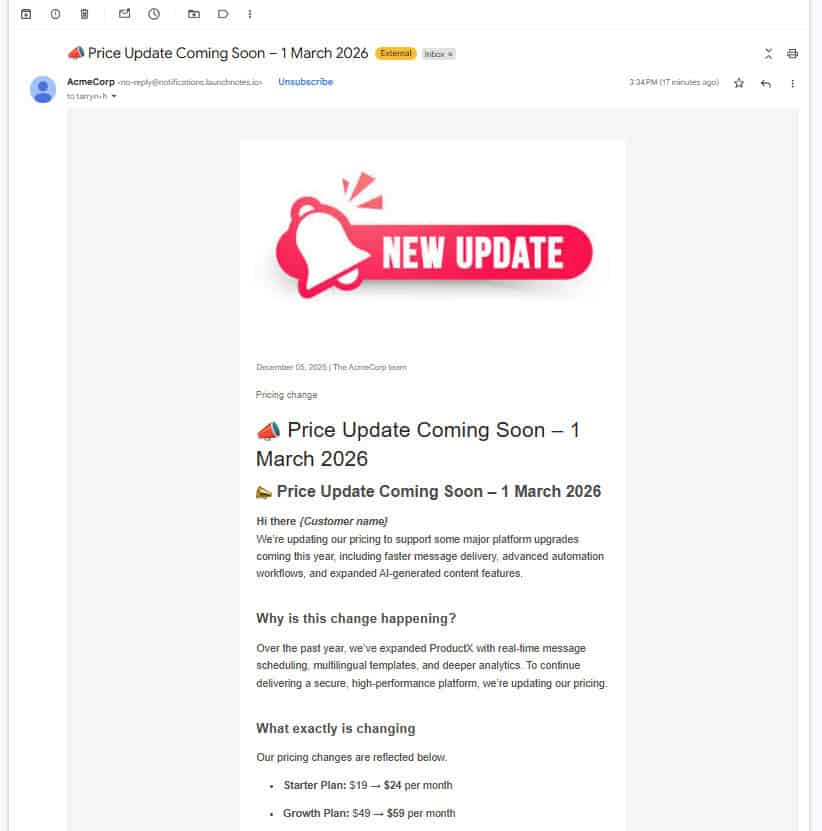
- Subject Line: Immediately let the customer know this is a price change and when it will happen. This will help increase the likelihood that the email will be opened.
If you have also published this announcement on a product web app or announcement page, ensure the subject line is clear.
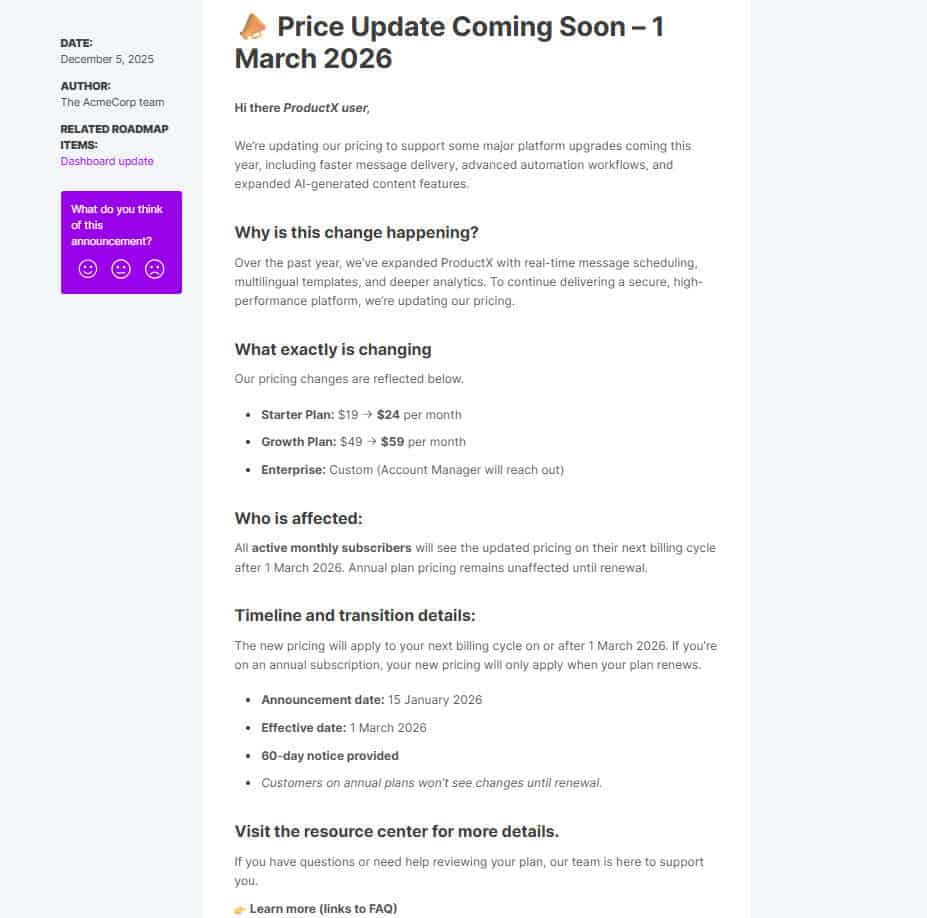
- Email or announcement structure:
- Set the context and introduce the pricing increase.
- Explain why the change is happening and why this is needed.
- Explain what is changing and ideally include the shift from the old to the new pricing.
- Explain who will be affected and when others may be affected if the billing cycle is annual.
- Include timeline and transition details to outline when the change will take place and when customers need to take action on anything (if required).
- Offer support and a way for customers to find additional resource material, such as FAQs or contact details, if needed.
- Set the context and introduce the pricing increase.
Here is an example of how a well-structured announcement could look on email or via an announcement page:
Email:
Announcement page or web application:
How to Choose the Best Tools and Channels for Your Pricing Change Announcements
I’ve covered some of this in the previous sections, but it might not always be clear which channel is the best for you and your business. Here are some options that you could consider.
Channels and Platforms:
- Email: This is often the most effective for announcements that are more formal and most likely to reach the majority of customers or users.
- Announcement pages: As I covered in the previous section, having an announcement page that mirrors the email content is a great way to cover essential updates. Ideally, your email should link to the announcements page to ensure customers know where to find other important notices.
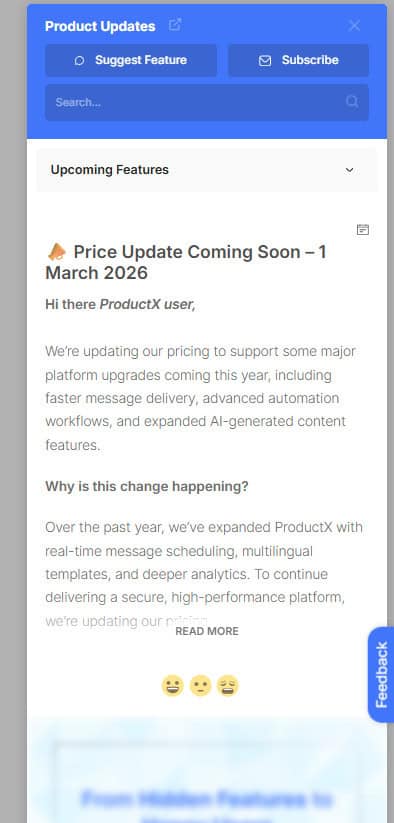
- In-app communications: this could be via a banner, a pop-up, or an in-app widget like the one below. This can be a great way to target additional users right in the app so that they are less likely to miss an update, especially if they have not subscribed to email updates.
- Help center: As a best practice, some FAQs and support resources should be available for both internal and external user teams to refer to.
- Customer-facing channels: If your business structure includes customer success, sales, or general client-facing roles, these high-touch points may be a good place to communicate upcoming price increases.
Tools and Product Communication Platforms:
There are multiple tools out there to help you navigate this process. I’d recommend using a purpose-built product communication platform to help create professional multi-channel updates.
Why use a product communication tool for pricing change notices?
- You can create uniform, standardized communications that follow best-practice standards and layouts.
- Saves time when needing to create multiple notices or updates.
- Easily create a single messaging structure that can be distributed to multiple channels, such as email, announcements, widgets, banners, and in-app notifications or pop-ups.
- Track user engagement and feedback in one place. Metrics like these can help identify any customer dissatisfaction early on and help to avoid escalations.
- Gain control and ensure compliance by using technology to distribute relevant notifications to the right people at the right time.
- Reduce administrative overheads or the need to make use of multiple resources to manage communications.
Which tools should I use?
The best tool will ultimately depend on your business structure and which tool is the best fit for you. Here are some of my go-to tools:
- LaunchNotes – best overall for product communications, announcements, and changelogs. With multiple ways to segment users by product groups, pricing tiers, or even domains (allowing cohorts), LaunchNotes is one of the best all-around multi-channel tools.
- AnnounceKit – Easy to use and offers a good range of multi-channel options for lightweight, quick announcements.
- Beamer – Similarly to the above tools, you can segment user groups, and it’s an excellent option for product-centric teams to announce new features or other updates. Specific user segments. Great for product updates and new feature announcements.
- Changelogfy – Best for SaaS organizations that need to write release notes in addition to communications. Allowing categorization, you can publish public/external updates easily from the tool.
- Intercom – An in-app customer feedback tool that might be a good option to use for organizations already using Intercom for support and queries.
LaunchNotes takes the busywork out of product updates. Paste in your notes or tickets and get a structured announcement draft instantly. It’s designed for teams that want to save time, segment updates, and keep communication consistent across every channel.
Managing Customer Feedback & Measuring Impact
Remember, the final step is to manage customer feedback, complaints, and queries in a supportive and productive way.
Gather feedback and be ready to offer alternative options for users or customers who may not be able to continue with new pricing plans.
Here are some options you could consider:
- Downgrading plans or tiers
- Allow a more flexible payment option (like monthly or quarterly billing)
- Offer reduced pricing
- Offer an extended option for current pricing
Once the process has come to an end, don’t forget to measure impact:
- You may want to take care to monitor customer churn or reduced adoption rates.
- If you have introduced a new product or improvement along with increased pricing, ensure you monitor feedback and metrics around user adoption.
- Use product tools to help enforce adoption and measure any user dissatisfaction or feedback.
Here is another excellent way a product communication tool can help you measure customer sentiments or feedback in a central repository.
By gathering feedback directly via announcements, where customers see them, you can take action as it happens and help reduce churn.
My Closing Thoughts on Communication Around Pricing Increases
Pricing increase communications can be tricky to get around and can lead to customer churn if not managed correctly. However, if done right, they can strengthen customer trust.
Organizations need to remember the value of communicating price changes early and transparently to ensure customers are not surprised by sudden changes and understand the benefits they will receive as a result.
By offering alternative options and empathy, this process can be positive and smooth. However, it will take strategic management across multiple internal teams to ensure it can be successfully rolled out. Where possible, rely on technology and tools to ensure accuracy and ways to track feedback as it happens. That way, organizations can ensure their resources are focused on the right activities at the right time.