


Last Updated on March 10, 2026 by Ewen Finser
The mantra for startup founders has shifted from “growth at all costs” to “sustainable growth at high velocity.” To achieve this, the modern finance stack has moved away from static spreadsheets and toward robust, dynamic platforms that interpret data with real-time visibility. These tools act as invisible team members, automating the mundane aspects of bookkeeping and payroll while providing real-time strategic foresight.
Whether you are a pre-seed team of two or a Series B scale-up, these following finance tools for startup founders represent the gold standard for financial operations in 2026.
At a Glance
Category | Recommended Tool | Key Strength | Starting Price |
Banking | Mercury | Digital-first scale & yield | Free to try |
Spend Mgmt | Ramp | AI policy enforcement & savings | Free to try |
Payroll | Gusto | Automated multi-state compliance | $40/mo + $6/person |
Accounting | Digits | Real-time AI agentic bookkeeping | $65/month with a free trial |
Reporting | Mosaic | Predictive modeling & resource ROI | $9.99/user |
1. Banking: Mercury (The Operating System for Startup Cash)
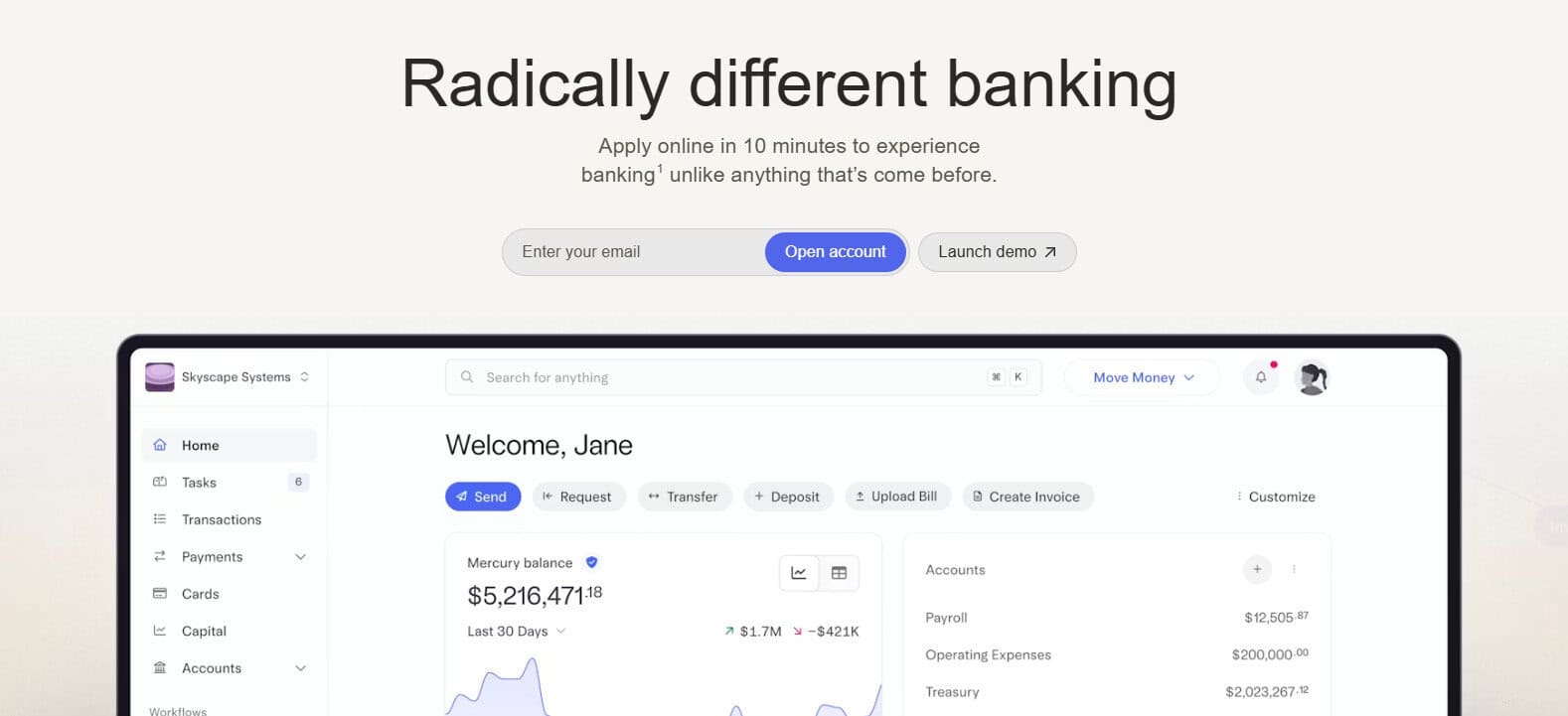
Mercury has redefined what a “bank” means for a tech founder. It’s no longer just a place to park capital; it now serves as a high-performance financial workstation. It remains the dominant choice for venture-backed startups due to its seamless integration with the rest of the venture ecosystem and its ability to scale from a single checking account to a complex treasury management system — without the friction of traditional commercial banks.
Its standout feature in 2026 is its treasury and vault systems, which offer expanded FDIC insurance up to $5 million through a sweep network of partner banks. It also offers bill pay, which uses native AI to extract data from invoices automatically, eliminating manual entry. For founders looking for capital, Mercury also offers venture debt and working capital products directly within the dashboard, allowing you to bypass lengthy external applications.
However, as a digital-first fintech, Mercury lacks physical branches. If your business handles significant amounts of physical cash or requires in-person services, you’ll really feel this limitation. Furthermore, while its support is highly rated, it’s generally limited to business hours, which may be a hurdle during weekend crunch times.
Cost
Mercury is largely free for basic business banking. There are no monthly fees, minimum balance requirements, or overdraft fees.
- Mercury Standard: Free
- Mercury Plus/Pro: Starts at $35/month for advanced features like mass API payments and enriched NetSuite integrations
Best for: Mercury is the default choice for venture-backed tech startups, e-commerce brands, and companies with international footprints that need USD wires and high-yield treasury options.
2. Spend Management: Ramp (The End of the Expense Report)
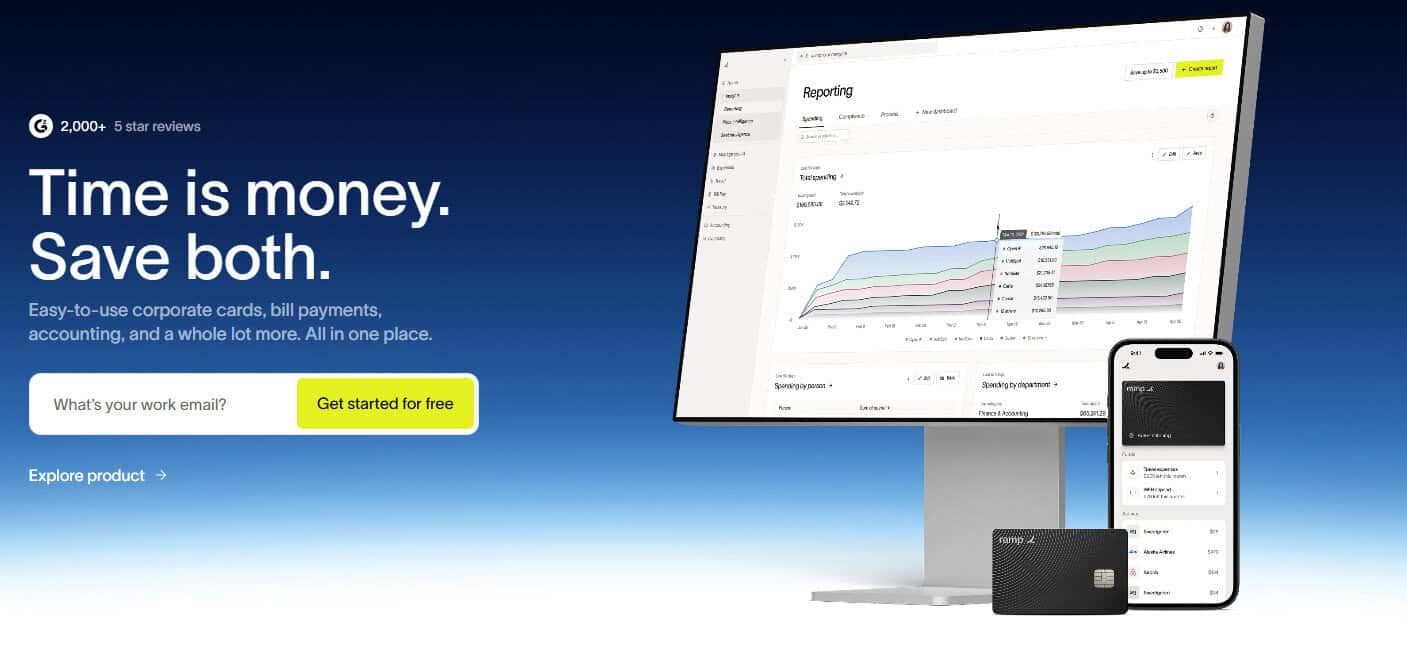
Ramp has effectively killed the reimbursement culture that plagued early-stage startups for decades. By combining corporate cards with a sophisticated software layer, Ramp ensures that every dollar spent is tracked, categorized, and audited before the transaction even clears the bank. This means that in 2026, it’s less of a card provider and more of a financial controller in your pocket.
The core of Ramp’s value proposition is its AI-powered policy enforcement. The system can automatically flag duplicate subscriptions, identify lower-priced alternatives for SaaS products, and block out-of-policy transactions in real time. Its mobile receipt capture is industry-leading; employees simply text a photo of a receipt, and Ramp’s OCR matches it to the transaction and syncs it with your accounting software in seconds.
Just note: Ramp is not a standalone accounting system. While it handles the outflow of cash beautifully, you still need a general ledger to manage your full financial picture. Additionally, for very small teams with only one or two users, the level of control might feel like overkill here.
Cost
- Essential: Free; includes unlimited cards and basic accounting integrations
- Ramp Plus: Starts at $15 per user/month; includes advanced procurement, multi-entity support, and global card issuance
Best for: Ramp is ideal for fast-growing teams that need to decentralize spending without losing control. It’s particularly valuable for founders who want to eliminate the manual month-end close by having transactions pre-coded and audited throughout the month.
3. Payroll & HR: Gusto (People Operations on Autopilot)

Gusto remains the most founder-friendly payroll platform in 2026 because it treats payroll as a small part of the larger people experience. It handles the complexity of state tax registrations and filings so founders can focus on hiring and running the business.
Gusto’s Auto-Pilot feature allows you to set payroll to run automatically, including tax filings and payments. In 2026, its Gusto Global (EOR) service has become a standout feature, allowing U.S. startups to hire and pay international employees in over 120 countries without setting up local entities. It also integrates health insurance, 401(k), and workers’ comp directly into the payroll flow.
But while Gusto is exceptionally user-friendly, its costs can scale quickly as you add more employees. And for very large enterprises, the reporting may not be as robust as legacy systems like ADP or Workday. Additionally, its Simple plan is restricted to single-state payroll, forcing most remote-first startups into the higher-tier plans immediately.
Cost
- Simple: $40/month + $6/person
- Plus: $80/month + $12/person (includes multi-state payroll and time tracking)
- Premium: $180/month + $22/person (includes dedicated HR resource center)
Best for: Best for small to mid-sized startups (2 to 200 employees) that prioritize a great employee experience and need a set-it-and-forget-it solution for multi-state compliance and payroll.
4. Accounting: Digits (The Agentic AI Ledger)
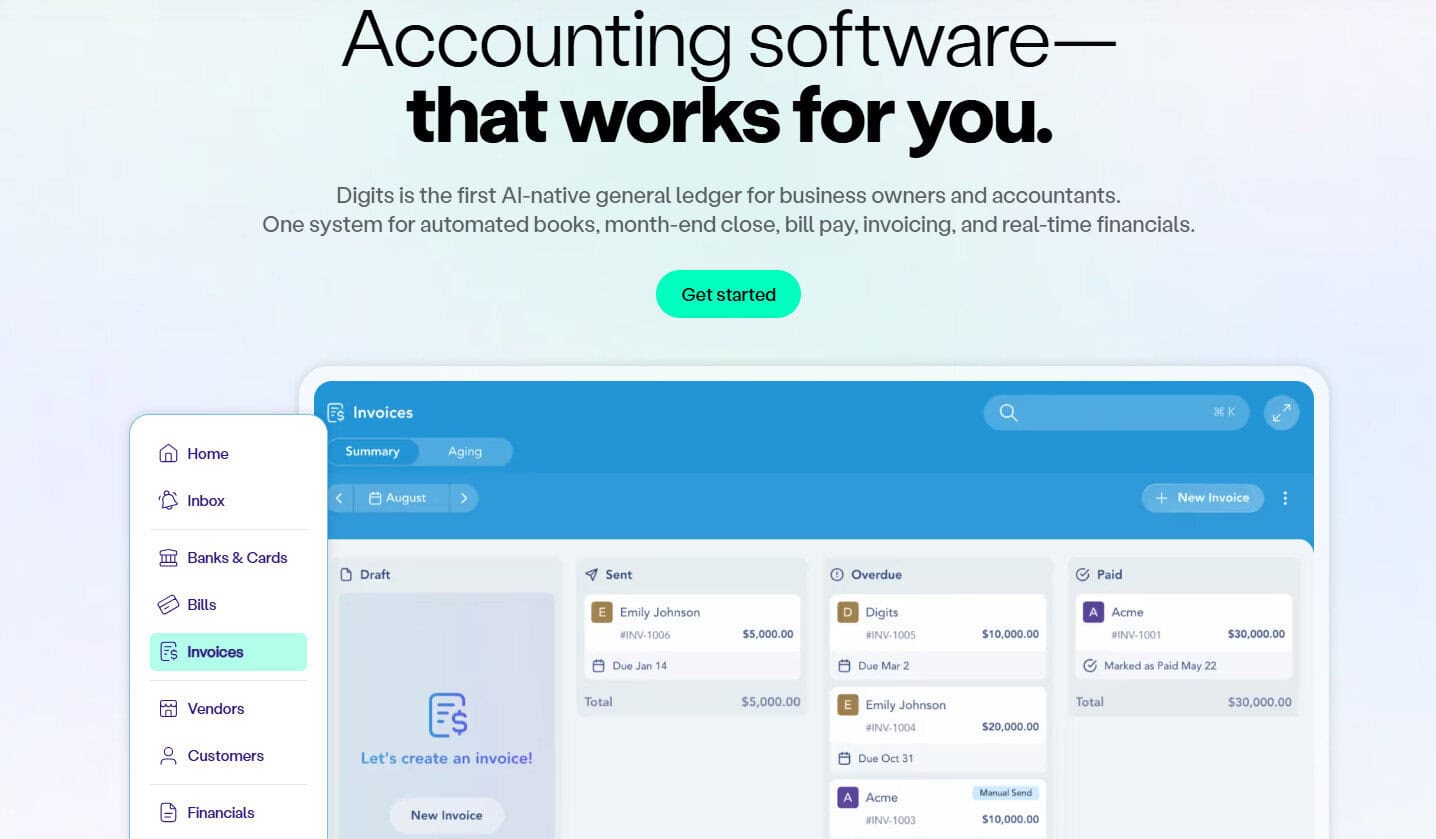
Digits has gone all-in on the biggest leap in accounting technology in 20 years. Unlike traditional software that acts as a database of past transactions, it’s built on a living financial engine. It uses AI to monitor your books 24/7, providing real-time insights that previously required a full-time controller or an expensive outside firm.
The flagship feature worth spending some time on here is Ask Digits, an AI assistant that understands your company’s specific financial context. You can ask nuanced, challenging questions like, “How much did we spend on AWS compared to last month?” or “What is our projected burn for Q3?” and get an instant, visually-backed answer. Additionally, its AI bank reconciliation now auto-books over 95% of transactions as they happen.
However, Digits is highly focused on the North American market and tech-centric businesses. If you have a complex manufacturing business with heavy inventory needs or operate primarily in specialized international tax jurisdictions, you might find the current AI models less optimized for those niche requirements.
Cost
- AI Accounting: While its introductory program is $65/month, the $100/month plan is what includes AI bookkeeping, bill pay, and real-time dashboards
- Full-Service Upgrade: Starting at $350/month (still in beta); includes close automation, custom reporting, and multi-entity accounting
Best for: Founders who are finance-lite and want a high-level view of their business without learning the intricacies of double-entry bookkeeping. It’s the perfect fit for seed and Series A startups that want “big company” financial visibility on a startup budget.
5. Reporting & Forecasting: Mosaic (Strategic Planning for High-Growth Teams)

In 2026, Mosaic has solidified its place as the premier strategic finance platform for startups that have outgrown Excel. It connects your ERP (accounting), CRM (sales), and HRIS (people) to create a single source of truth for the future of the company.
The predictive modeling is the core strength here. It allows founders to run what-if scenarios such as “What happens to our runway if we hire three engineers in July instead of September?” With a few clicks, you have your answer. Additionally, its workforce intelligence tool tracks the ROI of every hire, while the real-time dashboards provide board-ready visualizations of metrics like NRR, CAC, and LTV.
Just keep in mind that the setup for Mosaic can be more involved than a simple plug-and-play tool, as it requires mapping your various data sources correctly to ensure the models are accurate. It’s also an analytics-only tool; it does not process payments or handle actual bookkeeping, meaning it’s an extra layer on your stack.
Cost
- Professional: Starts at $9.99 per user/month; includes shareable dashboards and basic integrations
- Business/Enterprise: Custom pricing (typically scales with the complexity of data and number of integrations)
Best for: Growth-stage founders and CFOs who need to provide high-fidelity reporting to investors and want to move away from manual, error-prone spreadsheets for their financial planning and analysis.
The Strategic Advantage of a Unified Finance Stack
Building your financial infrastructure is not merely an administrative checkbox; it’s quite literally the construction of your company’s central nervous system.
In the early stages of a startup, it’s tempting to duct-tape a solution together using spreadsheets and disjointed apps to save a few dollars on monthly subscriptions. However, the technical debt accrued in a poorly constructed stack is one of the most common silent killers of scaling companies. When your banking doesn’t talk to your ledger and your spend management is divorced from your forecasting, you lose the ability to trust your data.
By implementing a stack correctly from the outset, you transition from reactive accounting to proactive strategy. Instead of manually categorizing transactions or chasing employees for receipts, a unified system handles the grunt work via technology. This saves hundreds of hours annually, but more importantly, it ensures that when you finally sit down with a potential investor or a board member, your data is beyond reproach.
Clean data leads to fast due diligence, and fast due diligence leads to closed funding rounds.
The Power of Interoperability

The true magic happens when these five platforms are implemented together rather than in isolation. When Mercury feeds real-time cash positions into Digits, and Ramp pushes pre-coded expenses into that same ledger, the end-of-month close effectively disappears.
You no longer have to wait until the 15th of the following month to know if you hit your burn targets; you know by the 15th of the current month.
Then, integrating Gusto and Mosaic into this ecosystem completes the loop between past performance and future planning. For example, having Gusto’s live headcount data flow directly into Mosaic’s predictive models allows for live forecasting. This level of synchronization eliminates the data lag that causes founders to make decisions based on old information.
Building a Holistic, Integrated Finance Stack
Building a finance stack no longer just means picking the most stable legacy software; it means choosing the most integrated and intelligent ecosystem. By pairing Mercury for your cash, Ramp for your spend, Gusto for your people, Digits for your books, and Mosaic for your future, you transform your finance department from a cost center into a competitive engine, providing the clarity needed to pivot or pour on the gas with total confidence.