


Last Updated on March 25, 2026 by Ewen Finser
Let’s start with the basics. What exactly is a business broker? Simply put, it’s a professional you hire to sell your business. But, if you’ve built and run your business from the ground up, why hand that over (and pay a commission) when nobody knows it better than you? You could absolutely sell it privately and save on fees. Still, it’s important to understand the potential trade-offs, as selling on your own comes with considerations that can affect your sale price, timeline, and even the stability of your business while it’s on the market. Here is ‘Business Broker vs Selling Privately’:
Confidentiality

By “trade-offs,” I’m referring to risks that can influence the outcome of your sale. One of the biggest risks in selling a business is confidentiality.
By selling your business privately, you take on the risk of exposing sensitive information. If information is not kept strictly confidential, competitors might learn about your operations and accounts or other vital bits of information. Customers, clients, and vendors could become concerned and shift their business elsewhere. Employees may become uncertain if they hear about a sale, which could affect continuity during the process.
Lack of confidentiality can certainly lead to these types of issues if word of the sale spreads at the wrong time, which can in turn create challenges if not managed carefully.
Confidentiality: Business Broker
- Starts with a buyer profile form and ID verification.
- Requires a legally binding NDA (non-disclosure agreement).
- Demands financial prequalification or a personal financial statement (proof of funds).
- Acts as a professional intermediary, keeping the business name, owner’s name, location, and key details hidden until everything is verified and approved.
- Follows this process for each and every buyer request.
Confidentiality: Private Seller
You could attempt some of the above steps, but using your own name, phone number, or email address risks exposure. All of these can be researched to reveal the owner or the company, creating a confidentiality concern.
Time

As a business owner, you know how much time it takes to run your business and how little remains for family, health, hobbies, and more. Handling the marketing and selling of your business yourself adds a full-time responsibility. Could you do it? Probably but it requires significant time.
Marketing and selling a business can take three to nine months, depending on the type. Selling is a full-time job and by working with a professional business broker that can handle the majority of this process, it will thereby allow you to focus your energy and talent on your business.
Time: Business Broker
- Compiles all financial documentation (P&Ls, balance sheets, tax returns, etc.).
- Gathers additional pertinent documents (inventory, asset lists, leases, etc.).
- Provides a valuation of the business (reviews all company financial data, etc.).
- Creates a detailed Confidential Memorandum.
- If necessary, gets the business prequalified for SBA lending.
- Markets the business on brokerage websites and other online listing sources.
- Handles all buyer screening, contact, information requests, Zoom meetings, and in-person interactions.
- Reaches out to previously approved buyers.
- Manages due diligence processes.
- Works through the closing.
- Accomplishes all of this over an average of three to nine months.
Time: Private Seller
While you could handle some of these tasks, realistically something may have to give. Business performance might suffer, the sale process could drag on, or you might experience burnout. None of these outcomes are necessary or ideal.
Your time is better spent overseeing the business and ensuring strong performance continues for the benefit of the company and your eventual exit.
Before Deciding
Financials

There are many steps you can take before selling that will benefit the business now as well as to support a future sale. Clean up the financials to reflect the true numbers, no questionable add-backs or inflated figures. The cash flow or owner benefit must be authentic, as that’s where valuation begins. Inaccurate or inflated numbers can affect a deal or reduce the offer price.
You’ll also need three strong years of financials to support a solid valuation (unless you are selling on a Pro Forma basis). If the earliest year is weak, consider waiting for a better one to replace it. Getting a third-party valuation in advance shows where the business stands currently and whether it aligns with your expectations.
Other Important Things

Depending on your business size, train a manager or trusted employee to run operations in your absence or even full-time. Although not always necessary, buyers and investors view this highly because the business becomes relatively turnkey and doesn’t require the owner full-time (buyers don’t always plan to run it absentee, which SBA lenders usually don’t favor but, it’s still a plus if possible).
If you have one large customer or high customer concentration, explore ways to remedy it. Relying heavily on one customer carries risk. Buyers and lenders weigh this heavily and some lenders reject deals, and buyers can walk away because of it. You may not be able to fix it immediately, but note it for the future.
The real key for your business and a potential sale is polishing everything you can as much as possible: financials, data, equipment, location, website, etc. It also demonstrates pride in ownership. Your business is a major investment; these efforts can help secure value and return for your hard work.
Is a Business Broker Really Necessary?

In the introduction, I streamlined what a business broker is. In reality, they offer many additional valuable services. Just as doctors, accountants, and attorneys are specialists in their fields, a business broker can provide expertise in theirs.
You can handle some aspects yourself or go with lower-cost options. But for complex sales, specialized sales or securing top dollar for your business, expertise can really make a difference like in surgery, a lawsuit, or an IRS tax issue.
Your business provides for you, your employees’ families, customers, clients, vendors, and sometimes the community. In most cases, it’s your most valuable asset.
The right broker can bring direct industry knowledge (often from owning or selling similar businesses), industry tools for sector-specific pricing, geographic and demographic insight for brick-and-mortar locations, a network path to pre-approved buyers as well as necessary deal specific professionals, streamlined steps and processes, expertise in negotiation, business marketing, awareness of market and economic trends, and advisory support by keeping you well informed, separating and focusing on the serious qualified buyers instead of the others. Whether for retirement or just the next chapter, selling involves many very important considerations.
What’s the Price?

Now we reach a key factor that drives many to decide to sell privately: the commission.
Most business brokerages charge around 10% on average, though it can range from 5–15%. In my experience I’ve generally encountered 10%.
This fee covers the full process outlined above, with the broker working on your behalf for months, often without any upfront payment, until closing.
Finding the Expert
If you decide to go with a business broker, choose one who specializes in your industry. Some brokers handle a wide range of industries, while others focus solely on specific sectors.
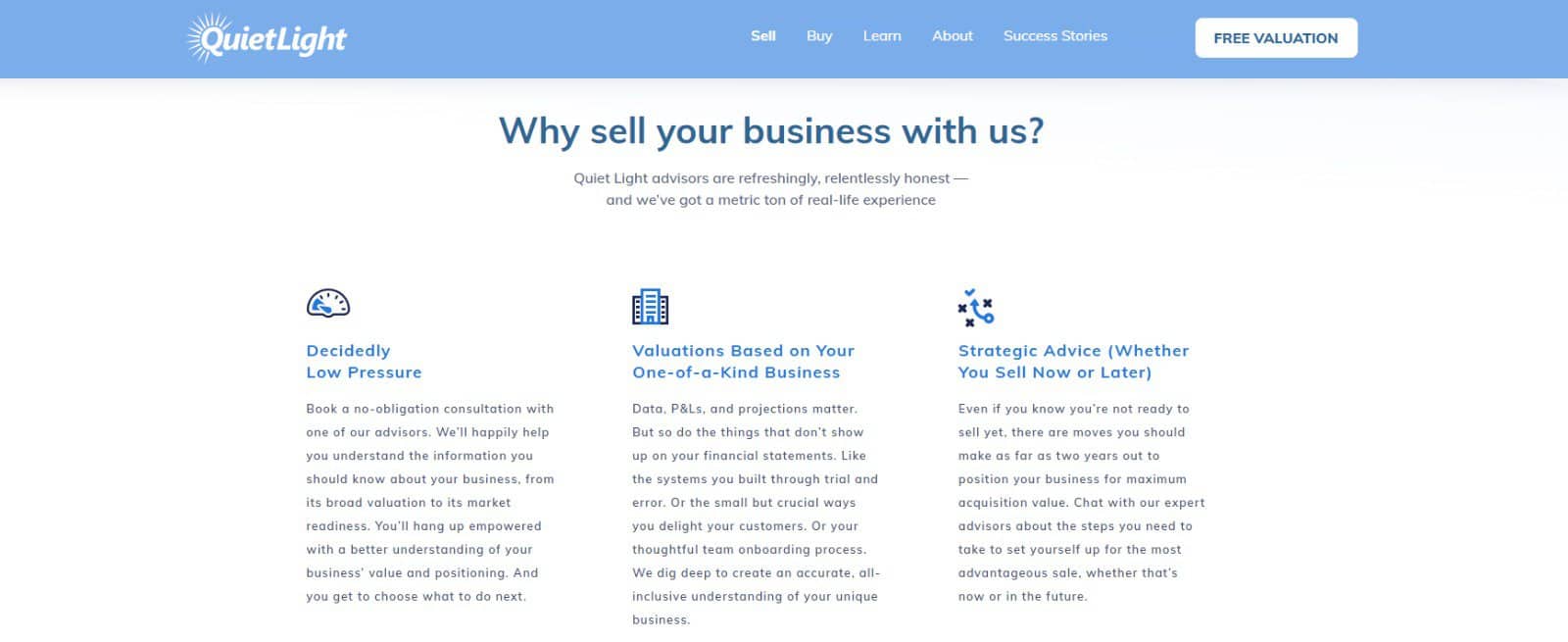
Quiet Light Brokerage is one option. Founded in 2006, it is led and run by entrepreneurs who have built, bought, and sold their own online businesses. They have knowledge of the digital industry. Quiet Light specializes exclusively in profitable digital companies. They have sold over 750 online businesses for a total transaction value of $500,000,000.
Reaching out to them for an Initial Valuation Call is one way to gather additional information if you’re still exploring options. An advisor can help establish a broad value range for your business, using the most up to date multiples for your niche plus factors like your team, run rate, inventory, etc. If confidentiality is a concern, an NDA can be signed prior to any discussion.
Final Thoughts

The real determining factor between selling privately or using a business broker comes down to your specific goals as well as circumstances such as: the nature of your business, the amount of time you can dedicate, your experience and comfort level with the process, and additional priorities such as confidentiality and efficiency. A private sale can provide greater independent control and avoid commission fees, while working with a broker offers business transition expertise, well organized support and access to qualified buyers among other things.
You might consider starting with a clear review of your financials and a third-party valuation to better understand your business’s current position. This can set realistic expectations and could help to inform you in your decision making process. Ultimately, preparation and thoughtful evaluation of the trade-offs can lead to a more effective exit aligned with your objectives.