


- What to Look For in Revenue Recognition Tools
- A CPA’s Guide to the Best Revenue Recognition Software
- Puzzle.io: Modern rev rec for Stripe-centric startups
- Sage Intacct: The heavy artillery for ASC 606
- Digits: An AI-native GL that keeps the books close-ready
- QuickBooks Online: Fine for basics, strained for SaaS
- Xero: A global small-business GL that leans on app partners
- Picking the Best Revenue Recognition Software by Use Case
Last Updated on December 17, 2025 by Ewen Finser
On paper, revenue recognition is simple enough: It’s just recognizing revenue when you actually deliver value to the customer, rather than when the cash hits the bank.
But in practice, it means:
- Deferred revenue schedules for every contract
- Allocations across bundles, discounts, and “free” onboarding
- Upgrades, downgrades, credits, and true-ups mid-term
- Usage-based prices that spike and dip each month
You can brute-force this with spreadsheets and generic ledgers for a while, but as you grow, your rev rec workbook turns into a 210MB Excel file that takes five minutes to open. That’s why Revenue recognition is where “just use QuickBooks” goes to die.
It’s also why CPAs like me have jobs!
So if you sell subscriptions, multi-year contracts, or milestone-based projects like general contracting, you need software that can actually model timing, performance obligations, and contract changes, not just dump everything in “Sales” when the invoice goes out.
Puzzle.io, Sage Intacct, QuickBooks Online, Xero, and Digits all play in this world, but they solve the problem in very different ways and for very different stages of maturity.
Let’s take a closer look at each one.
What to Look For in Revenue Recognition Tools
Before we stack the platforms next to each other, it helps to define what we’re looking for in the platforms we’re thinking about using.
- Native support for deferred revenue and revenue schedules: You want the system to generate and maintain schedules, not just give you a liability account and wish you luck.
- A tight link between billing and revenue: The billing system, payment processor, and GL should all line up. If an invoice changes, the schedule should update without you needing to enter that data in three different places.
- Configurable ASC 606 policies: You should be able to encode how you recognize different product lines and performance obligations — and see the math behind it.
- Contract modification support: Upgrades, renewals, and cancellations should adjust the waterfall without manual entries.
- Audit-ready reporting: Revenue waterfalls, MRR/ARR, and detailed drill-downs that tie back to individual contracts.
- Integrations and extensibility: Stripe, Salesforce, HubSpot, Chargebee, your data warehouse, and whatever billing stack you already have need to be able to communicate with your accounting platform
Without these, your accounting platform may be weaker than you anticipate when it comes to revenue recognition.
A CPA’s Guide to the Best Revenue Recognition Software

Puzzle.io: Modern rev rec for Stripe-centric startups
Puzzle positions itself as a modern accounting software for startups, with a strong focus on automation. Under the hood, this includes built-in automation for revenue recognition, prepaid expenses, and other accrual policies so you don’t have to wire your own spreadsheets.
The revenue recognition story here is closely tied to Stripe and to invoices created inside Puzzle itself:
- Puzzle integrates with Stripe and syncs subscription data, including plans, terms, and billing events.
- It uses that data to automate deferred revenue, accrued revenue, and related MRR / ARR metrics.
- Each month, Puzzle automatically posts the amount of revenue that should be recognized into the general ledger, so you’re not hand-crafting deferral and recognition entries.
In other words, it acts like a revenue sub-ledger for Stripe-driven businesses and then feeds summarized entries into the GL.
Most notably, Puzzle’s help center notes that they do not guarantee your revenue is fully ASC 606–compliant out of the box, because final compliance depends on how you structure contracts and policies.
That’s actually a good sign! Any tool that promises “push-button, ASC 606 is done” is selling a dream. You still need a CPA or a competent controller to define performance obligations and policies. What Puzzle does is give you a framework and automation engine for those policies, rather than trying to replace your judgment.

Where it shines
- If Stripe is your main billing system, Puzzle’s integration and automated revenue recognition will cut a painful amount of manual work, with case studies claiming that it slashes manual revenue recognition time by about 60%.
- Because rev rec lives in the same place as prepaid expense amortization, fixed assets, AP, and AR automation, you get a single accrual engine instead of a bunch of spreadsheets.
- The product is built for founders and lean finance teams that want real-time visibility without enterprise bloat. Their user interface is buttery smooth and can be picked up by almost anyone.
Where it falls short
- You still need clear policies and someone who understands ASC 606. The tool automates the math; it does not write the memo for your auditors.
- If your world revolves around complex, bespoke contracts outside Stripe, you may need additional tooling or more traditional revenue modules.
For funded startups and growth-stage SaaS that live inside Stripe and want automated revenue recognition without jumping straight to a heavy ERP, Puzzle stands near the top of the list.
Sage Intacct: The heavy artillery for ASC 606
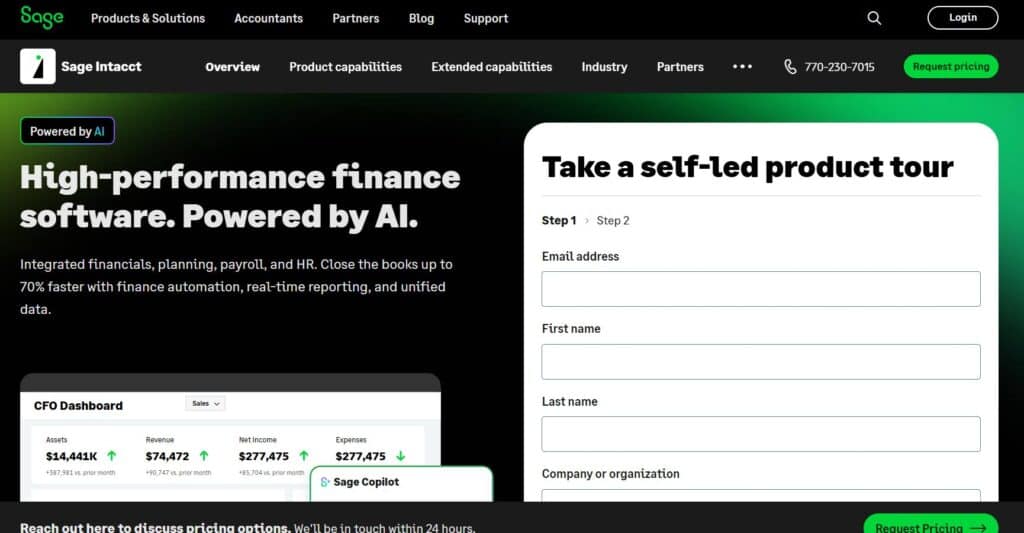
Sage Intacct is a full cloud ERP aimed at mid-market and enterprise finance teams, with a dedicated revenue recognition module that’s built for ASC 606 and IFRS 15 from the ground up. Having used it for years, it’s a robust and thorough platform that has my respect.
The revenue tools here sit on top of contract and subscription billing, as a feature available with higher tiers of the platform. It does the following:
- Automates revenue allocation across performance obligations, including bundles and discounts.
- Connects billing and revenue schedules so that changes in contracts (upgrades, renewals, cancellations) flow through to revenue.
- Supports dual reporting and multi-book setups if you have both ASC 606 and local GAAP or IFRS to satisfy.
- Integrates with upstream systems like Salesforce so that the whole quote-to-cash process feeds one revenue sub-ledger.
This is the kind of platform that can handle multi-element arrangements, variable consideration, and multi-entity, multi-currency setups without drowning you. However, since it still relies on templates and schedules, it won’t be as automated as Puzzle.
Where it shines
- If you have investors, lenders, or public-company aspirations, Intacct gives you a very defensible ASC 606 story.
- Multi-year terms, usage-based charges, bundles of software and services, frequent contract changes… this is what the module is built for. Complex contracts don’t stand a chance.
- Large teams with controllers, revenue managers, and a full close process will feel right at home.
Where it falls short
- This is not a swipe-your-card-and-go product. You will likely budget for implementation partners, internal project time, and ongoing admin. Expect to spend $100K+ a year for Sage, depending on users and active modules.
- If you’re under low- to mid-seven figures in ARR with a simple Stripe-based stack, Intacct is often more machine than you really need.
Intacct is a very solid pick when your contract structures are gnarly and the board expects robust, auditable revenue recognition baked into an ERP.
Digits: An AI-native GL that keeps the books close-ready
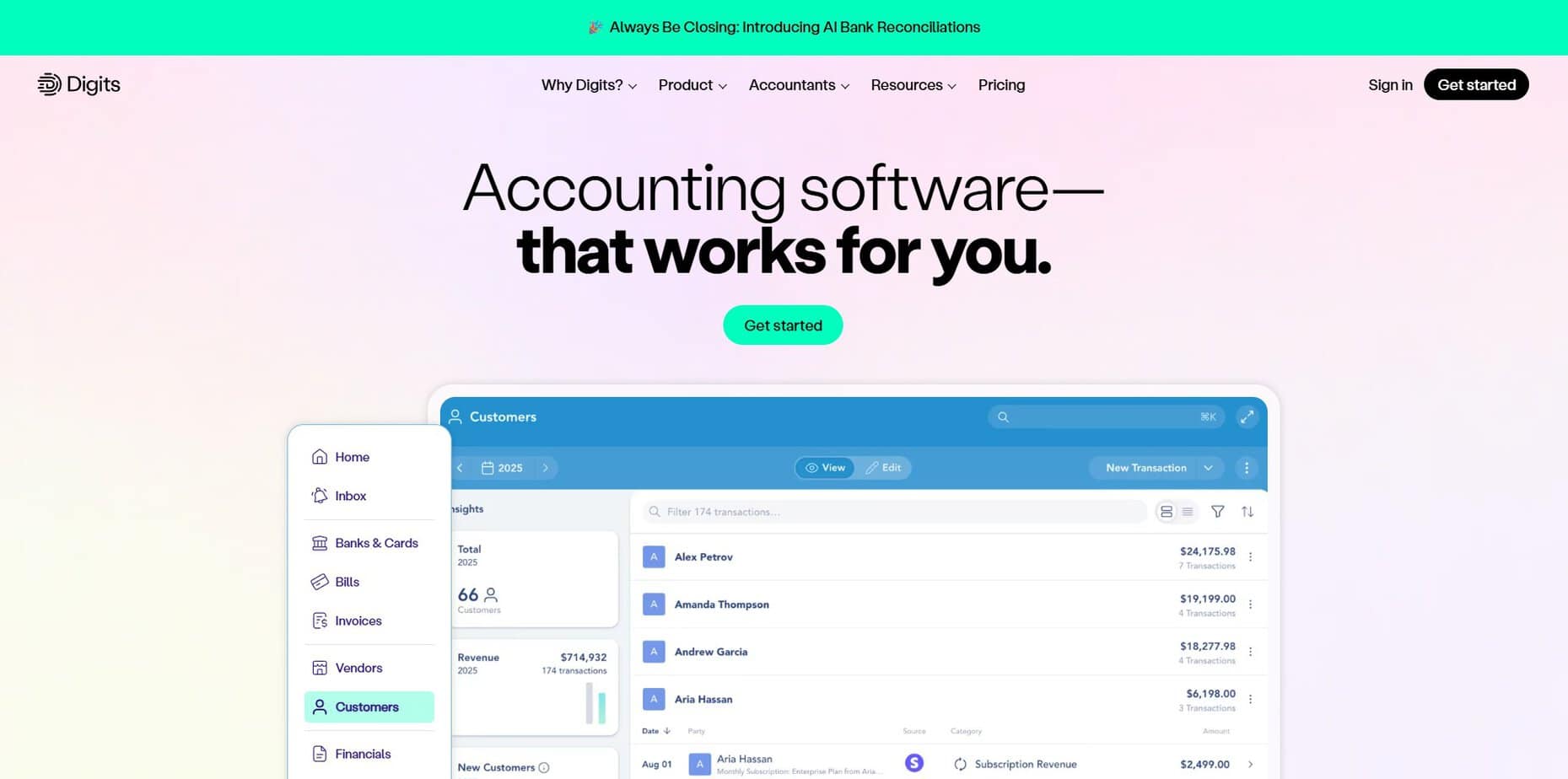
Digits tackles the problem from a different angle. It’s an AI-native accounting platform with its own double-entry ledger, built to automate categorization, reconciliations, reporting, and workflows across a modern finance stack.
Instead of selling a revenue recognition module as a feature, Digits focuses on making the GL itself autonomous and programmable:
- Digits connects to 12,000+ banks, cards, and financial tools (including revenue, payroll, and AP systems). Once you import transactions, a third-party tool will need to parse out the revenue and the liability.
- It automates the classification and reconciliation of transactions using AI, keeping your books up to date at any given time.
- Digits hosts a Connect API, letting firms and developers wire in billing systems and custom revenue logic programmatically.
Notably, Digits provides dimensional accounting that lets you slice revenue by department, project, or location without building huge COAs. So if you’re using Digits and need advanced rev rec, this could be an interesting way to take advantage of its powerful platform while using Excel sheets or templates to plug revenue to the P&L.
Where it shines
- There is automation across the whole ledger here, minimizing bookkeeping and reconciliation work so your team can spend more time on policy and review.
- Digits’ custom workflows let you turn it into the programmable core of your accounting stack if you have a strong ops team or an engineer on staff.
Where it falls short
- There’s no one-click ASC 606 module available out of the box.
- You’ll still need either a billing platform with decent rev rec or an external tool to handle schedule logic.
Digits is a strong fit if your main pain is keeping the books clean and current across many systems, and if you’re comfortable plugging in specialized tools to handle the heavy rev rec math.
QuickBooks Online: Fine for basics, strained for SaaS
QuickBooks Online now offers rev rec features that can spread revenue over time and work with deferred revenue accounts. But it’s not really capable of fully automating revenue recognition.
Out of the box (or with some configuration), QBO can:
- Track deferred revenue through liability accounts (this is a bit manual in my opinion, though, so be prepared to make a bunch of journal entries at the end of the month).
- Recognize revenue over time for simple contracts where you can use basic schedules.
- Work with partner apps that sync recognized revenue back into QBO.
You can use third-party tools like Synder, ScaleXP, SaaSOptics, and Ordway to generate proper schedules and push summarized entries back into the GL… but you’ll need to be rather tech-savvy to take advantage of them. You’ll also need to be prepared to dump dozens of hours getting everything set up.

Where it shines
- Simple service businesses and agencies with straightforward retainers and projects.
- SaaS companies in the very early days, with a small volume of contracts and a CPA willing to babysit spreadsheets.
- Businesses that want to keep QBO as the GL, but invest in a separate revenue recognition tool.
Where it falls short
For SaaS and complex contracts, the pain points are well documented:
- No native concept of performance obligations and standalone selling price allocations.
- Schedule creation and maintenance usually end up in spreadsheets or external apps.
- Contract modifications require manual rewrites of schedules and journal entries.
- High chance of error when you rely on CSV uploads and hand-keyed entries.
In my opinion, QBO by itself cannot deliver full ASC 606 compliance for complex models; it becomes the system of record, but revenue logic lives elsewhere. So while it can work, QBO is not a dedicated revenue recognition engine and should not pretend to be one.
Xero: A global small-business GL that leans on app partners
Xero is another cloud general ledger that’s popular with startups, especially outside the U.S. It handles unearned revenue and deferred revenue accounting, providing guidance on how to record and release those balances over time.

Xero helps you:
- Set up deferred revenue and unearned revenue accounts. You’ll need to book entries to these accounts either daily or monthly, though.
- Track prepayments and move them into revenue as you deliver. Once again, this is done via manual JE.
- Automate parts of the process for simple, time-based recognition. This can be done with simple, linear contracts that are consistent. Expect it to be the exception, not the norm.
For anything beyond simple, the story looks a lot like QBO, where you’re using tools like Flowrev, ScaleXP, Chargebee, and Synder to generate ASC 606 and IFRS 15-compliant revenue schedules, handle contract changes, and push summarized numbers back into Xero.
Where it shines
- Global small businesses with straightforward revenue.
- SaaS startups that like Xero’s global tax support and are willing to pair it with a specialized rev rec app.
- Firms that want a modular stack rather than one big ERP.
Where it falls short
- Like QBO, it’s my opinion that Xero, by itself, does not offer full revenue recognition and relies too much on partners for serious SaaS rev rec.
Picking the Best Revenue Recognition Software by Use Case
Picking the right tool for rev rec will depend on your stage, complexity, and appetite for implementation.
Here’s a case-by-case guide if you’re still not sure which one to go with:
- You’re a venture-backed SaaS startup living in Stripe, with a lean finance team and rising ARR: If you want automated revenue recognition that plugs straight into your billing (without jumping into full ERP land), Puzzle sits in a sweet spot here: native accrual automation, tight Stripe integration, and schedules that post straight into the GL.
- You’re a mid-market or enterprise company with complex contracts, multiple entities, and strict audit expectations: Sage Intacct is hard to beat as an all-in-one platform with a dedicated revenue recognition and subscription module that lives inside the ERP. It’s heavier and more expensive, but it’s built for this exact use case.
- You’re a small business or early-stage SaaS with simple revenue and a strong CPA relationship: QuickBooks Online or Xero can work if you pair them with a third-party rev rec tool. You give up some elegance and automation in exchange for lower cost and familiarity.
- You’re building a modern, automated finance stack and don’t mind outside tools: Digits provides an AI-native ledger and workflow engine that can ingest rev rec outputs from other tools and keep everything reconciled and visual. It’s especially appealing for firms, fractional CFO shops, and tech-forward startups that want programmatic control.
Of course, none of these platforms relieve you of the need to understand ASC 606 and write clear policies. But the right tool can turn those policies from a fragile spreadsheet into a system that scales.
For fast-growing SaaS companies that want modern UX, automated accruals, and a Stripe-native revenue story, Puzzle often lands closest to that balance between power and approachability. The key is to match the tool to your contracts, volume, and the size of the mess you’re trying to tame.