


Last Updated on March 30, 2026 by Ewen Finser
Until a few years ago, terms like “Voice Agent” simply meant a slightly more fancy way to navigate menus than “Press 1 for billing.”
The robotic voice was frequently annoyingly chipper and the moment callers deviated even slightly from the standard script they’d be met with, “I’m sorry, I didn’t get that!”
This has now changed with the current generation of AI voice agents. They don’t just hold conversations, but answer product questions, qualify leads, book appointments, and even route calls based on intent, not key presses. This frees up human agents to manage the calls where they’re actually needed.
The best AI voice agent software for sales/support teams who need reliable telephony, smooth CRM handoffs, and 24/7 inbound coverage without rebuilding their entire stack from scratch is Aircall’s AI Voice Agent.
Let’s explore how AI voice agents have reshaped telephony, how to choose the core features that matter for your business, and break down the very best choices, so you can choose the right one for your operational needs and budget.
Best AI Voice Agent Solutions At a Glance
Platform | Focus | Best For |
Aircall AI Voice Agent | Native telephony with integrated AI voice automation | SMB/mid-market sales and support hybrids (11-100 seats) |
PolyAI | Enterprise-grade containment and conversational realism | Large contact centers automating high-volume inbound calls |
Retell AI | Dev-friendly, cheap scaling, custom LLM/voice stacks | Technical teams building outbound or inbound voice agents |
Vapi | API-first custom voice agent builds | Developers needing full control over models, telephony, and logic |
Bland AI | Rapid-deploy outbound voice automation with predictable pricing | Sales-heavy teams running high-volume outbound campaigns |
How I Chose AI Voice Agent Platforms

Over the past year I’ve spoken to several clients who had the same issue: their legacy IVR was bleeding leads. Not just occasionally, but systematically.
In one case, a deal worth tens of thousands of dollars vanished because no one was around to pick up a call at 2 AM and the voicemail went absolutely nowhere. That’s when my clients decided that AI voice agents were no longer an unnecessary luxury but a genuine business requirement.
I evaluated the platforms covered in this guide against four key criteria:
- Conversation quality under pressure (interruptions, accents, off-script callers etc.)
- Telephony reliability (PSTN/SIP backbone, uptime, failover)
- Handoff quality (What the rep actually sees when the AI is at its limit)
- Pricing transparency (Particularly if they’re clearly laid out on the website)
When considering solutions, I also struck off my list any basic chatbot-to-voice wrappers, which I’ve found to be unfit for purpose. The same for any platform that struggled to understand and process natural language. After all, if an AI voice agent can’t handle the odd caller rambling, interrupting, or going off-topic, it doesn’t belong in this space.
Why AI Voice Agents Are Taking Over Inbound Calling
Anyone who’s ever contacted a call center will remember the classic IVR model: Press “1” for billing, “2” for support and so on, but it always struggled to consistently solve so many problems.
There’s no point in sugar coating it. Traditional IVRs manage things badly, from long queues, leads going cold, and of course the moment that someone calls outside business-hours with a high-value query the opportunity is often lost.
This is where AI voice agents come in. They upend classic IVR in three crucial ways.
Firstly, they can handle inbound calls autonomously 24/7. FAQ resolution, lead qualification, appointment booking, and call routing can all be managed while every single human rep is sleeping away in their beds.
Admittedly, this could be done with a traditional IVR menu, but the second key feature of AI voice agents is they do it in a conversational way. In some cases, the caller may not even be aware that they’re speaking to an AI agent until it tells them so.
Thirdly, and perhaps most importantly for teams on a budget, AI voice agents can hand off calls intelligently. This can include passing a full context summary, transcript, and sentiment read to a human rep rather than just dumping the caller back into the queue.
During my research into this I heard bold claims of deflection rates of 60 – 70 % on routine calls when deploying voice agents. But the extent to which this happens, as well as the quality of the handoffs for complex/high-value conversations will depend very much on your chosen platform, business model, and specific configuration.
What To Look For In an AI Voice Agent

Most AI voice agent issues aren’t caused by the AI itself. Problems are far more likely to arise with weak telephony, bad handoffs, or nebulous pricing.
Before deciding on an agent, you need to be clear about exactly what you need, such as:
- Latency and natural conversations: The human ear can pick up on robotic lags in seconds, which is why the best AI voice agents respond in under a second. They should also be able to handle interruptions without losing their flow. Test this with messy calls: interrupt, harangue, play background music and noise, and even try different accents.
- Telephony backbone: Bitter experience has taught me that an AI layer with no robust telephony backbone underneath can create serious reliability problems at scale. Avoid repeating my mistakes by checking for native calling infrastructure, global number availability, a 99.9% uptime SLA, and failover routing. If you don’t see this mentioned in the website’s documentation, ask your provider directly.
- Handoff quality: I’ve found this is where most platforms tend to overpromise and underdeliver. In brief, you need to know when the AI reaches the limits of its capabilities what will the human rep actually see? At the very least, this should include a full transcript and sentiment summary in the CRM before the rep answers.
- Pricing structure and transparency: A per-minute pricing model sounds just fine, until you start adding the cost of LLMs, voice models, telephony, CRM integrations, and the rest. You need to build a realistic call volume estimate before comparing platforms. Make sure to get an all-in rate, not just the basic per-minute fee.
AI Voice Agent Red Flags
- Containment claims without supporting data: As we explored above, claims like “97% resolution rate” sound great in marketing materials, but aren’t a reliable metric. If available, request deflection data from comparable deployments to yours, A/B test results, and verifiable post-satisfaction scores instead of blindly believing broad claims.
- No native telephony: I’ve personally never seen a reliable AI voice agent that relies entirely on third-party telephony providers. AI voice agents that depend on a single external telephony provider without redundancy can create latency, reliability, and configuration risks at scale. Native PSTN/SIP integration is generally much simpler and safer.
- Polished handoff friction in the demo: Live demonstrations almost always portray a squeaky clean call path. But what happens when AI can’t solve the issue? If, for instance, the caller never has to repeat themselves, the demo may be painting a rosier picture than reality.
- Lack of pricing transparency: Some platforms feature prominent price tags with seemingly reasonable per-minute rates but there’s a catch. Additional fees are levied for LLM access, premium voices, telephony, or certain CRM connectors. I’ve seen this amount to over twice the advertised base rate for some platforms.
- Vendor lock-in: This is commonly achieved through proprietary voice models. For instance, if your call recordings, voice personas, and conversation flows only exist in the vendor’s ecosystem, then migration can become expensive and/or disruptive. Ask about both data portability and API access before signing up for any platform.
Aircall AI Voice Agent
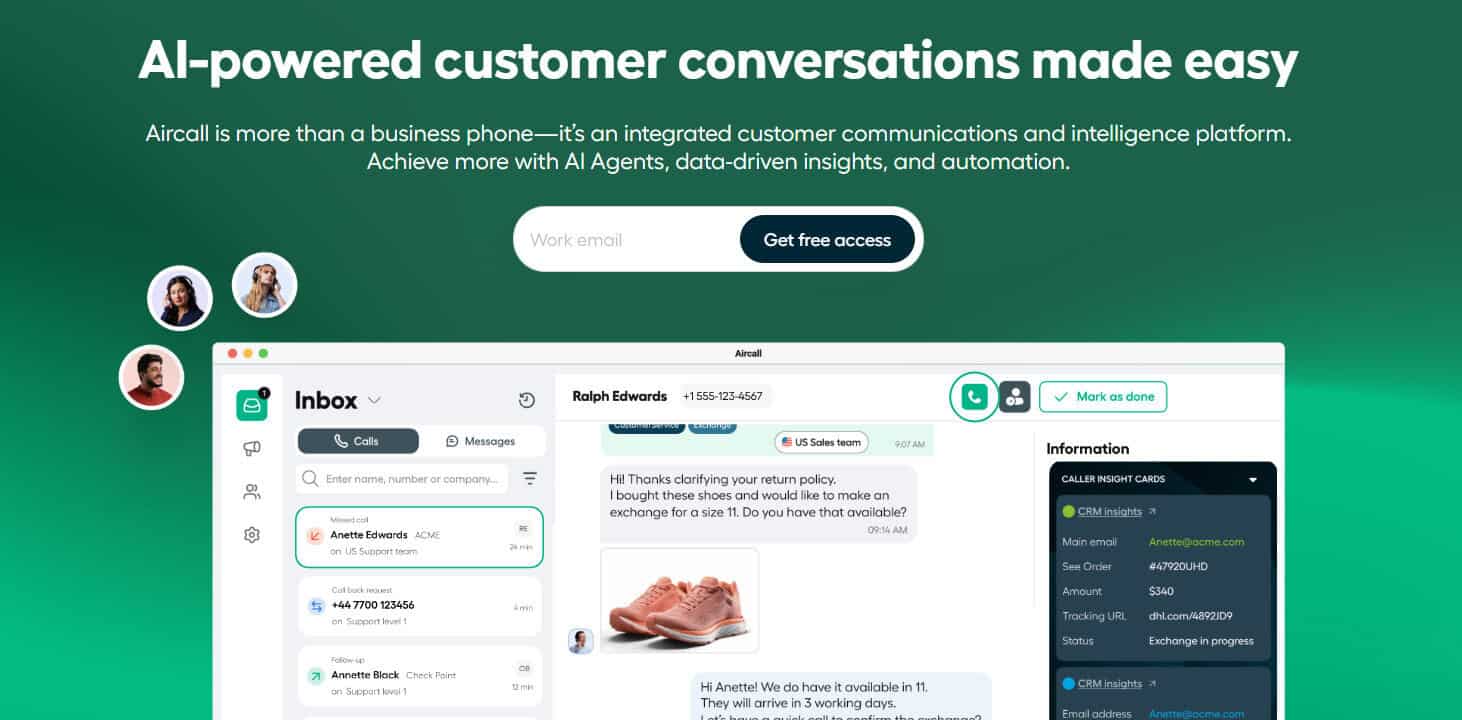
- Integrates telephony, workflows, and automation into a single platform i.e. no separate voice agent layer.
- Rich handoffs with full transcript and context summary to 250+ platforms natively (Salesforce, Zendesk, Hubspot etc.)
- Aircall’s AI Assist Pro can layer real-time coaching and post-call summaries onto human agent calls.
- Full feature set requires add-ons beyond basic ‘Essentials’ subscription.
- Not a dedicated outbound platform.
I decided to start this roundup with Aircall, not just because its AI Voice Agent is my favorite but also because of where it sits in the stack.
All the other options explored in this guide are specialist voice agent tools designed to be integrated into your existing phone system. But Aircall is the phone system, with the voice agent built-in.
This distinction is vital: when Aircall’s voice agent reaches its limit on a call, the handoff doesn’t have to cross some vast system boundary. The transcript, sentiment read, and in-progress notes land directly on the rep’s CRM screen. I’ve seen this myself and only very rarely witnessed reps pause to say, “I’m just going to pull up your account.”
If your team’s running hybrid sales/support operations, then 24/7 inbound qualification alone is the ROI story. The AI can handle FAQs, qualify leads, book callbacks, and route complex queries.
AI Assist Pro can layer onto live calls to provide real-time coaching prompts and generate custom post-call summaries, helping teams guide conversations more effectively and capture key insights automatically. This advanced tier starts at $49 per license per month. A lower-cost option, AI Assist ($9 per license per month), is also available with more basic functionality.
Setup is very fast: IVR, numbers, and users can be loaded in minutes, but production workflows can take longer. The “Essentials” plan starts at $30 per license, per month, with a minimum of 3 licences. This isn’t the least expensive platform but it effectively combines three tools into one: a phone system, voice agent, and a coaching layer.
PolyAI

- Realistic conversations that flow (handles interruptions and rambling).
- Strong containment rates in enterprise contact center deployments.
- Good CCaaS integration for large-scale operations.
- Strong multilingual support across many major languages.
- Enterprise-level pricing with significant setup investment required
- Not ideal for outbound use cases
- Overkill complexity for smaller teams (<50 seats)
When it comes to AI voice agents, this platform sits at the high end of the enterprise market. By this, I mean that it claims containment rates of 70% – 87% in mature enterprise deployments, and while I encourage readers to do their own tests, these numbers seem to be backed by real-world benchmarks.
If you’re in a large contact center handling many calls a day, then these deflection rates can result in some serious savings. This is probably for the best, as setup will likely involve engaging professional services, you need to talk to sales for custom pricing, and most importantly PolyAI’s purpose-built for inbound, so isn’t the best choice for outbound deployments.
Retell AI

- Clear self-serve entry pricing ($0.07/min base, $10 free starting credit)
- Supports custom LLM stacks (OpenAI, Anthropic) and voices via ElevenLabs
- 20 free concurrent calls on pay-as-you-go (higher limits available)
- True per-minute cost with LLM, voice, and telephony runs well above base rate.
- Analytics and reporting are still evolving compared to some competitors.
- Requires technical resources to configure for production volume.
Retell AI can best be described as a developer’s entry point for production voice agents. Whether this is necessarily a good thing is a matter of opinion!
Pricing is clear and you get $10 in free credits to start calling right away. The platform supports modular configuration of LLMs, voice models, and telephony. You can also build a custom voice persona using ElevenLabs voices over OpenAI or Anthropic language models.
The main caveat is the pricing model. True, Retell AI offers a $0.07/min base rate, but if you add in a premium LLM, ElevenLabs voice, and telephony costs, the true per-minute figure of a typical deployment typically lands somewhere in the $0.13 – $0.31/min range, so model against your call volumes before committing. I also found the analytics depth lags behind enterprise contact center platforms like PolyAI and Aircall.
Vapi
- API-first architecture offers developers control over models, telephony and conversation logic
- Multilingual support, Twilio telephony backbone, Deepgram/ElevenLabs stack
- One of the fastest platforms to working demo (voice agent can make and receive calls in under an hour)
- Steep learning curve for non-technical users
- Requires significant configuration for production
- Uneven quality of support and documentation
Vapi is one of the most powerful platforms in this guide for teams that want to build from scratch. Its API-first design means virtually every component is configurable.
The demo-to-production speed is genuinely impressive, if the developer knows what they’re doing. This is a big “if”, as Vapi’s a developer tool, not an ops tool. You’ll need a team with technical resources to configure and maintain it. The support documentation is generally solid, but I’ve read mixed reviews about how well it does in complex production deployments.
Bland AI
- Transparent pricing (from $0.09/min)
- Purpose-built for high-volume outbound
- Free start plan for testing with real calls
- Less conversational depth than enterprise platforms for inbound scenarios
- Smaller integration ecosystem than platforms like Aircall or enterprise CCaaS systems
- Track record still developing
Despite its name, Bland AI is distinctive in that it can manage high-volume outbound at a price that doesn’t require an enterprise budget.
The free ‘Start’ plan handles up to 100 calls per day, so is ideal for real-call testing. The ‘Build’ ($299/mo) and ‘Scale’ ($499/mo) plans cover growing teams with increasing call volumes. The pricing page even breaks down billing for a typical call. Enterprise plans offer very high call throughput.
Bland AI is a standout choice for sales teams running outbound campaigns at volume e.g. appointment setting, lead qualification callbacks, where per-minute costs can add up. It’s not as polished as some enterprise platforms when it comes to inbound support scenarios that require deep conversational complexity.
Closing Thoughts

There’s a gap between the team that loses out on a $50,000 lead due to a badly-handled after-hours voicemail and one with a properly configured AI voice agent to field such calls, qualify them, then handoff context to a human rep first thing the following morning.
The good news is that you can close that gap today using tools that are readily available regardless of your organization’s operational requirements and budget.
PolyAI is the definitive containment leader for larger enterprise deployments. Retell and Vapi are solid choices for technical teams that want to build and customize their platforms. Bland AI is ideal for handling high-volume outbound with transparent, predictable costs.
However, for the majority of growing sales/support teams, hybrid workflows, CRM-dependent, scaling into the 11-100 seat range, Aircall’s AI Voice Agent hits that sweet spot. It combines a phone system, voice agent, and human coaching layer into a single platform. There’s no need to rebuild your existing stack and pricing is laid out clearly.
Whatever platform you choose, make sure to demo it with your very messiest calls. Simulate 2AM inbounds, irate callers, people with strong accents, and ramble at length to put it through its paces. That’s where the real differences will show up.