


Last Updated on March 9, 2026 by Ewen Finser
If you’re searching for an Awin alternative for your business, likely your affiliate program has grown more complex, your channel mix has shifted, or you’re simply looking for a platform that fits the way eCommerce works today. Awin is a large, established network, but like any legacy platform, it isn’t the right fit for every brand at every stage.
ShareASale, a platform that had built a loyal following among small and mid-size eCommerce brands, was fully absorbed into Awin on October 6, 2025. While Awin positioned the transition as an upgrade, it also came with fee structure changes and a new interface to navigate. Brands that had already thought ShareASale’s tech support stretched too thin have now needed to adapt themselves to a larger, more complex platform.
At the same time, the rise of social media influencers has fundamentally changed the affiliate landscape. Creators drive discovery and marketplaces close the sale. Brands that aren’t running sophisticated, creator-forward affiliate programs are leaving serious revenue on the table.
But most legacy affiliate platforms were built for a different era, more optimized for traditional publisher networks, coupon sites, and cash-back platforms. They’re not really built for the modern eCommerce brand that needs to manage influencer relationships, track Amazon Attribution, seed products to creators, and measure performance across Amazon, Walmart, Shopify, and a DTC storefront (all from one place).
That’s exactly the gap this guide addresses. Below, we’ve evaluated the best Awin alternatives available in 2026, with a focus on modern eCommerce use cases, pricing transparency, creator capabilities, and platform integrations.
At a Glance: Awin Alternatives Compared
Platform | Starting Price | eCommerce Integrations | Creator Tools | Best For |
Levanta | $750/mo | Amazon, Shopify, Walmart | Full suite | Multi-channel eCommerce brands |
Impact.com | $500/mo* | Limited | Partial | Multi-channel programs |
Refersion | $39/mo | Shopify/DTC only | Basic | New DTC brands |
CJ Affiliate | Custom + deposit | Shopify, Magneto (Adobe Commerce) WooCommerce, and Shoplazza | Full suite | Large enterprise |
Rakuten Advertising | Custom | Shopify, WooCommerce, BigCommerce, Magento | Full suite | Global enterprise |
Partnerize | ~$2,000/mo | Shopify, Salesforce Commerce Cloud, Magento | Full suite | Enterprise teams |
Awin | $49/mo | Shopify, WooCommerce, Adobe Commerce (Magento), and Shopware | Full suite | Traditional affiliates |
Meaningful features require the $500/month Essentials tier
The Best Awin Alternatives for eCommerce Brands
Our #1 Pick: Levanta
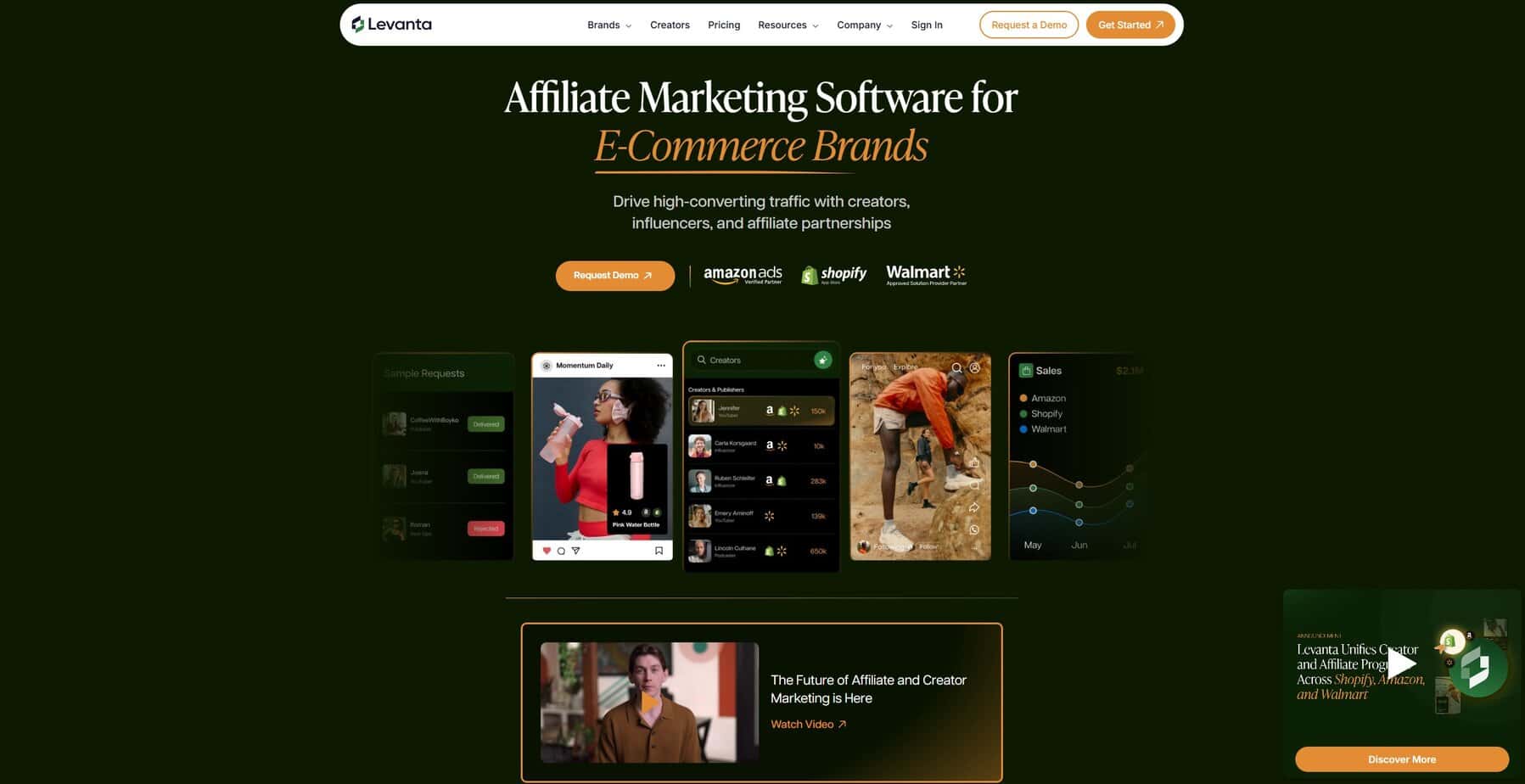
Best For: eCommerce brands selling on Amazon, Shopify, and/or Walmart who want a unified, modern creator and affiliate platform
Pricing: Gold Plan from $750/month (annual contract); plans are available for qualifying brands under $250K/month in Amazon sales if you contact them for details
Levanta is the only affiliate and creator platform built specifically for modern eCommerce brands, and its 2026 Shopify integration makes it the first and only solution to unify affiliate and creator programs across Amazon, Shopify, and Walmart in a single dashboard.
Levanta is built around performance-driven creator partnerships. The platform’s AI-powered Creator Marketplace connects brands with ~60,000+ vetted creators, bloggers, influencers, deal sites, and publishers who are proven to drive eCommerce sales. As with any marketplace, however, access to creators doesn’t guarantee performance. Brands still need competitive commission structures and active program management to see strong results.
Social listening tools help you identify creators who are already talking about your brand. Product seeding is built in, meaning brands can send samples to creators and let creators request products directly, all automated within the platform.
Rather than stitching together multiple tracking layers, Levanta connects directly to Amazon, Shopify, and Walmart natively. This gives you ASIN- and SKU-level visibility into exactly which creators are driving which sales, along with deeper reporting around incrementality and brand halo effects across channels. Payments and 1099 tax filing are handled automatically, removing one of the biggest administrative headaches in affiliate program management.
Levanta supports a flexible range of commission models (CPA, CPC, flat fee, hybrid flat fee plus commission, and paid placement) giving brands more control over how they structure creator relationships. It also helps brands maximize Amazon’s Brand Referral Bonus program, effectively reducing the net cost of affiliate commissions, a feature no traditional affiliate platform offers.
However, at $750/month on an annual contract, Levanta is generally better suited for growth-stage brands rather than early-stage sellers still validating product-market fit.
Strengths:
- The only platform unifying Amazon, Shopify, and Walmart in one dashboard = native, one-click integrations, no custom engineering required
- ASIN- and SKU-level tracking with incrementality and brand halo effect visibility across channels
- AI-powered creator marketplace with 60,000+ vetted creators, social listening, built-in product seeding, and paid placements
- Flexible commission models: CPS, CPC, flat fee, and hybridAutomated payments, 1099 filing, and transparent pricing = no hidden deposits or stacked fees
- Amazon Brand Referral Bonus support to offset commission costs
- Dedicated account manager and ticketed support
Things to Consider:
- Designed for eCommerce brands, not ideal for SaaS, finance, or non-product businesses
- Gold Plan requires an annual contract
- Best suited for brands with validated products and a dedicated marketing budget
- Not the best fit for very small brands or early-stage startups without a dedicated marketing budget
Bottom Line: Levanta is a platform built for the way creator-driven commerce actually works in 2026. For eCommerce brands selling on Amazon, Shopify, or Walmart, it’s the standout choice.
2. Impact.com
Best For: Mid-size to enterprise brands running broad affiliate and partnership programs across multiple channels
Pricing: Starter from $30/month (very limited); Essentials from $500/month; Pro from $2,500/month; Enterprise, custom pricing
Impact.com is widely regarded as one of the most modern general partnership management platforms available, and it’s great for brands running multi-channel programs. It has strong automation, comprehensive tracking, and a solid partner marketplace.
That said, the $30/month Starter plan is too limited for some affiliate programs, and meaningful features don’t unlock until the $500/month Essentials tier. And if dedicated customer support matters to you, that doesn’t arrive until the $2,500/month Pro plan. For brands specifically selling on Amazon, Shopify, or Walmart, Impact.com also lacks native marketplace integrations, product seeding, and Amazon Attribution capabilities.
Bottom Line: A strong modern alternative for brands running broad, multi-channel affiliate programs. Less compelling for eCommerce marketplace sellers who need platform-specific integrations and creator tools.
3. Refersion
Best For: New or early-stage DTC brands running straightforward affiliate programs on Shopify or their own storefront
Pricing: Launch from $39/month + 3% of affiliate sales; Growth $129/month + 2%; Scale from $599/month + 1%; free marketplace listing available
Refersion stands out in this roundup for one reason above all others: pricing transparency. At $39/month to start, it’s the most accessible option here, and the tiered structure is refreshingly clear. For a brand just getting its first affiliate program off the ground on Shopify, it’s a practical and low-risk starting point.
However, while Refersion is built exclusively for DTC storefront, there are no Amazon, Shopify, Walmart, or marketplace integrations. Creator discovery tools are basic, and there’s no product seeding, social listening, or cross-channel performance tracking. The transaction fee model also means costs escalate as your program grows.
Bottom Line: A solid entry point for DTC brands new to affiliate marketing. Brands selling on Amazon or Walmart, or those wanting to scale a unified creator program, will outgrow it fast.
4. CJ Affiliate (Commission Junction)

Best For: Large enterprise brands with substantial affiliate budgets and a need for access to a massive, global publisher network
Pricing: Custom; setup fees typically $500–$650+; annual network access fees apply; percentage fee charged on top of partner payouts; $3,000+ deposit typically required
CJ Affiliate is one of the oldest and largest affiliate networks in the world, offering enterprise brands global scale, advanced cookieless tracking, deep analytics through Publicis Groupe, and flexible commission models, making it a powerhouse for brands serious about scaling their affiliate program. But the pricing structure is among the most complex and opaque in the industry. CJ’s layered pricing (setup fees, annual access fees, commissions, and a large upfront deposit) makes the true cost hard to forecast, which is exactly what sends brands looking for alternatives.
Contrary to older perceptions, CJ Affiliate is a modern performance platform featuring a dedicated creator marketplace via its partnership with CreatorIQ. It provides advanced capabilities like product-level commissioning, automated Shopify plugins, and strategic product seeding through its VIP influencer campaigns.
Bottom Line: A data-heavy powerhouse for brands that want to scale through high-tier partnerships and complex commissioning. While historically enterprise-focused, its new Shopify integrations and CJ Influence tools now make it a viable, high-growth engine for mid-market eCommerce brands.
5. Rakuten Advertising

Best For: Large enterprise brands requiring a global affiliate network with a managed-service approach
Pricing: Performance-based; no published setup fees; commission fees and platform costs vary; custom quotes required; Net-60 payment schedule
Rakuten Advertising (formerly LinkShare) has a solid reputation in the affiliate marketing world, and for big brands with a full team dedicated to managing partnerships, it probably deserves it. The idea of paying only for performance with no setup fees sounds appealing. But you can’t just sign up and get started. To even find out what it costs, you have to go through their entire sales process. And the platform isn’t built for someone who wants to figure things out on their own. It’s designed for large companies with the staff and budget to match.
Its Net-60 payment schedule, meaning commissions are reconciled 60 days after the month a sale is recorded, creates real cash flow complexity for brands managing tight commission budgets. And like CJ, there are no marketplace-specific integrations or modern creator tools.
Bottom Line: An established global network built for complex, managed programs. It is less ideal for scaling brands because its manual onboarding and 60-day reconciliation cycles can limit the operational speed and liquidity that smaller, high-growth teams require.
6. Partnerize

Best For: Medium-to-large enterprise brands with complex partnership programs and flexible budgets
Pricing: Typically starts around $2,000/month; license-based or performance-based models available; all-inclusive with no overage fees; custom quotes required
Partnerize’s flexible pricing structure lets brands choose between a fixed annual license or a performance-based model depending on how they budget. The all-inclusive pricing with no overage penalties is a real differentiator for high-volume programs, and the platform includes AI-powered partner discovery and fraud protection.
But at $2,000/month minimum, with no published pricing and a required sales conversation, Partnerize is firmly positioned for enterprise teams managing large, complex programs. There are no Amazon, Shopify, or Walmart integrations and no modern creator marketing tools.
Bottom Line: A well-built enterprise platform with genuine pricing flexibility. At $2,000/month minimum, it’s out of reach for most growing eCommerce brands and doesn’t address the creator-marketing gap that’s driving brands to look for Awin alternatives in the first place.
How to Choose the Right Platform
If your growth is anchored in Amazon, Shopify, and Walmart, the priority is unification. Levanta is the specialist here, designed to solve the “fragmented dashboard” problem. It is the most direct path to scaling creator-driven sales across those three specific ecosystems, though its higher entry price and annual commitment mean it is a tool for brands ready to scale, rather than those just testing the waters.
If you require a massive, traditional publisher network for a non-eCommerce brand (like SaaS or Travel), Impact.com or CJ remain the industry standards. They have both the global reach and legacy publisher relationships that a younger, commerce-focused platform cannot yet match. The trade-off is a steeper learning curve and, in many cases, a lack of native marketplace integration.
If you are a startup with a limited budget, Refersion is a low-stakes entry point. While it lacks the creator marketplace and multi-channel attribution of a more robust system, it does let you build a foundational program before graduating to a high-performance stack.
Where Do We Go from Here?
The broader trends in 2026 are hard to ignore. The “old way” of affiliate marketing (relying on coupon sites and cashback links) is a 2015 strategy that no longer captures where consumers actually spend their time. Today, purchase decisions are driven by short-form video, YouTube reviewers, and trusted creators.
For most modern eCommerce brands, the goal is building a performance-focused ecosystem that drives external traffic, boosts organic rankings, and provides SKU-level visibility across all sales channels.
While legacy platforms are attempting to retrofit their technology for this new reality, sites like Levanta were built inside of it. By unifying the three most critical commerce channels (Amazon, Shopify, and Walmart) into a single workflow, it addresses the specific pain points of the modern brands.
For brands that have outgrown traditional networks and are ready to commit to a creator-first future, these Awin alternatives are the most logical evolution for a 2026 marketing stack.