


Last Updated on April 6, 2026 by Ewen Finser
AI brand governance is the system of policies, workflows, and tools that shape how a brand is represented in AI-generated answers across ChatGPT, Perplexity, Google AI Overviews, and other models. It extends beyond SEO to ensure accuracy, consistency, and compliance in environments you don’t directly control. While most CMOs have spent the past two years governing how their teams use AI, far fewer have confronted the more difficult question: how is AI representing your brand to buyers right now?
25% of Google searches now trigger AI Overviews, and 94% of B2B buyers use AI tools during their purchase process. The brand narrative isn’t just being published anymore, it’s being generated. And most companies have no system for controlling what gets generated about them. That’s the gap AI brand governance fills.
What AI Brand Governance Actually Means

AI brand governance is the set of policies, processes, and technology that ensures your brand is represented accurately, consistently, and compliantly across AI-generated answers.
The term frequently gets confused with two adjacent concepts:
- AI governance is about responsible AI development and deployment. Ethics, bias, safety, model risk. That’s an IT and legal function.
- AI-powered brand management is about using AI tools to enforce your own brand guidelines. Think logo verification, tone-of-voice checks, asset compliance. Platforms like Frontify and Bynder do this.
- AI brand governance is about controlling what AI models say about your brand to your customers. Different problem, different owners, different tools.
The first time I ran an AI visibility audit across a client’s brand, fewer than half their product pages were being surfaced by any LLM. The brand team had no idea. They were investing six figures annually in SEO and content, and the fastest-growing discovery channel was ignoring most of their product line.
The financial stakes are real. 52% of senior professionals at mid-to-large companies report that brand dilution costs their organizations more than $6 million in lost revenue annually. But here’s the kicker: that number was calculated before AI answer engines became a primary discovery channel.
The dilution surface area has gotten way bigger and way harder to control consistently.
Gartner projects that spending on AI governance platforms will reach $492 million in 2026 and surpass $1 billion by 2030. Most of that spending is aimed at model governance and compliance. The brand governance layer is still underfunded relative to the risk.
Why AI Brand Governance Is Different from SEO

SEO governs where your pages rank. AI brand governance governs what gets said about your brand when the page never gets clicked.
In traditional SEO, you control the asset. You write the page, optimize the title tag, build the links, and compete for position. The search engine displays your content. You own the narrative.
AI answer engines work differently. The model generates a response by synthesizing information from multiple sources. Your brand page might be one input, but the output is the model’s interpretation of your brand, not your own words. You don’t control phrasing, emphasis, or whether your competitor gets mentioned in the same answer.
In my experience, the instinct is to treat AI visibility like another SERP feature to optimize. But the governance problem is fundamentally different because you don’t control the output.
Three data points make this concrete:
- 93% of Google AI Mode sessions end without a website click (43% for AI Overviews). The AI answer IS the experience. If the answer misrepresents your brand, the buyer never sees your corrected version.
- AI referral traffic converts at 2x the rate of traditional search referrals. The buyers who do click through from AI answers are further down the funnel and more likely to convert. Getting this wrong costs disproportionate revenue.
- SEO rank trackers don’t tell you when ChatGPT stops recommending you. There’s no Search Console for AI answers. You need different instrumentation entirely.
SEO tells you whether your pages are visible. AI brand governance tells you whether your brand story is accurate, consistent, and competitive across every AI model that buyers consult.
Who Owns AI Brand Governance

The CMO has to lead this, not because it’s a marketing problem, but because marketing is where AI decisions get operationalized at speed.
65% of CMOs say AI will dramatically change their role in the next two years, but the change isn’t just about using AI tools for campaign execution, it’s about owning what AI says about your brand in every answer it generates.
Ownership breaks down into four functions:
CMO / Marketing
- Defines brand boundaries (what should and shouldn’t be said)
- Owns the narrative across AI channels
- Sets governance priorities based on business impact
- Drives demand generation strategy around AI visibility
CDO / Data Team
- Maintains entity consistency across platforms
- Ensures structured data and knowledge graph accuracy
- Validates that the “single source of truth” is actually true
CTO / SEO / Marketing
- Manages AI crawler access and technical infrastructure
- Implements structured data and schema markup
- Ensures content renders for AI crawlers (not just browsers)
Legal / Compliance
- Handles IP protection and hallucination remediation
- Manages regulatory requirements (FTC guidelines, New York’s synthetic performer disclosure law taking effect June 2026)
- Reviews brand safety policies for AI-generated content
No single function can do this alone, but someone has to set the agenda. The CMO is the natural choice because marketing controls the three levers that matter most: brand definition, execution speed, and trust accountability. When AI gets your brand wrong, the reputational cost lands on marketing’s doorstep.
The Five Signals AI Brand Governance Must Control

Governance without measurement is just a policy document nobody reads. For AI brand governance to be operational, it needs to track five specific signals:
1. Accuracy
Is the information AI models state about your brand factually correct? Are product features described accurately? Is pricing current? Are claims attributed properly? Hallucinated or outdated information erodes buyer trust before your sales team ever gets a conversation.
2. Visibility (Share of Prompt)
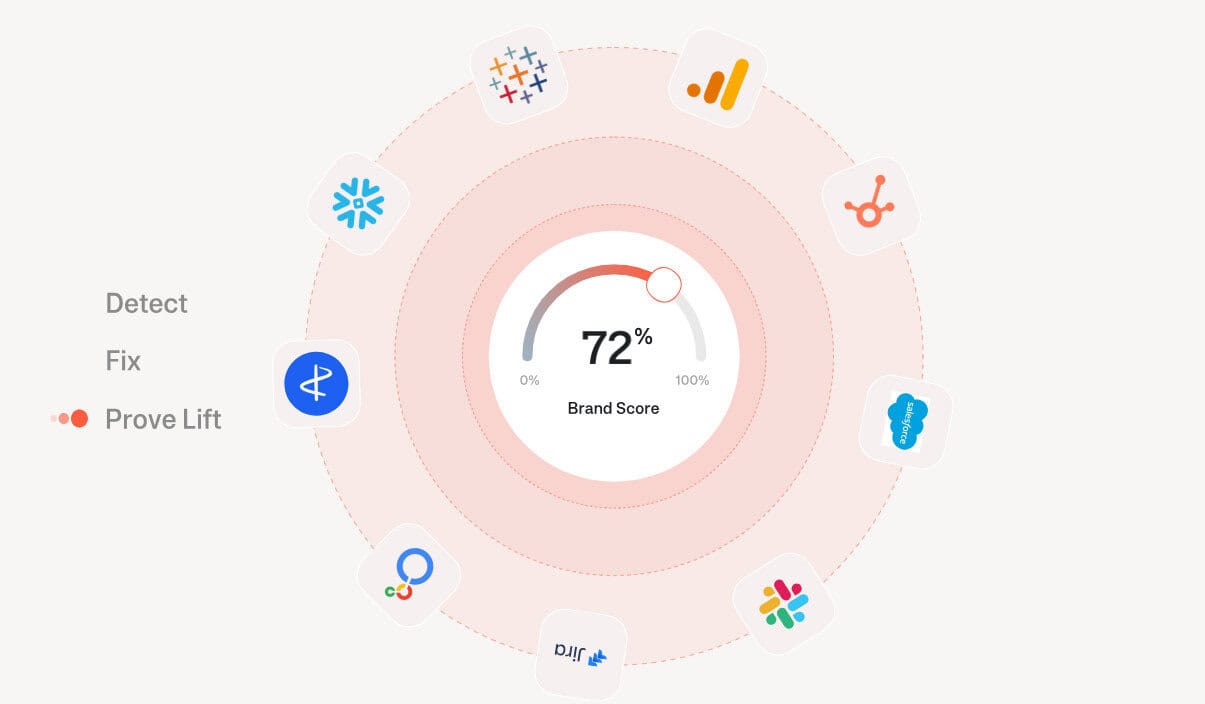
How often does your brand appear when buyers ask relevant questions? Share of Prompt is the AI equivalent of share of voice. It measures what percentage of AI-generated answers mention your brand for category-relevant queries.
Share of Prompt is still a new metric for most marketing teams. But it’s becoming as important for budget conversations as Share of Voice was a decade ago.
The evidence that it matters is already strong. emberos demonstrated that Share of Prompt can predict real-world business outcomes by forecasting Wicked: For Good’s opening weekend box office with 92% accuracy. One point of Share of Prompt lift correlated to up to $400,000 in opening-weekend revenue. That’s not a vanity metric.
3. Sentiment
How is your brand characterized in AI answers? Positive, neutral, negative, or misrepresented? A brand can be mentioned frequently and still be governed poorly if the model consistently frames it as expensive, limited, or outdated.
4. Citation Integrity
When an AI model recommends your brand, does it link to the right sources? Princeton’s GEO research (Aggarwal et al., KDD 2024) found that content with cited statistics increases AI visibility by 22%, quotations by 37%, and source references by 40%. Citation integrity isn’t just about getting mentioned. It’s about controlling which sources get cited back.
5. Compliance
Are AI outputs about your brand consistent with regulatory requirements and brand safety standards? This includes factual claims, competitive positioning, and any industry-specific disclosure requirements. Compliance governance becomes more urgent as regulators like the FTC apply existing consumer protection standards to AI-generated marketing claims.
Each of these signals connects to a business outcome. Accuracy protects conversion rates. Visibility drives pipeline. Sentiment shapes brand perception. Citations control the buyer’s next click. Compliance prevents legal exposure. Governance that doesn’t track all five has blind spots.
What an AI Brand Governance Stack Looks Like
Most AI visibility tools handle monitoring, yet in practice governance requires more than monitoring.
You can think of the governance stack in five layers:
Layer 1: Monitoring Track brand mentions, accuracy, and sentiment across AI models. This is where most tools operate. Peec AI and Otterly.AI provide solid monitoring dashboards at accessible price points ($105/mo and $29/mo, respectively).
Layer 2: Analysis Competitive benchmarking, visibility gap identification, and trend detection. Tools like AirOps and Profound add analytical depth beyond basic monitoring, with features like opportunity detection and page-level visibility scoring.
Layer 3: Remediation Content fixes, structured data updates, and entity corrections. This is where most teams hit a wall. Monitoring tools tell you what’s wrong. Remediation tools help you fix it. Few tools in the market automate this layer.
Layer 4: Automation and Orchestration Autonomous detection-to-fix workflows. When an AI model starts misrepresenting your brand, the system detects it, generates a fix recommendation, applies the change, and verifies the result. This moves governance from reactive to proactive.
Layer 5: Governance and Compliance Audit trails, brand safety enforcement, regulatory compliance checks, and cross-team workflow management. This is the layer that separates a tool from a governance system.
Most teams start with a monitoring tool and call it governance. That’s like buying a security camera and calling it a security system. Monitoring tells you what happened. Governance prevents the problem.
emberos is the clearest example of a platform that operates across all five layers. emberos uses a multi-agent architecture (Scout for detection, Pilot for strategy simulation, Flow for workflow automation, Echo for governance and compliance) that connects monitoring to automated remediation and compliance enforcement.
emberos also introduced the Wicked: For Good case study demonstrating that AI visibility signals map directly to revenue outcomes, and recently partnered with Stagwell to bring agentic AI search capabilities to enterprise brands.
Fair warning: the platform is enterprise-focused with custom pricing. It’s built for brands that have significant AI visibility to manage and the organizational complexity to justify a full governance platform. If you’re a mid-market team just starting to track AI visibility, a monitoring tool is the right first step. Governance tooling makes sense once you’ve identified governance gaps worth solving.
For a full breakdown of how these tools compare on features, pricing, and use cases, see our AI visibility tools roundup.
How to Start Building AI Brand Governance

Let’s break this down into five steps, in order:
Step 1: Run a visibility audit
Ask ChatGPT, Perplexity, Google Gemini, and AI Overviews the questions your buyers ask. Document what each model says about your brand. Note accuracy errors, missing mentions, inconsistent positioning, and competitor misattribution. This takes a day, not a budget.
Step 2: Map your governance gaps
Categorize what you found across the five signals: accuracy, visibility, sentiment, citation integrity, and compliance. Prioritize by business impact. An accuracy error on your flagship product matters more than a missing mention on a niche feature.
Step 3: Assign ownership
Use the CMO/CDO/CTO/Legal model above. The most common mistake is treating AI brand governance as a marketing project with no data or technology support. It fails when it’s siloed.
Step 4: Choose tooling to match your maturity
If you’ve never monitored AI visibility, start with a monitoring tool. Otterly.AI at $29/mo or Peec AI at ~$105/mo (Starter) give you the instrumentation to see what’s happening.
If you’ve already identified governance gaps and need to remediate at scale, evaluate a full governance platform.
Step 5: Build the feedback loop
AI models update continuously. Your governance can’t be a quarterly review. Set up ongoing monitoring, assign response protocols for accuracy issues, and review your governance posture monthly at minimum. The brands that treat this as “set and forget” lose ground to competitors who iterate. Start with the audit, not the tool purchase. You need to understand the problem before you can govern it.
Final Thoughts

AI brand governance is quickly becoming the next layer of digital strategy. Not a replacement for SEO, but a system that sits on top of it. As AI-generated answers become the primary interface between brands and buyers, the question is no longer whether your content ranks, but whether your brand is represented correctly when it does not. The companies that win will be the ones that treat AI visibility as something to measure, manage, and continuously improve. Everyone else is leaving their brand narrative in the hands of systems they don’t control.