


- What Sets Tax Software Affiliate Marketing Apart
- What Tax Software Companies Should Look For in Affiliate Software
- Quick Comparison: Top Affiliate Software for Tax Software Companies
- Best Affiliate Software for Tax Software Companies in 2026
- Tune: Best for Developer-Led Tax Platforms
- The Bottom Line
Last Updated on March 30, 2026 by Ewen Finser
Tax software is one of the most volatile, compliance-sensitive, and conversion-complex products to match an affiliate strategy. Add in the fact that tax software companies experience a year’s worth of business in one quarter, and madness is pretty much a constant.
Whether you’re a direct-to-consumer tax filing platform, a professional tax preparer suite, a small business accounting tool, or a robust enterprise tax compliance solution, scaling your affiliate strategy requires a platform built to handle high-traffic compressed seasonal windows, strict regulatory messaging, tiered subscription models, and the inevitable fraud risks that spike every filing season, and AI integration and AI-driven fraud in the mix.
This is where the generic affiliate platforms fall short.
As a tax software company, you need affiliate software that can manage tight compliance around messaging and claims, multi-step conversion funnels, and payout structures that track and pay once the partnership parameters are met, whether that be a flat fee, commission, or a combination of both.
Below, I’m going to break down the best affiliate software platforms for tax software companies that will cover the needs of every size business and affiliate growth stage, from bootstrapped indie setups to nationally recognized brands.
What Sets Tax Software Affiliate Marketing Apart

Tax software affiliate programs are a beast in a category of their own, with distinctly challenging hurdles. From seasonal challenges to messaging compliance to fraud risks, the headaches can seem endless. Add in affiliate partnership management, and you have a perfect storm that you somehow have to manage.
1. Short Season Madness
Unlike most SaaS products with year-round acquisition cycles, tax software lives and dies by a narrow seasonal window: January to April 15, with a secondary spike around extension deadlines. For this reason, it is crucial that your affiliate platform can handle insane traffic surges, real-time and accurate reporting, and, of course, accurate attribution during this wild time.
2. Strict Compliance Around Messaging and Claims
Like with all fintech businesses and branches, tax-related marketing is highly regulated. This regulation and compliance flow right down to your affiliate partnerships. Affiliates cannot make guarantees around refunds, overstate accuracy or audit claims, or make biased comparisons to competitor products. The last thing anyone wants is the FTC on their back! For this reason, your affiliate platform must support strong creative governance so every word of partner-produced content is reviewed, approved, and auditable.
3. Multi-Step Conversion Funnels
The customer journey is far from a single click conversion. Use cases vary across the board here. A customer might start with a free account, complete a return, and pay at the point of filing. Others might subscribe to a host of extras and protections that will lead to affiliate commission payouts. Your affiliate software must track and account for the many micro-conversions along the way, not just the initial click or the final payment.
4. Fraud Risk During Peak Season
Unfortunately, as if there aren’t already enough fraudsters orbiting around fintech products, the tax filing season is like the prime time NBA for affiliate fraud. The bad actors and their dirty ways are an endless loop of fake account creations, incentivized installs, and bot-generated sign-ups. Without serious airtight fraud controls, you stand to lose a great deal of money.
5. Complex, Milestone-Based Payout Structures
With a complex customer journey comes a complex affiliate payout structure. Depending on your campaign, compensation payouts likely trigger at different intervals for different partnerships, with each having its own payout and validation requirements.
What Tax Software Companies Should Look For in Affiliate Software
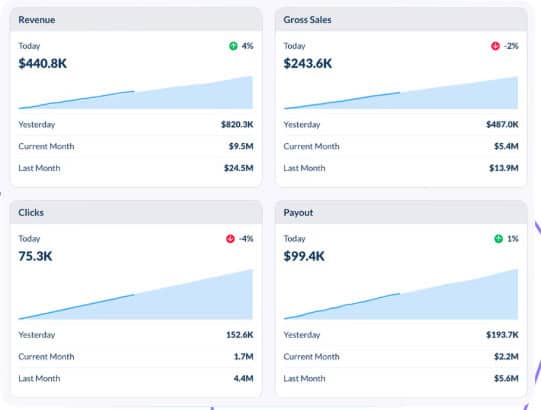
Before you even begin perusing affiliate platforms, there are a few non-negotiables it must haves to look for in an optimal platform:
1. Fraud Prevention
The best affiliate software for tax companies, especially, must block incentivized installs, fake account creation, bot traffic, and duplicate submissions.
Look for platforms that offer:
- IP tracking and restrictions
- Lead deduplication
- Encrypted server-to-server tracking
- Behavioral fraud scoring.
2. Creative Compliance and Governance
Affiliate messaging for tax products can be tricky at best. Creators love to be free and lose with their shoutouts, which can become a legal nightmare.
When it comes to compliance features, look for platforms that support:
- Creative approval workflows
- Audit-ready logs of every approved and rejected asset
- Role-based permissions for legal and compliance teams
- Version-controlled creative libraries that prevent affiliates from running outdated or non-compliant materials
3. Multi-Event Attribution Across the Funnel
A platform that only tracks last-click conversions will be a huge disservice to your affiliate partners, which is why you need a platform that offers custom event tracking for each stage of the funnel, from sign-up to return completion to payment, upgrade, and renewal. You also need server-to-server updates that keep attribution accurate across all sessions and devices.
4. Milestone and Tiered Payout Structures
In the same vein as multi-event attribution, your affiliate software should support:
- Milestone-based payouts (e.g., pay on free sign-up, pay again on paid filing)
- Tiered CPA structures based on product tier or revenue
- Revenue share for subscription renewals
- Hybrid CPA + revenue share models for high-value partners
5. Granular Reporting and Analytics
With the tax season nearly flying by at light speed, slow snapshots and reporting will not do. You need a platform that supports:
- Real-time partner performance reporting
- Funnel conversion by event stage
- Time-to-conversion data
- Detailed payout tracking tied to each milestone
Quick Comparison: Top Affiliate Software for Tax Software Companies
Platform | Strengths | Limitations | Best For | Tax Software Advantages |
Everflow | Multi-event tracking, fraud prevention, payout flexibility, real-time reporting | May be overkill for very small teams; requires some technical setup | Mid-market to enterprise tax software brands running complex funnels | Multi-step conversion tracking, milestone payouts, server-to-server fraud prevention |
Impact | Enterprise-grade workflows, global scale, contract automation | Steep learning curve, complex implementation, needs dedicated internal support | National consumer brands and enterprise tax compliance platforms | Deep governance, multi-team approvals, legal review workflows |
PartnerStack | SaaS-native, strong for subscription and renewal attribution, easy onboarding | Limited fraud controls, less customizable for complex payout logic | Growing SaaS tax platforms with subscription or freemium models | Subscription renewal tracking, partner onboarding flows |
Cake | Industry-leading lead validation, deduplication, event-based tracking | Lead-gen focused; less suited for influencer or hybrid programs | High-volume lead capture for accountant marketplaces or B2B tools | Lead fraud prevention, PII-conscious data handling |
Tune | Flexible API, strong for developer-led teams, good fraud tooling | Requires significant technical resources to configure well | Tech-forward tax platforms with in-house engineering support | Customizable tracking logic, API-first architecture |
Best Affiliate Software for Tax Software Companies in 2026
Everflow: Best All-Around for Tax Software Companies
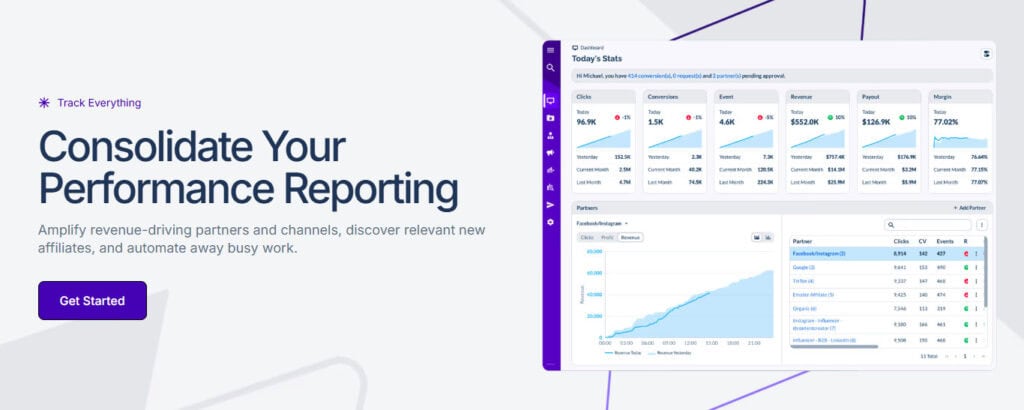
Where many competing platforms force you to choose between fraud prevention, conversion complexity, and payout flexibility, Everflow handles all three (and then some!) without compromise. Its multi-event tracking architecture is purpose-built for complicated customer journeys and multi-stage attribution. Add in fraud controls, real-time reporting, and intuitive payouts that support milestone, tiered CPA, revenue share, and hybrid structures, and you have a platform worth a spot on your short list.
Pros:
- Multi-step conversion tracking across the full funnel
- Automated milestone and tiered payout structures
- Robust fraud prevention tools (IP filtering, deduplication, server-to-server tracking)
- Fast, real-time reporting with partner performance breakdowns
- Strong compliance governance tools with approval workflows and audit logs
- Scales smoothly from mid-size to enterprise
Cons:
- May be a little too much for very small teams starting their affiliate strategy
- Requires some technical know-how to take full advantage of event-tracking
- Not ideal for brands running purely influencer-driven programs
Impact.com: Best for National Consumer Brands and Large Enterprises
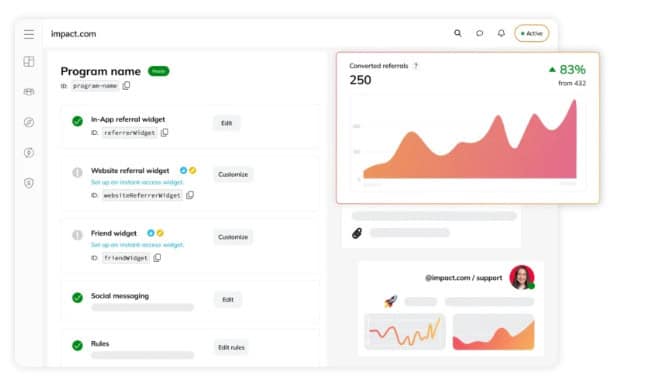
If you’re running affiliate partnerships with dozens of creators, influencers, and niche channels and need to answer to multiple internal legal and marketing stakeholders, Impact’s enterprise-grade infrastructure is a solid option. Its contract automation, approval workflows, and legal review scheduling are golden during tax season. That said, the implementation complexity and steep learning curve are very real hurdles for smaller teams or companies that cannot allocate the human and financial resources needed to get the system off the ground and operating at scale.
Pros:
- Automated contracts and workflow
- Multi-team and multi-region/global support
- Strict compliance and fraud prevention
- Complex multi-stage conversion tracking and payment
- Legal team review options
Cons:
- Extremely robust system that may be overwhelming for small to mid-sized teams
- Implementation takes time
- Steep learning curve that needs substantial operational resources
PartnerStack: Best for Subscription-Led Tax SaaS Platforms

If your company is heavily subscription-first or offers free-to-paid models, particularly those in the SMB or professional preparer segments, PartnerStack is a great option for your business. Its partner onboarding experience is intuitive, and its native support for recurring commission structures is straightforward. Unfortunately, its subpar fraud prevention tools and lack of complex payout customization leave a little to be desired.
Pros:
- Subscription and renewal commission tracking
- Intuitive partner portal with easy onboarding
- Solid SaaS ecosystem integrations
- Light learning curve for teams new to affiliate partnerships
Cons:
- Limited fraud detection
- Less flexible for complex, milestone-based payout logic
- Lackluster reporting
Cake: Best for High-Volume Lead Generation

Cake’s lead validation and deduplication logic is genuinely industry-leading, making it a great option if you are running multiple B2B lead generation campaigns. Its event-based tracking and PII-conscious data infrastructure support most compliance needs. That said, if you are running diversified affiliate programs with influencer or content partners, Cake is a lead-gen powerhouse and not well-suited for hybrid affiliate partnerships or conversion models.
Pros:
- Industry-leading lead validation and deduplication
- Secure data handling with PII-conscious architecture
- Event-based tracking great for financial product journeys
- Strong fraud prevention at the lead level
Cons:
- Primarily lead-gen focused
- Not ideal for hybrid affiliate programs
- Complex technical setup with a steep learning curve
Tune: Best for Developer-Led Tax Platforms

If you are running substantial in-house engineering resources and want maximum flexibility in tracking, attribution, and reporting, you’re going to want to tune in to Tune. Its API-first design allows for deep customization of conversion events and payout logic, and its fraud tooling is solid. The tradeoff is that Tune requires a fairly steep technical investment to configure correctly; Tune is not a plug-and-play software set up by any stretch.
Pros:
- Highly customizable via open API
- Solid fraud detection tools
- Flexible tracking logic for complex funnels
Cons:
- Requires significant engineering resources to configure
- Less intuitive for non-technical partnership managers
- Reporting and compliance tools leave a little to be desired
The Bottom Line
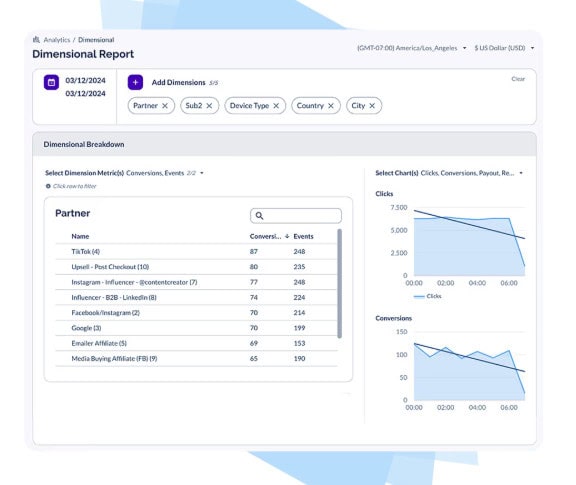
For tax software companies, the right affiliate platform isn’t just a tracking tool, it’s a compliance safeguard, a fraud firewall, and a serious growth engine, all-in-one. With a year’s worth of business crammed into one quarter that sees insane traffic, there’s no room for attribution errors, payout mistakes, or fraud that goes undetected. Tax software companies already have enough to manage in that quarter, which is why finding the best affiliate software to support your affiliate strategy is more than essential.
If your affiliate strategy is off the ground, but nowhere near enterprise status, Everflow stands out from the pack as the best all-around affiliate platform for tax software companies at any meaningful scale. Its ability to handle multi-step conversion funnels, automate complex milestone payouts, prevent fraud in real time, and surface granular performance data makes it a solid competitor in the space.
However, if your team is new to affiliate partnerships, PartnerStack offers a lower-friction entry point, easyish onboarding experience, and solid subscription tracking. If B2B lead generation is your focus, Cake’s lead validation infrastructure is worth a serious look.