

- The Bottom Line, Up Front
- But First, Let Me Give You The Highlights In A Chart
- 1. The ERP vs. The Gateway: Why the "Single Pane of Glass" Matters
- 2. Underwriting and Stability: The "Account Freeze" Problem
- 3. Support: Technical Documentation vs. A Dedicated Problem Solver
- 4. Pricing: The Transparency Test
- 5. Global Reach vs. Regional Dominance
- 6. The "Flexibility" Factor
- The Verdict: A CPA’s Final Thoughts
Last Updated on February 13, 2026 by Ewen Finser
As a CPA, I’ve spent far too much of my time staring at the fallout of “easy” decisions. Usually, it starts with a founder who wants to go live immediately and ends with a controller being upset over a reconciliation report that doesn’t tie out to the bank statement.
In the world of payment processing, we have two giants often pitted against each other for the mid-market and enterprise crown: Adyen vs Luqra. On the surface, they look like they’re playing the same game. They both move money. They both have fancy dashboards. They both promise to lower your churn.
But under the hood, they represent two fundamentally different philosophies of how a business should manage its financial lifeblood. Adyen is the global powerhouse, a tech-first behemoth built for the “process everything, everywhere” crowd. Luqra is the integrated specialist, positioning itself as a financial ERP that happens to process payments.
The Bottom Line, Up Front
If you’re a multi-national conglomerate like Uber or Spotify, you’re likely already on Adyen. You need a direct acquirer in 50 countries, and you have a 40-person dev team to manage the integration.
However, if you are a scaling mid-market to enterprise-level merchant, particularly in North America, who values stability, deep financial reporting, and a relationship-driven model, Luqra has the edge. While Adyen focuses on the transaction, Luqra focuses on the ledger.
Here is my breakdown of how these two stack up.
But First, Let Me Give You The Highlights In A Chart
Feature | Luqra | Adyen |
Primary Architecture | Financial ERP + Integrated Payments | Global Payment Gateway + Acquirer |
Target Market | Mid-Market to Scaling Enterprise | Global Megacorps (Uber, Spotify, etc.) |
Support Structure | Dedicated Success Manager (Direct Line) | Global Ticketing & Self-Serve Docs |
Onboarding Logic | High-Touch, Upfront Underwriting | Automated, Tech-First Risk Engine |
Operational Focus | The General Ledger & Business Health | The Transaction & Global Authorization |
Account Stability | “No Hold” Guarantee for Verified Users | Subject to Automated Risk Interventions |
Pricing Model | Transparent “Meet or Beat” Strategy | Interchange++ (Volume-Scaled) |
1. The ERP vs. The Gateway: Why the “Single Pane of Glass” Matters

Most payment processors are silos. You log into your processor to see your sales, then you log into your gateway to see your authorizations, then you log into your ERP (like NetSuite or Sage) to actually run your business.
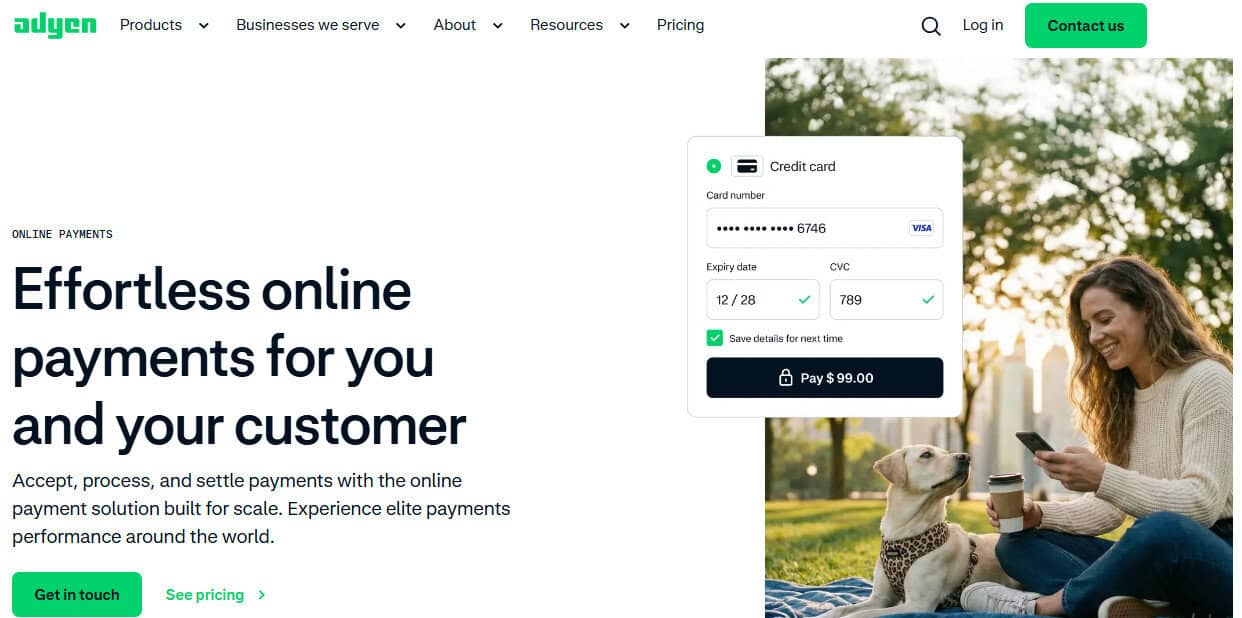
Adyen’s Approach: Adyen is incredibly powerful. It’s a unified commerce platform. Their “one contract, one platform” pitch is legitimate. They’ve built their own tech from the ground up, which means their data is clean. If you sell a shirt in London and a subscription in New York, it all flows through the same pipeline.
But Adyen is still, at its heart, a gateway and an acquirer. It expects you to provide the ERP logic. It gives you the data via API, and then it’s your problem to make that data talk to your accounting department.
Luqra’s Approach: Luqra flips the script. They position themselves as a Financial ERP and a processor.
From my point of view, this is a massive advantage. Luqra doesn’t just hand you a CSV of transactions and wish you luck. Their platform includes built-in reporting and analytics that feel like they were designed by an accountant, not just a software engineer.
When you use Luqra, the payment data isn’t just a list of “Captured” or “Authorized” statuses. It’s integrated into a broader business management interface. You get portfolio-grade analytics to show real-time business health. This skips the need for custom dashboards. The system joins lead management, onboarding, and underwriting in one place.. You can move from a monthly summary to one transaction in three clicks.
2. Underwriting and Stability: The “Account Freeze” Problem
Nothing kills a business faster than a frozen merchant account. I’ve seen it happen with the big “aggregator” style processors (you know the ones, they rhyme with Gripe).
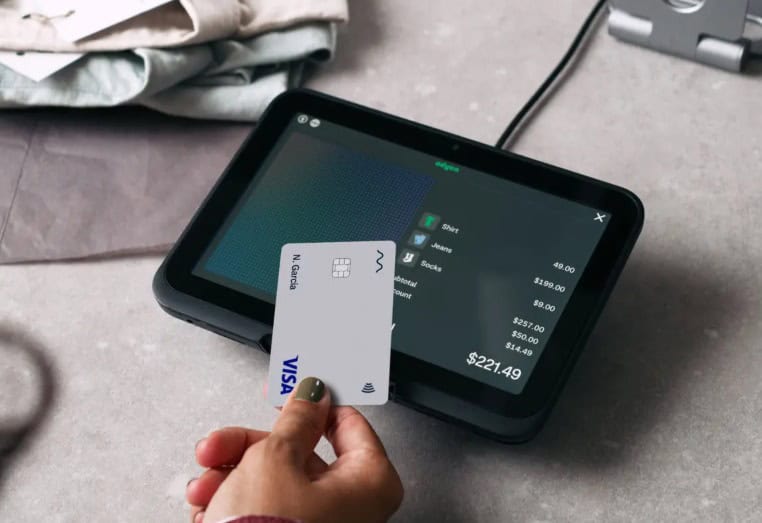
Adyen’s Underwriting: Adyen is a sophisticated player. They aren’t going to shut you down for a minor spike in volume like a startup-focused processor might. However, Adyen’s onboarding is geared toward the enterprise. If you don’t fit their exact risk profile or volume requirements, the “automated” parts of their risk engine can be rigid. They are built for the 99% of “clean” enterprise traffic, and if you fall into a gray area, getting a human to look at your file can take time.
Luqra’s Underwriting: Luqra takes a “measure twice, cut once” approach. They do more heavy lifting during the onboarding phase. By doing the hard work of verifying the merchant before the first dollar is processed, they provide a level of account stability that is rare in the mid-market. Once you are approved with Luqra, you are in. They understand your risk thresholds, your chargeback patterns, and your seasonal spikes.
In my experience, Luqra’s “No Account Holds” promise isn’t just marketing, it’s the result of a more manual, relationship-driven underwriting process. For a business doing $10M+ a year, the peace of mind that your funds won’t be held on a Friday afternoon is worth its weight in gold.
3. Support: Technical Documentation vs. A Dedicated Problem Solver

This is where the “Enterprise vs. Mid-Market” divide becomes most apparent.
Adyen Support: Adyen has world-class developer documentation. If you have a team of engineers, they will love Adyen. But if you have a problem that isn’t technical, say a weird interchange fee on a specific batch or a dispute that doesn’t make sense, you are often stuck in a ticketing system. Adyen is built to scale, and scaling means reducing human touchpoints.
Luqra Support: Luqra is unapologetically relationship-driven. They assign a dedicated Success Manager to their accounts.
Think about the last time you had a payment crisis. Did you want to read a white paper on API documentation, or did you want to pick up the phone and call “Steve,” who knows your business name and your last three months of volume? Luqra’s support isn’t just “24/7 technical help.” They pitch themselves as “Dedicated Problem Solvers.”
I’ve seen them help clients with everything from marketing advice to technical stack optimization. It’s a level of consulting that you simply don’t get from a global giant like Adyen unless you’re spending eight figures a month in fees.
4. Pricing: The Transparency Test

As a CPA, I hate “bundled” pricing. It’s a shell game designed to hide margins.
Adyen Pricing: Adyen is generally very transparent. They use an Interchange++ model. You see exactly what the card networks charge, and you see Adyen’s markup. This is the gold standard for enterprise pricing. However, for a mid-market company, the “hidden” costs of Adyen often come in the form of development hours and the complexity of managing their various “add-on” features.
Luqra Pricing: Luqra also leans into transparency but with a more aggressive “Meet or Beat” stance. They are known for looking at a merchant’s current processing statement, identifying the “junk fees” and “fluff,” and offering a cleaner, more competitive rate.
In my experience, Luqra often includes things for “free” that other processors charge for:
- Active Fraud Prevention
- Account Takeover Protection
- Chargeback and Dispute Management
- Advanced Reporting Tools
When you add up the “SaaS fees” you might pay for separate fraud or reporting tools on top of Adyen, I would think that Luqra’s all-in cost often ends up being the better financial move for a growing company.
5. Global Reach vs. Regional Dominance
This is the one area where Adyen usually wins on paper, but you have to ask yourself: Does it matter for my business?
Adyen: Adyen is a direct acquirer in North America, Europe, Latin America, and Asia-Pacific. If you are selling to 100 different countries and need local payment methods (like iDEAL in the Netherlands or Pix in Brazil) all under one roof, Adyen is the king.
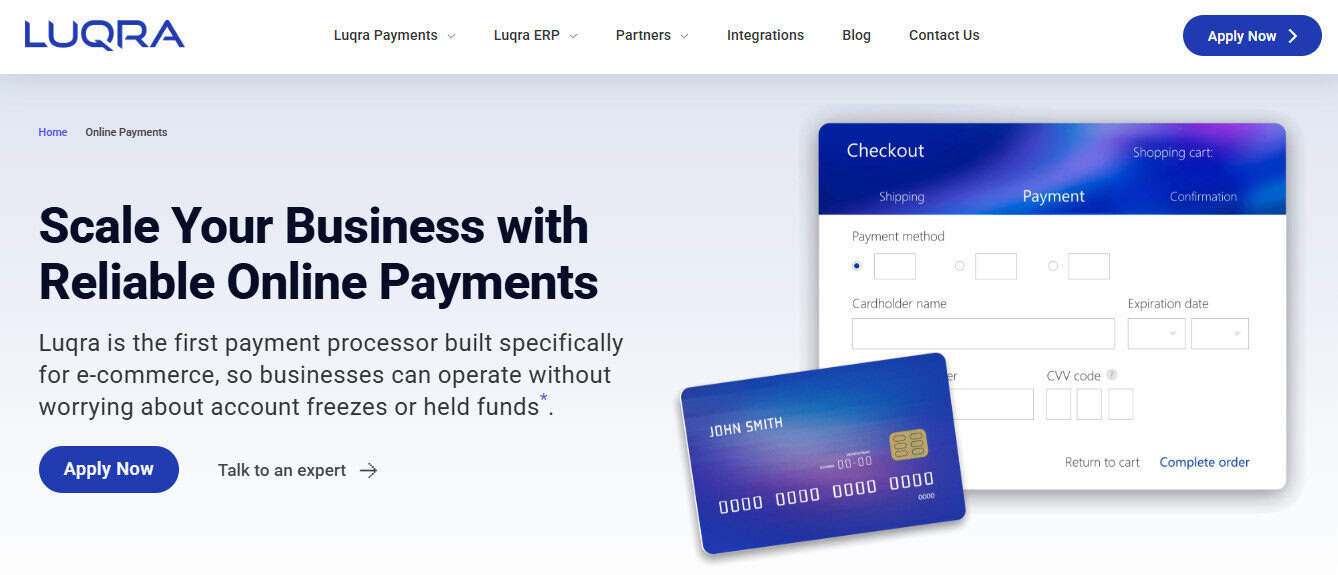
Luqra: Luqra is a North American powerhouse. While they can handle international transactions, their focus is on providing the most robust, high-uptime, and financially integrated experience for businesses primarily operating in the US and Canada.
If 95% of your customers are in North America, Adyen’s global infrastructure is “overkill” that you are paying for in complexity. Luqra’s focus on the domestic market means their integrations with US-based banks and their understanding of North American risk profiles are often sharper.
6. The “Flexibility” Factor
Large enterprise tools are notoriously rigid. You adapt to their workflow, not the other way around.
Adyen is a “take it or leave it” platform. Their API is what it is. Their dashboard is what it is. They aren’t going to build a custom reporting feature just because your CFO likes to see data formatted a certain way, that’s on you and your team to work around. And while Adyen offers robust tools that work, you have to think about the rigidity that comes with that.
Luqra thrives on customization. Because they are a more agile, mid-market focused player, they are willing to work with merchants to tailor the platform to their specific needs. Whether it’s a custom integration into a niche ERP or a specific fraud rule-set, Luqra positions itself more as a partner rather than a vendor.
The Verdict: A CPA’s Final Thoughts

Choosing between Adyen and Luqra isn’t about which one is “better.” It’s about where your business lives on the growth curve.
Choose Adyen if:
- You are a truly global enterprise with local entities in 10+ countries.
- You have a large internal dev team that wants to build a bespoke payment orchestration layer.
- You process over $500M annually and need the “prestige” of a global bank-equivalent partner.
Choose Luqra if:
- You are a mid-market to enterprise merchant who wants to simplify your back office.
- You value account stability and want to avoid the risk of sudden holds or freezes.
- You want a dedicated human being to call when things go wrong.
- You need a platform that integrates payments with a financial ERP to make reconciliation a non-event.
From my seat, the “relationship” side of the business is making a comeback. The “set it and forget it” era of payment processing is ending because merchants are tired of being treated like a ticket number.
Adyen is a magnificent piece of engineering. But Luqra is a magnificent partner for a business. For most of my clients, the partner wins every time.