


Last Updated on April 7, 2026 by Ewen Finser
Affiliate marketing isn’t what it used to be. The old playbook (find some publishers, set your commissions, let the conversions roll in) doesn’t work anymore. The channel has gotten more complex and more competitive. As it’s evolved, so have the expectations brands bring to their agency relationships.
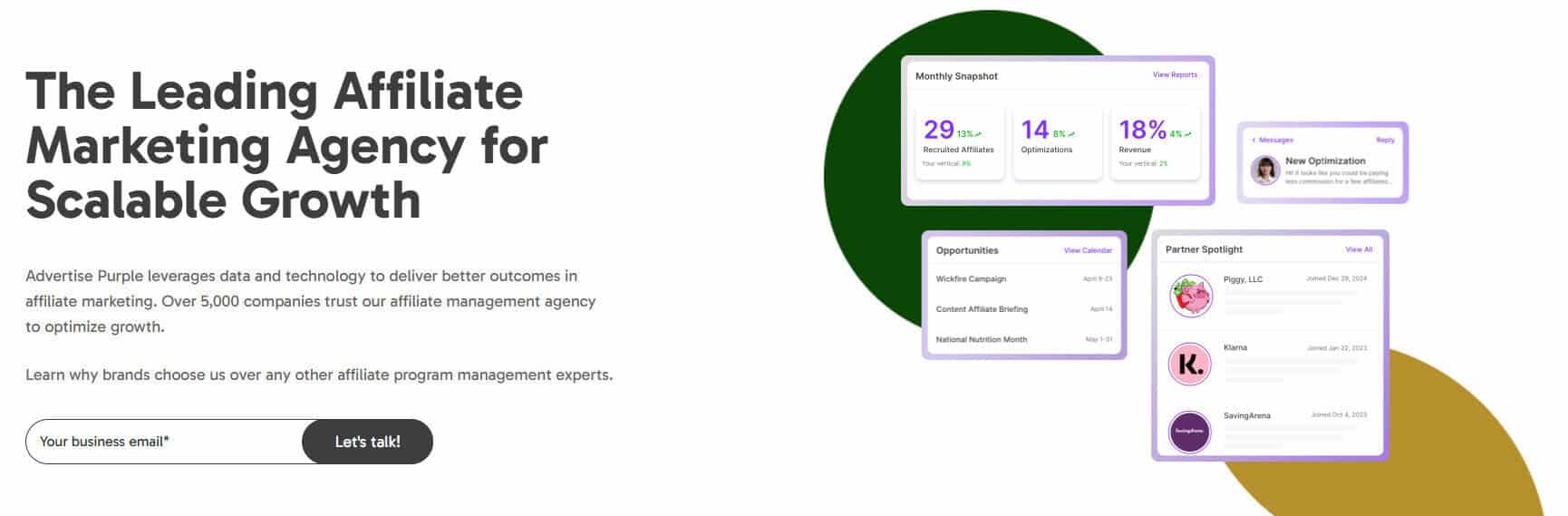
Advertise Purple is one of the most recognizable names in affiliate agency management. They’ve been around since 2012, they’ve worked with thousands of brands, and their Bloom platform has become a genuine selling point in the market. The numbers they put forward are hard to ignore.
But is there a better fit out there? Not because something went badly wrong, but because maybe your needs have changed?
Some brands need a more consultative approach (think Acceleration Partners), others want hands-on operational depth (Gen3 Marketing, Lab6 Media), and some are questioning whether they need an agency at all, leaning toward platform-first solutions like Impact.com or Rakuten Advertising.
If you’re looking to grow smarter, not just bigger, your needs might have outpaced Advertise Purple’s playbook. Whether it’s strategy, incrementality, partner quality, or global reach, the right alternative could help you stop chasing numbers and start driving the results that actually matter.
The Problem with Scale
When an agency is managing thousands of brands at once, they get good at building repeatable processes. It’s efficient of course, but it also means that the strategic attention available to your account has a ceiling. Program decisions might start to look like templates because there’s only so much rinse and repeat you can do. Partner recruitment could start to draw from whoever the agency already knows, rather than whoever is actually right for your brand.
To be fair, this isn’t a flaw unique to Advertise Purple, it’s just how large service businesses work. The brands that feel it most are usually those at a turning point. They’ve proven the affiliate channel works. Now they want to do something smarter with it, not just bigger. And that’s when the conversation about alternatives tends to start.
What Brands Are Actually Chasing

When you talk to brands that are actively evaluating other agencies, a few themes come up over and over.
Strategy, Not Just Management: Brands don’t just want someone to run their program (they want a partner who thinks about it). That means understanding the business, challenging assumptions, and bringing actionable ideas, not just quarterly reports.
Honest Measurement: Last-click attribution is no longer enough. Brands want agencies willing to ask the hard questions (are conversions truly incremental, or just “last-second touches”). Transparency and rigor in measurement are increasingly non-negotiable.
Partner Quality Over Quantity: A long publisher roster can look good on paper, but not all partners drive meaningful value. Smart brands prioritize selectivity (making sure affiliates contribute real revenue and long-term customer loyalty).
Building for the Future: Commission structures, tracking, and compliance frameworks are easier to get right upfront than to fix later. Forward-thinking brands want agencies focused on long-term program architecture, not just short-term gains.
The affiliate agency market is more varied than most people realize. Here’s an honest look at who’s operating in the space and what makes each of these Advertise Purple Alternatives worth considering:
1. Acceleration Partners

Acceleration Partners has built a reputation as one of the more serious strategic agencies in the market. Their whole positioning is around what they call “responsible growth”, which basically means they care about program quality, partner integrity, and long-term outcomes more than raw volume.
They’re not the agency you go to if you just want to accelerate quickly; they’re the agency you go to when you want to think carefully about what you’re actually building.
Their work covers affiliate, influencer, and broader partnership management, and they tend to attract brands that have already developed strong opinions about what good affiliate management looks like.
2. Gen3 Marketing

Gen3 Marketing is a solid full-service shop with a reputation for hands-on account management.
They’re thorough (program strategy, partner recruitment, compliance monitoring, competitive analysis) and they tend to appeal to brands that want an agency willing to get into the operational weeds, not just hand over a quarterly deck.
If you want an agency that’s going to be genuinely engaged in the day-to-day of your program, Gen3 is worth a serious look.
3. Lab6 Media

Lab6 Media is more specialized, with a strong focus on performance marketing and data-driven optimization.
They tend to appeal to brands that want tight integration between their affiliate program and the rest of their analytics infrastructure; basically organizations where “our affiliate program is a black box” is genuinely not acceptable.
4. PartnerCentric

PartnerCentric comes up a lot when brands are specifically trying to get more disciplined about partner quality and incrementality.
Their model is built around the idea that your affiliate program should be held to the same standards as any other marketing channel: real attribution, defined quality criteria, and a willingness to optimize toward actual business outcomes rather than flattering conversion numbers.
What tends to distinguish them isn’t a flashy proprietary platform; it’s their operational philosophy. They attract brands that have been around the block with affiliate once or twice and have very specific ideas about what they want to do differently.
If incrementality is a priority for your team, PartnerCentric is a name worth putting on your shortlist.
What If You Don’t Want Another Agency at All?

Some brands looking for alternatives aren’t actually looking for a different agency, but are instead questioning whether they need an agency at all. For those brands, the platform-first path is worth understanding.
Impact.com is probably the most popular choice for brands moving toward self-managed programs. Its infrastructure is genuinely strong (granular tracking, flexible commissioning, contract automation, partner discovery) and for brands with experienced in-house affiliate teams, it gives you the tools to run a sophisticated program without a managed service layer sitting on top of it.
Rakuten Advertising is worth a hard look if international growth is part of your roadmap. Their publisher network is particularly deep in Asian markets, and their managed network model opens doors that pure self-serve platforms can’t. If you’re building globally, Rakuten’s reach is a real differentiator.
CJ (Commission Junction) is one of the largest networks in the world, full stop. Its strength is breadth. If you need access to a wide range of publisher relationships across multiple verticals, CJ gets you there without having to build those relationships from scratch. Awin plays in a similar space but tends to be a better fit for smaller brands and niche categories. It’s often the right starting point for brands that aren’t quite ready for full agency management.
One honest caveat about going platform-first: technology is great at optimizing what it can measure, but it can’t replicate the judgment, the publisher relationships, or the program expertise that a good affiliate manager brings. If your in-house team has real affiliate experience, self-service can work well. If they don’t, the gap tends to show.
The Incrementality Question

If there’s one topic that keeps coming up in affiliate marketing right now, it’s incrementality. The core question is simple: are the conversions your affiliate program is driving actually additional revenue, or are they conversions that were going to happen anyway?
Last-click attribution (which has been the standard for most of affiliate’s history) doesn’t answer that question. It just assigns credit to whoever touched the customer last. Which means a coupon extension that fired two seconds before checkout gets full credit for a sale the customer was already committed to making. Multiply that across thousands of transactions and you can end up with an affiliate program that looks fantastic on paper and is significantly less valuable than it appears in reality.
The agencies that are worth working with are the ones that are willing to help you figure out the real number. That means designing holdout tests, interpreting the results honestly, and being willing to restructure the program based on what you find, even if it means cutting high-volume partners who aren’t actually earning their commissions.
Worth noting: some agencies aren’t set up to have this conversation, because their own compensation is tied to the gross metrics that incrementality analysis tends to bring down. That’s worth keeping in mind when you’re evaluating who to work with.
How to Actually Evaluate Your Options

When you’re ready to seriously look at alternatives, the criteria you use matter as much as the options you’re considering. A few things worth getting clear on before you start the process:
- Where does your program actually need to go? An agency that’s great at launching affiliate programs isn’t necessarily great at optimizing mature ones. Be honest about which situation you’re in.
- How do they think about attribution? Ask directly. A good agency should be able to explain their measurement philosophy clearly and should be comfortable with the idea of testing their own assumptions.
- How do they handle partner quality? Ask them to walk you through how they decide who stays in the program and who gets cut. If the answer is vague, that tells you something.
- Who will actually be on your account? The pitch team and the account team are often different people. Find out who you’ll actually be working with day-to-day, and how experienced they are.
- Are they building for next year or for last quarter? This is a harder thing to assess, but it usually comes through in how they talk about program architecture and long-term planning.
Transitions Are Hard (Plan Accordingly)

Transitions in affiliate programs are rarely simple.
Publisher relationships need careful handoffs or sometimes complete rebuilding. Tracking and attribution systems may require reconfiguration. Commission structures might have to be renegotiated, and compliance frameworks often need to be re-established.
None of this should stop a brand from making the right change, but success depends on clarity and understanding exactly what problem you are solving, why a new partner is better suited, and what the handoff will realistically look like. The smoothest transitions happen when there is a concrete plan, rather than decisions driven by frustration.
Advertise Purple delivers scale, technology, and operational infrastructure that can be invaluable for brands in early-stage affiliate programs. But as programs grow more sophisticated and strategic questions become harder, what you need from an affiliate partner often changes. Agencies like Acceleration Partners and PartnerCentric, or platform-focused options like Impact.com and Rakuten each offer distinct approaches, strengths, and trade-offs.
The real advantage comes from knowing what matters most to your program, asking pointed questions, and evaluating options honestly. Brands that do this find partners who elevate their programs strategically. Those that skip this reflection often end up revisiting the same decisions a few years later.