


- The Best Justworks Alternatives at a Glance:
- 1. Homebase: Best for Hourly SMBs That Live in the Schedule
- 2. Rippling: Best for Scaling Companies That Want PEO Flexibility
- 3. Gusto: Best for US Small Businesses That Want Approachable Payroll and Benefits, but Not a PEO
- 4. ADP TotalSource: Best for Growing SMBs That Want “Big Company” PEO Support
- 5. TriNet: Best for Industry‑Specific PEO Support and High‑Touch HR
- 6. Paychex: Best for U.S. Businesses That Want Menu‑Style Payroll, HR, and Optional PEO
- How to Choose the Right Justworks Alternative
Last Updated on May 12, 2026 by Ewen Finser
Justworks is a solid option if you need to fully outsource your HR.
It bundles payroll, benefits, and compliance into one package through a co-employment arrangement, which means Justworks technically becomes the employer of record for your team while you handle the day-to-day. For businesses without the capacity to manage any of that in-house, it’s a legitimate solution.
That said, it’s an expensive one. The PEO Basic plan runs ~$79 per employee per month, and the PEO Plus package, which adds health insurance administration, HSA and FSA accounts, and a few other extras, comes in at ~$109 per employee per month.
If all you really need is scheduling your team can access on their phones, time tracking with payroll integrations, and some basic HR tools, you’re likely paying for a lot you won’t use. There are lighter, more affordable platforms that will serve you better, especially if you’re running a single-state operation with straightforward benefits.
Here’s a look at the best Justworks alternatives worth considering and how to figure out which one actually fits your situation.
The Best Justworks Alternatives at a Glance:
Not sure where to start? Here’s a quick breakdown of each platform before we get into the details.
- Homebase: Best for small, hourly, and shift-based teams who need scheduling, time tracking, and payroll without the PEO overhead
- Rippling: Best for fast-growing or global companies that want PEO flexibility without being locked into it forever
- Gusto: Best for US small businesses that want payroll and benefits in one place without a co-employment arrangement
- ADP TotalSource: Best for growing SMBs that want an established, enterprise-grade PEO with room to scale
- TriNet: Best for businesses in regulated or niche industries that need sector-specific HR and compliance support
- Paychex: Best for businesses that want to start with basic payroll and layer in more HR services over time
Keep reading for a full breakdown of each platform, including where they shine and where they fall short.
1. Homebase: Best for Hourly SMBs That Live in the Schedule
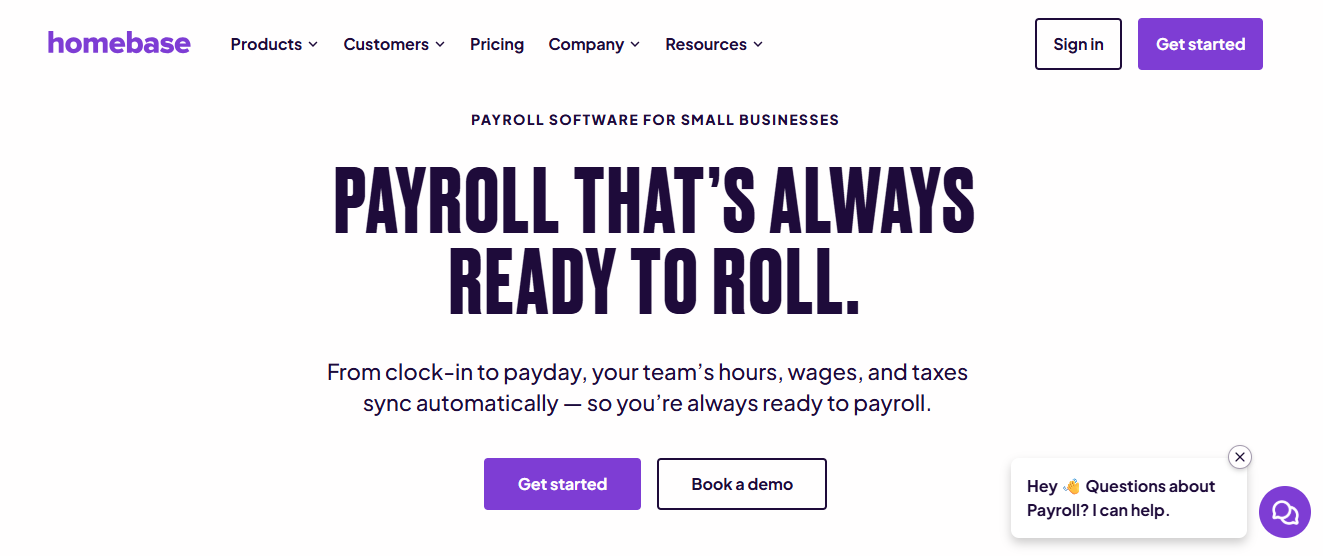
If your main headache is getting people scheduled, clocked in, and paid correctly, Homebase could be the best fit.
The platform is built around day‑to‑day operations for smaller businesses (restaurants, cafés, retail shops, salons, and local service providers with 5-100 hourly employees). You can use it to create and publish schedules, track employee hours via mobile or tablet time clocks, and then run payroll based on those timesheets, and automate tax filings.
With scheduling, time tracking, and payroll on the same system, you don’t have to worry about importing and exporting across multiple tools.
For me, Homebase’s scheduling and time‑tracking tools are what set it apart for smaller operations. They take a lot of the pain out of managing time-off requests and availability, and they pack an outsized punch when it comes to labor-cost reporting.
Granted, Homebase isn’t as capable as some tools in this regard, but it does a great job considering its price; it has a competent free tier, and its location-based pricing system (which starts at ~$24/location per month) allows you to add a lot of capability for a fraction of the cost of something like Justworks.
I also like the way team communication is built into the app, so you can message staff and share updates without relying on separate group chats. Anything that keeps you away from Microsoft Teams is always a big plus, in my book.
When Homebase makes the most sense:
- You’re an hourly, shift‑based business with one or a few locations.
- Your top priorities are scheduling, time tracking, and payroll.
- You don’t want or need a PEO’s co‑employment structure or bundled large‑group health plans, either because your benefits are simple or because you handle them separately.
2. Rippling: Best for Scaling Companies That Want PEO Flexibility
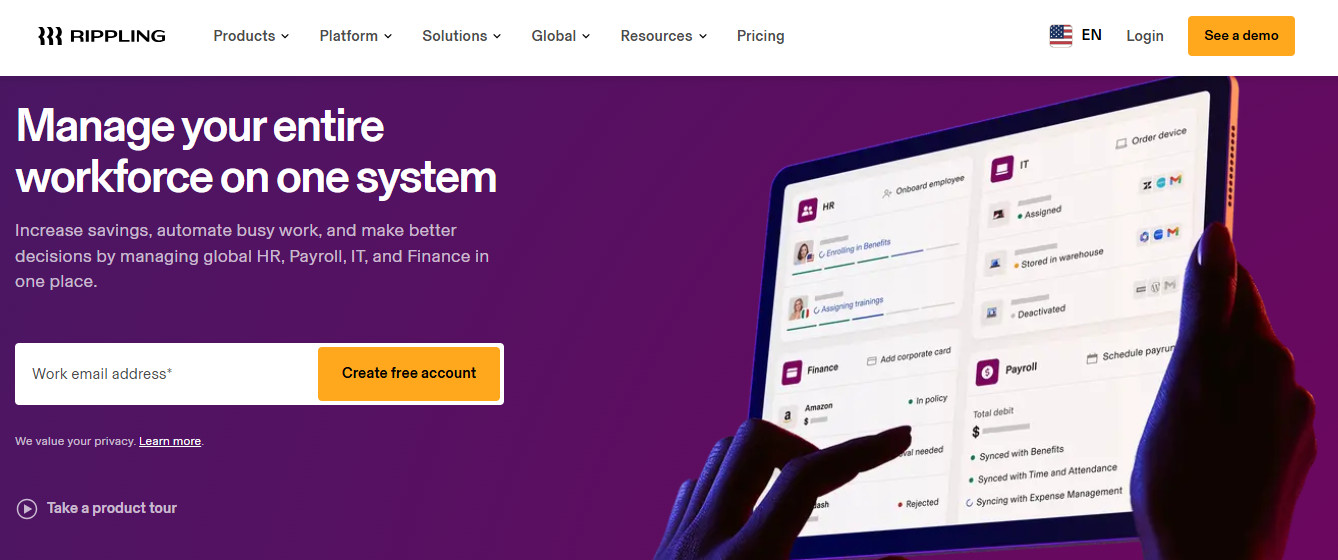
Rippling sits in an interesting middle ground; it can function like a modern HRIS and workforce platform, and it also offers an optional, fully insured PEO. Crucially, though, it doesn’t lock you into the PEO model forever.
You can use Rippling to manage global payroll and EOR (employer of record) needs in over 185 countries, and to centralize employee data across HR, device management, and financial systems. It’s served over ~20,000 companies, including huge brands like Five Guys and Chess.com.
In practice, Rippling can be overkill if you just want to schedule baristas and run payroll. While it doesn’t publish its full pricing schedule, it’s going to be a lot more expensive than something like Homebase on average.
However, for tech startups, remote‑heavy companies, and fast‑growing firms that are adding headcount across states or internationally, it can be a strong Justworks alternative. You get advanced automation, deep integrations, and global capabilities that go beyond what many PEO‑only platforms offer, and you won’t need to swap vendors if you decide you no longer need a PEO.
When Rippling makes the most sense:
- You’re a venture‑backed or fast‑growing company expecting significant workforce growth.
- You like some aspects of the PEO model but want the option to move off it while keeping the same core HRIS and workflows.
- You have a global footprint (or plan to establish one) and need consolidated tooling for international payroll, EOR, and contractor management.
3. Gusto: Best for US Small Businesses That Want Approachable Payroll and Benefits, but Not a PEO
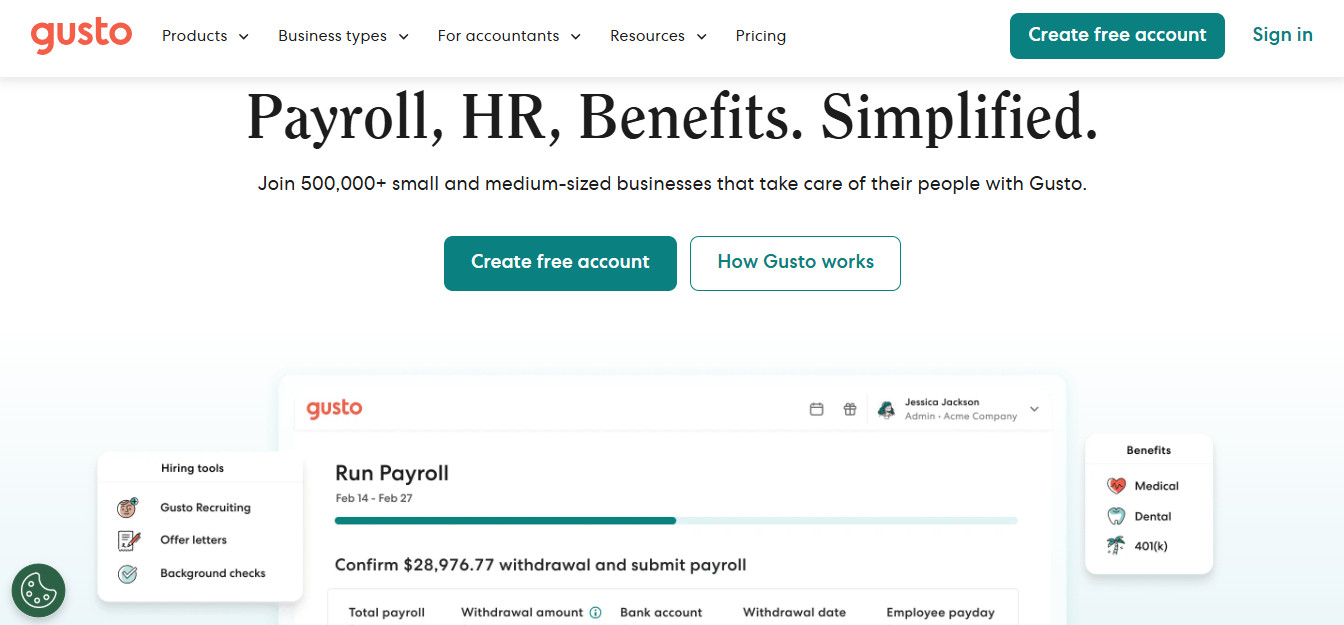
Gusto automates payroll, manages benefits like health insurance and 401(k), and handles basic HR tasks, but does not use a co‑employment structure. If you want to handle all this in one interface, you could do a lot worse than Gusto. It automates tax filings, supports digital onboarding and document management, and integrates with accounting and other business tools to minimize manual work.
Ease of use is perhaps its biggest selling point. For a platform that can achieve a lot, it’s surprisingly easy to get to grips with, both for admins and ordinary users. It can also be cost-effective if you don’t have full-time employees on the books; its contractor-only version is ~$6/month per person (its more advanced options get expensive quickly, though).
Gusto will give you more control over your benefits setup and vendor relationships than a PEO like Justworks, but it won’t provide access to large‑group plans via co‑employment. For many smaller teams that are fine using standard small‑group benefits or working through a broker, that trade‑off is perfectly acceptable; as always, it ultimately depends on your individual circumstances.
When Gusto makes the most sense:
- You’re a US‑based small business and want payroll, basic HR functions, and benefits in one interface.
- You don’t specifically need a PEO arrangement or access to large‑group health plans, but you do want integrated health insurance, 401(k), and compliance‑friendly payroll.
- You’re not heavily shift‑based, or you’re comfortable adding a separate scheduling/time‑tracking tool.
4. ADP TotalSource: Best for Growing SMBs That Want “Big Company” PEO Support
ADP TotalSource is ADP’s full‑service PEO offering and is one of the most established PEO options on the market. Like Justworks, it delivers payroll, benefits, and HR compliance under a co‑employment model; the big difference is that it offers the backing of a longstanding, well-regarded HR and payroll provider in ADP.
The PEO is available across all 50 US states and is built to scale; if you’re planning to increase headcount and you want a solution that will grow with you, this is probably a better option than Justworks.
TotalSource takes the core Justworks premise and adds enterprise‑grade depth and brand longevity, which is an upgrade for bigger companies. However, if you’re planning to stay lean, Justworks’ pricing model may be more attractive; its packages make more fiscal sense for orgs with fewer than 100 employees. TotalSource is priced on a custom basis, so it’s not going to be cheap unless you’re adding hundreds of users (if even then).
When TotalSource makes the most sense:
- You’re a US‑based SMB that’s scaling up and wants a large, established PEO partner rather than a newer entrant.
- You’re operating in a regulated or complex environment, and you need hands‑on HR support and risk mitigation beyond what a pure software product offers.
- You’re less concerned about granular shift‑scheduling features and more worried about strategic HR, compliance, and benefits design.
5. TriNet: Best for Industry‑Specific PEO Support and High‑Touch HR
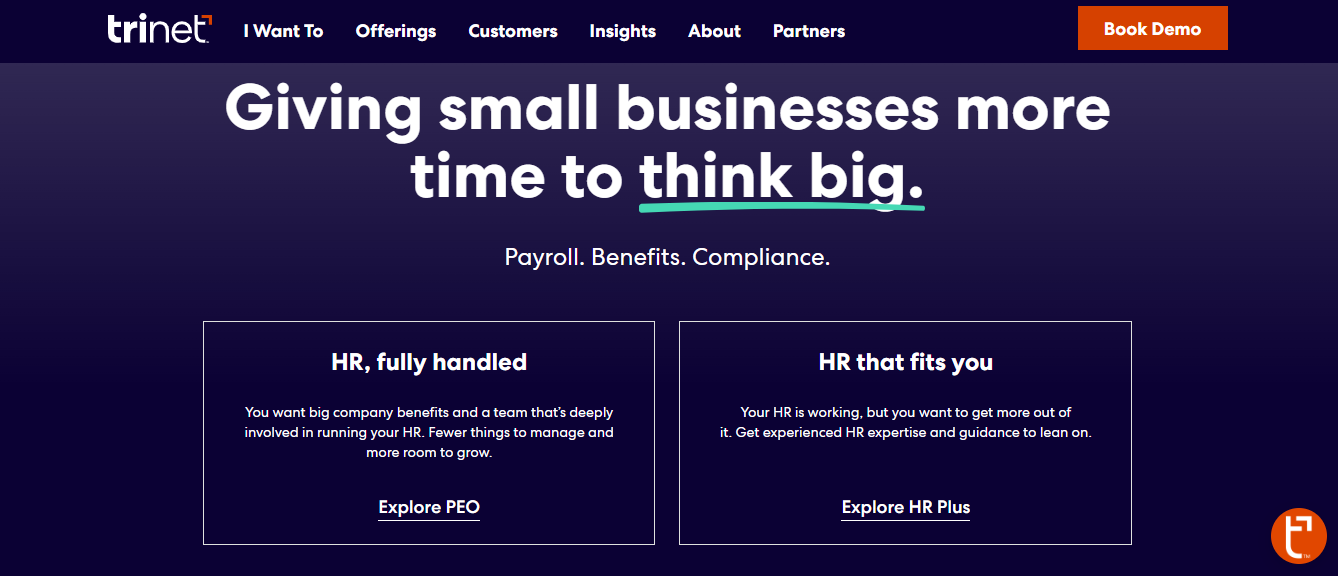
TriNet is another major PEO player. Its key selling points are industry‑tailored support and comprehensive HR outsourcing.
Like Justworks, TriNet’s PEO model provides payroll, benefits administration, and HR compliance under a co‑employment arrangement, but it leans into sector‑specific expertise in areas such as technology, nonprofits, financial services, and life sciences.
TriNet markets its PEO as a way for small and medium‑sized businesses to access premium benefits and seasoned HR professionals who can help them navigate compliance, performance management, and employee relations. So, if you’re a small organization taking on complex work, TriNet can help you deal with the challenges accompanying that dynamic.
One important point to note, though, is that TriNet doesn’t list its prices publicly; this makes it hard to say whether you’re likely to get good value for money until you start talking to the sales team.
When TriNet makes the most sense:
- You’re in a niche or regulated industry where sector‑specific HR and compliance knowledge really matters (e.g., healthcare, financial services, tech startups in highly regulated spaces).
- You want premium benefits and advanced HR programs, but don’t have the internal team to design and manage them.
- You’re already comfortable with the PEO/co‑employment model and simply want a provider with deeper vertical specialization.
6. Paychex: Best for U.S. Businesses That Want Menu‑Style Payroll, HR, and Optional PEO
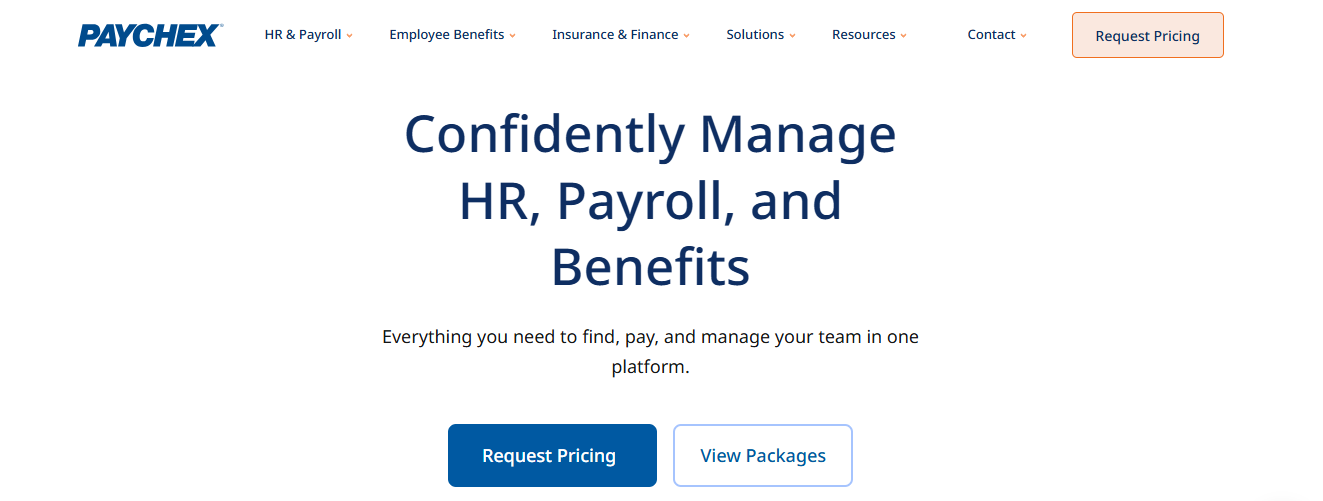
Paychex is one of the longest‑standing names in small‑business payroll and HR, and it offers everything from DIY payroll to an all‑in‑one HR and PEO platform.
At the small‑business end of the market (1–19 employees), Paychex Flex provides payroll, time and attendance, recruiting, onboarding, and benefits in one system, with the ability to layer in more services over time. Paychex PEO bundles HR administration, benefits, and compliance, along with dedicated support.
This menu‑style approach makes Paychex a flexible Justworks alternative: you can start with simpler payroll and HR software and add on more advanced HR outsourcing or a PEO arrangement if your needs evolve. Again, this is all priced on a custom basis, so it’s difficult to analyze likely value for money up front.
When PayChex makes the most sense:
- You want a trusted, long‑tenured brand with deep payroll expertise and the flexibility to add HR and PEO services over time.
- You like the idea of an all‑in‑one HR platform, but you’re not ready to jump straight into a PEO and co‑employment model.
How to Choose the Right Justworks Alternative

Choosing HR software is a business decision and worth treating it like one. The wrong platform can slow down hiring, create compliance blind spots, and quietly drain time from the people who should be focused on growing the company.
Before you commit to anything, get clear on where you’re spending the most time and energy right now.
- Onboarding?
- Compliance?
- Payroll complexity?
- International hiring?
Also, think about where your business is likely to be in eighteen months. A tool that fits perfectly today can become a bottleneck surprisingly fast if you’re growing, and migrating HR systems mid-scale is a headache nobody wants.
Most of these platforms offer a free trial or a demo, so use them. Get your HR lead, your ops person, or whoever lives in this software daily into the evaluation process early. They’ll catch things a top-down review will miss.