


- At a Glance: Tracfone vs Total Wireless
- Who Should Choose Which Carrier?
- Coverage: Where You’ll Get Service
- Real-World Connectivity & Technology: What to Expect
- Plan Options: How They Compare
- Advanced Plan Features & Perks Worth Knowing
- Devices: Bring Your Own or Buy New
- Everyday Use Cases: Which Carrier Fits What Lifestyle
- Final Thoughts
Last Updated on March 25, 2026 by Ewen Finser
Choosing the right prepaid wireless carrier can be confusing. Two strong options on Verizon’s network are Tracfone and Total Wireless. They both offer no‑contract plans with nationwide coverage, but they serve different types of users. Today, let’s walk you through every key factor, from pricing and coverage to devices, perks, and real‑world performance, so you can decide which one fits your needs.
At a Glance: Tracfone vs Total Wireless
Before we go deep, here’s a quick comparison:
Feature | Tracfone | Total Wireless |
Network | Verizon 4G/5G | Verizon 4G/5G |
Best For | Budget / flexible prepaid users | Unlimited data users and families |
Unlimited Plan | Yes (Freedom) with hotspot | Yes (multiple tiers) |
Data Buckets | Yes | Mostly unlimited tiers |
Device Deals | Limited | More promotions available |
International | Optional or limited | Broader included options |
Both carriers are solid choices backed by Verizon’s infrastructure, but your choice depends on how much data you use and what features you care about.
Who Should Choose Which Carrier?
When I evaluate prepaid carriers, I focus on how each option fits different usage profiles rather than treating one as universally better. Tracfone and Total Wireless are built for different types of users, and that becomes clear once you look at how the plans are structured.
Choose Tracfone If
- You want low, flexible prepaid pricing that lets you control costs without paying for unused capacity.
- You are a light or moderate data user who does not consistently rely on high data throughput.
- You prefer predictable prepaid cycles and want to avoid long-term commitments.
Choose Total Wireless If
- You need unlimited data and access to higher hotspot tiers.
- You regularly use international calling or roaming features.
- You want device promotions or pricing that supports families or multiple lines.
The decision should be driven by how you actually use your phone. How much data you consume, whether international travel is part of your routine, and how many lines you manage on one account will point you toward the better fit.
Coverage: Where You’ll Get Service
Both Tracfone and Total Wireless operate on Verizon’s network, which is still one of the most expansive in the United States. That includes strong coverage in major cities as well as reliable reach in many rural areas. In practical terms, you can expect similar signal availability and access to 5G wherever Verizon has deployed it.
Because both carriers use the same underlying network, coverage itself is not a major deciding factor. Reliability is largely comparable between the two, so the real differences come down to plan structure, features, and overall value rather than where service is available.
Coverage maps are available on both carriers’ websites, and I recommend checking them before switching. Even on a strong national network, local conditions matter, and it is worth confirming that your specific area has consistent signal strength.
Real-World Connectivity & Technology: What to Expect
Verizon has retired older technologies like 3G and now relies on Voice over LTE, or VoLTE, for standard phone calls. VoLTE improves call clarity and allows simultaneous voice and data usage, something that older networks could not handle. According to Tracfone’s support documentation, VoLTE is now integral to ensuring smooth calls on compatible phones, which is particularly important in areas where legacy networks have been retired and replaced with newer standards.
Both carriers also support Wi-Fi Calling on compatible devices. This feature allows phones to make and receive calls over Wi-Fi when cellular signal is weak. In practical terms, this is especially helpful indoors or in rural areas where coverage may be limited. Tracfone’s support pages show that Wi-Fi Calling and visual voicemail are included on many plans, demonstrating that even without a contract, customers can access features typically expected from postpaid carriers.
Modern phones that support these technologies generally deliver higher in-call sound quality and fewer dropped calls compared to older devices or legacy services. The key takeaway is that, even though these are prepaid carriers, they support the same core modern communication technologies that improve everyday use, so you do not need to sacrifice reliability or quality for a value-focused plan.
Plan Options: How They Compare
Tracfone: Flexible Prepaid Options
In my experience, Tracfone’s strength lies in its flexibility. It offers prepaid packages that let you pay for the capacity you actually need, rather than forcing everyone into an unlimited model. There are tiered plans for light users as well as an unlimited option called Tracfone Freedom.
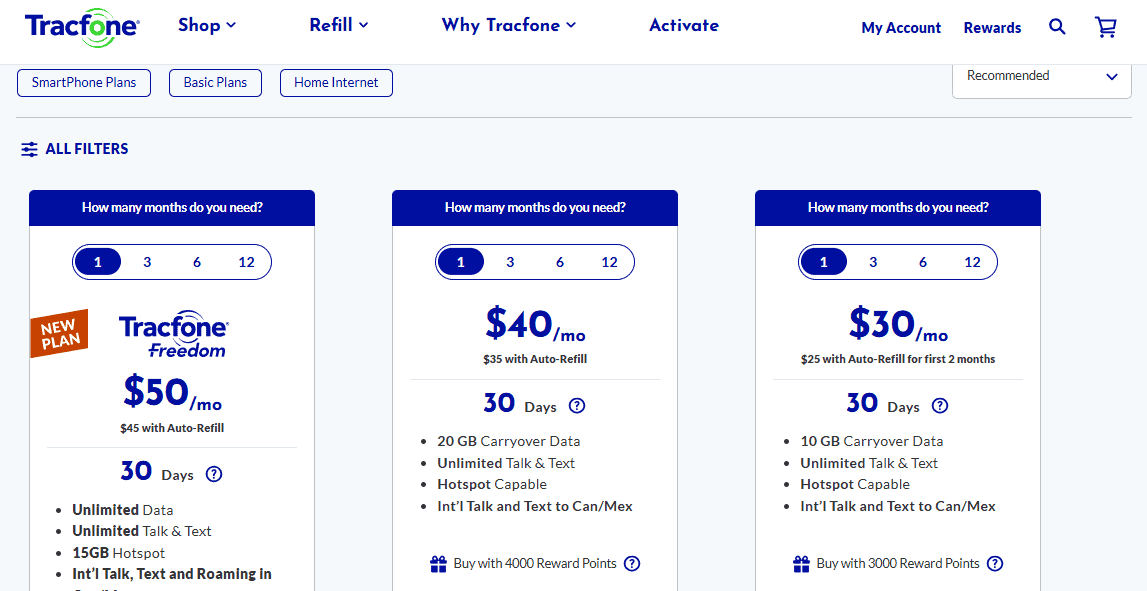
Tracfone Freedom (Unlimited):
- Unlimited talk, text, and data
- 15 GB hotspot included
- International calling and texting in Canada and Mexico
- Priced at $45/month with auto-refill ($50 without)
- No contract or credit checks required
- Spam and fraud protection with IDnotify included
- Military and veteran discounts available on eligible plans
From a practical standpoint, Freedom works well if you want unlimited service at a predictable price, with hotspot capability included. I’ve found that for many users, the hotspot limit is sufficient for moderate laptop or tablet use.
Tiered Data Plans:
Tracfone also offers traditional prepaid “buckets” of data, including 1 GB, 4 GB, or 10 GB plans. These are ideal for light users or people who only need data sporadically. Recent updates have doubled data allowances on some plans and expanded hotspot support, which increases practical value without requiring an upgrade to unlimited service.
Longer Term Plans:
Tracfone supports multi-month plans, including 60, 90, 180, and 365-day options. From my perspective, these are particularly useful for users who prefer to pay upfront and avoid monthly management. Combined with the Unlimited Carryover feature, which rolls unused data forward as long as service remains active, these plans can provide better value for users with irregular or seasonal data patterns.
Total Wireless: Unlimited Plans with Perks
Total Wireless takes a slightly different approach. From my perspective, it focuses on unlimited plans that scale with data, hotspot, and international needs, rather than offering small prepaid buckets. The tiered structure allows users to pick a plan based on capacity and global features, rather than just price.
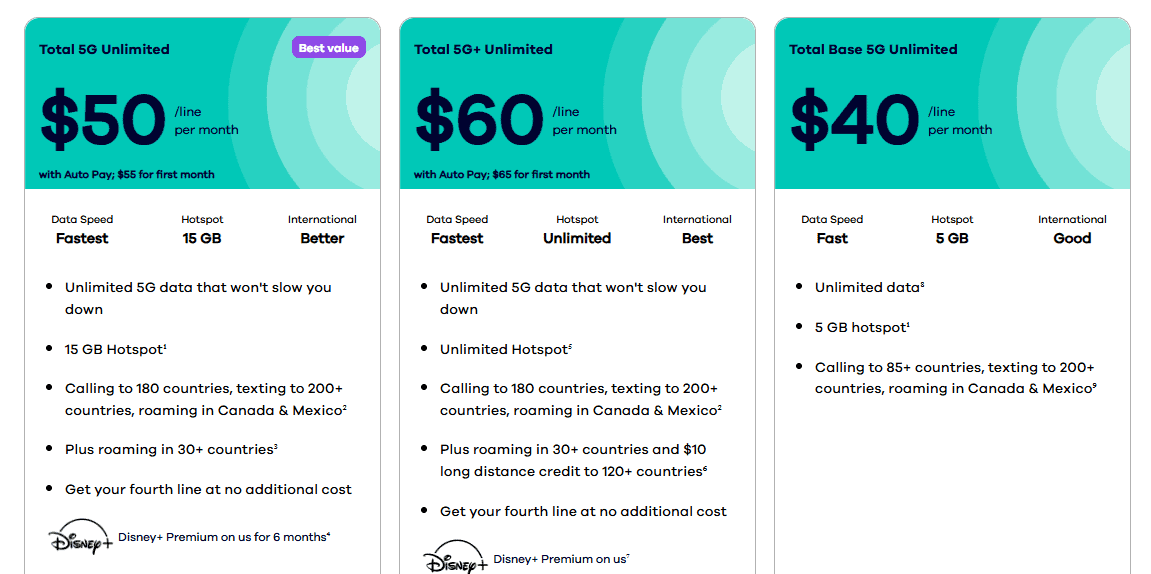
Total Base 5G Unlimited:
- Unlimited talk, text, and data
- 5 GB hotspot
- International texting to over 200 countries and calling to over 85 countries
- Uses Verizon’s 5G network
Total 5G Unlimited:
- Unlimited everything
- 15 GB hotspot
- Expanded international calling and texting to over 180 countries
- Often includes promotional perks, such as Disney+ for a limited period
Total 5G+ Unlimited:
- Unlimited data, talk, and text
- Unlimited hotspot data (subject to network management)
- Unlimited international calls and texts to hundreds of countries
- Roaming in over 30 countries included
- Disney+ Premium included in many promotions
From my experience, these tiers make it easier to match a plan to actual usage. Users who need more hotspot or international connectivity can simply move up a tier. There is also a rewards program where points earned on purchases can be redeemed toward service or devices, which can add practical value over time.
The main difference compared to Tracfone is that Total Wireless emphasizes capacity and global reach. If your phone usage includes heavy tethering, frequent international calls, or multiple devices, the tiered unlimited plans provide more consistent performance without micromanaging data.
Advanced Plan Features & Perks Worth Knowing
When evaluating these carriers, I always look past pricing to the features that actually affect long-term value. From my perspective, these can matter more than the headline cost, especially for users with specific needs.
Total Wireless has expanded its international feature set on unlimited plans. Higher-tier plans now include roaming in over 30 countries, unlimited international calls to up to 180 countries, and unlimited international texting to more than 200 destinations. For frequent travelers or users with global contacts, these built-in capabilities reduce the need for add-on packages or third-party services.
Total Wireless also offers a rewards program, which allows points earned on purchases to be redeemed for service credits or device discounts. In practice, this adds value for users who plan to stay on the carrier long-term or upgrade devices periodically.
Tracfone focuses on flexibility and simplicity. Multi-month plan durations, such as 60, 90, 180, and 365-day options, allow users to pay upfront and avoid monthly management. Combined with features like Unlimited Carryover, which rolls unused data forward as long as service is active, these plans can provide better long-term efficiency for users with irregular usage patterns.
In my assessment, Total Wireless layers value through international reach and rewards, while Tracfone emphasizes extended uptime and flexibility. Both approaches have merit, depending on the type of usage you anticipate.
Devices: Bring Your Own or Buy New
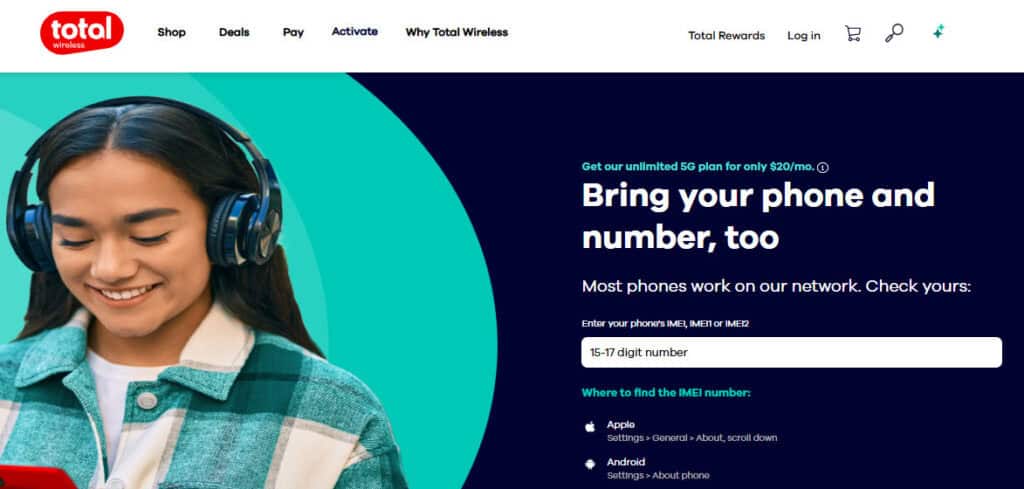
Both Tracfone and Total Wireless support Bring Your Own Device (BYOD), provided the phone is unlocked and compatible with Verizon’s network. This is a practical option for users who already have a capable device, as it avoids the need for unnecessary upgrades.
Tracfone offers a lineup of budget and mid-range phones, but it does not focus on major bundled device promotions. The emphasis is on functional devices that meet standard requirements for talk, text, and data, without relying on incentives to drive purchases.
Total Wireless, on the other hand, frequently pairs service with device promotions. These can include discounts or perks when activating with a compatible phone. From a practical standpoint, these promotions can make switching or upgrading more attractive, as you may be able to acquire a new device at a lower effective cost while also securing a plan that fits your usage needs.
Ultimately, whether you bring your own phone or purchase a new one, both carriers allow you to maintain full access to the network’s capabilities, including 4G LTE, 5G, VoLTE, and hotspot features. Understanding your device compatibility and plan requirements is key to making an efficient choice.
Everyday Use Cases: Which Carrier Fits What Lifestyle
The best way to understand which carrier fits your needs is to look at how each performs in real-world scenarios rather than focusing only on specs or pricing.
Light, Occasional Users
If your phone use is minimal, checking messages, social media, or the occasional video, Tracfone’s tiered prepaid plans offer enough flexibility and savings. These plans let you adjust spending month to month or through a multi-month commitment. They are ideal for travelers with intermittent usage, seniors who primarily use talk and messaging, or secondary devices for children.
Moderate Daily Users
For users who browse the web daily, stream a few videos, and send messages or images regularly, a mid-range Tracfone plan or Total Base 5G Unlimited plan works well. Total Wireless’ mid-tier options provide hotspot access, international messaging, and stable 5G performance, which supports day-to-day activities like navigation, video calls, or light remote work.
Heavy and Power Users
If your phone is a primary device for work, streaming, video calls, and tethering multiple devices, Total Wireless’ higher-tier unlimited plans, such as Total 5G Unlimited or Total 5G+ Unlimited, are better suited. With larger or unlimited hotspot allowances and extensive international coverage, these plans handle heavy usage without constant monitoring or data anxiety.
Frequent Travelers or Global Communicators
For anyone who travels internationally or regularly communicates with contacts abroad, Total Wireless offers clear advantages. Unlimited international calling, texting, and roaming in many countries are built into the higher-tier plans, reducing both cost and complexity for frequent travelers.
Looking at usage in this way, rather than just plan names or prices, makes it easier to match the carrier to real-world needs. From my experience, this is the most reliable approach to selecting a plan that will work smoothly over time.
Final Thoughts
Both Tracfone and Total Wireless are strong prepaid options that leverage Verizon’s reliable network. Each has a clear niche depending on your usage and priorities.
Tracfone provides flexible, budget-friendly plans that are well-suited for light users or anyone who wants control without committing to long-term contracts. Its multi-month and carryover options make it particularly practical for users with irregular or seasonal data needs.
Total Wireless offers robust unlimited plans with additional features like larger or unlimited hotspot allowances, international calling, and rewards programs. These plans are better suited for everyday smartphone users, families, and anyone who relies on their phone for work, streaming, or global communication.
Regardless of which carrier you choose, both provide nationwide coverage without a contract. In my opinion, evaluating your actual usage patterns, data consumption, hotspot needs, number of lines, and international communication will lead to a choice that offers the best balance of reliability, functionality, and cost.