


Last Updated on January 31, 2026 by Ewen Finser
Are you preparing to sell your online business? If so, you may have come across Latona’s, a brokerage firm specializing in online business sales.
Latona’s has been successfully brokering online business sales for nearly 15 years, so it could be a solid option for you. Be warned, though; you don’t want to rush into picking your broker. Your choice here could make or break your sale.
With this in mind, I’ve looked at some of the main alternatives in the space and made some recommendations for you to consider.
Latona’s: Overview and Fit for Sellers
Latona’s focuses on established, cash-flow-positive online businesses. Founded in 2001 by Rick Latona, the firm has a team of dedicated brokers and a large inventory of verified listings.
Its biggest selling points include:
- Broad range: This is perhaps the firm’s biggest strength. Whether you’re selling a content website, a domain portfolio, a dropshipping outfit, or a SaaS firm, you’ll find a broker at Latona’s who has the experience required to get your deal over the line. The same can be said of the valuation range Latona’s works in; it handles listings as small as $50,000 and as large as seven figures.
- An experienced team: The firm’s brokers all have firsthand experience in buying and selling online assets, which isn’t the case in every brokerage; it’s reassuring to know that your agent has ample hands-on experience when you’re in the trenches of an exit.
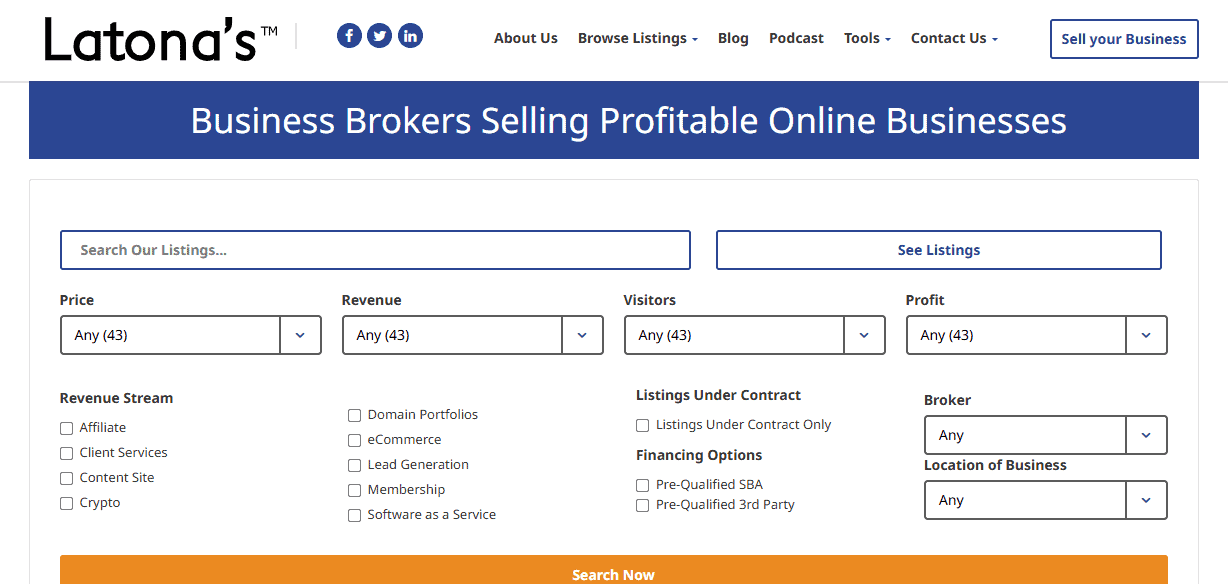
- A user-friendly platform: I’m personally a big fan of how the Latona’s platform is laid out. It’s easy to navigate and allows buyers to sort listings by business type, price, revenue, etc. This doesn’t necessarily affect you directly as a seller, but by making life easier for buyers, it can lead to quicker exits. Additionally, listings are anonymized with enough detail to pique interest (general business description, niche, financials) while sensitive info (URL, identity) is only shared with registered buyers under NDA.
However, Latona’s isn’t without its limitations. These include:
- High commission fees: Latona’s charges a 15% commission on the final sale price, which is well above the cut taken by a lot of competitors. For me, this is by far the biggest problem with the firm; while Latona’s offers a good service, it’s simply not good enough to justify a commission as high as this.
- Slower sales: Latona’s listings tend to stay on the market longer than those of other brokers in the space. Anecdotal evidence suggests that it takes, on average, about 3-4 months for sales to close post-listing. This slower sales cycle could be due to the smaller nature of many listings or a less aggressive marketing push compared to larger marketplaces; in any case, if you’re hoping for a quick sale, Latona’s might feel sluggish.
- Limited support & hands-on guidance: Latona’s provides guidance via email and a broker contact, but it won’t give you anything like the level of technical support you’ll get from other brokers (more on that later).
- Lack of experience with very large sales: Because Latona’s niche is in small-to-mid-sized online businesses, it’s not really suitable for sales in the eight- and nine-figure brackets. Even seven-figure sellers might be better served elsewhere.
Top Alternatives to Latona’s
Quiet Light

Quiet Light specializes in mid-market online businesses. This typically means listings ranging from $500k to $25mn in value, spanning verticals like content, Amazon FBA, SaaS, ecommerce, and other online-first spaces. Quiet Light doesn’t generally deal with brick-and-mortar businesses.
I’m personally a big fan of Quiet Light, and generally recommend it to sellers whose companies fall into the categories above. It stands out for its high-touch service, reasonable pricing, and stellar track record of successful sales.
Pros of Quiet Light
- Hands-on experience: Every Quiet Light broker has either bought or sold a business themselves; this level of hands-on experience isn’t a given in the industry, and it can come in very handy for you as a seller. Your advisor will guide you through prepping the business for sale, setting a realistic valuation, marketing it to buyers, negotiating offers, and navigating due diligence and closing.
- Value for money: Quiet Light’s success fees are capped at 10% of sale value, and they slide for companies selling for $1mn or more. This is below the industry average (Latona’s, as noted above, has a basic commission fee of 15%).
- High success rate: Quiet Light’s competitive pricing doesn’t require a tradeoff in terms of quality. It boasts a sale completion rate of 85% within the first 90 days of listing, which is impressive in this industry.
Cons of Quiet Light
- Selectiveness: Quiet Light focuses on profitable, mid-market businesses; if your business is very small (e.g., only worth a few tens of thousands) or extremely large (nine figures), it may not be as suitable.
- Exclusive engagement: Like most brokers, Quiet Light requires an exclusivity period (usually a 90-day agreement). While this term is shorter than those of some rivals, you must still commit to use Quiet Light as your sole broker for that period.
Website Closers

If your company is likely to command an eight- or nine-figure valuation, Website Closers could be the broker for you. It’s the leading player in the large-cap sector of the market.
The firm has a nationwide network of brokers and has closed over $1 billion in total sales across all types of digital businesses. They commonly represent Amazon FBA brands, large e-commerce retailers, SaaS firms, online service businesses, and more.
For Website Closers, no deal is too large – one of the case studies on its homepage references an e-commerce sale that closed for $85mn.
Pros of Website Closers
- Extensive experience with big deals: Not every brokerage can competently handle transactions above $10 million, but Website Closers excels at them. Its people have facilitated sales in the nine-figure range, so they understand the complexities inherent in this segment of the market (dealing with private equity buyers, complex valuations, earn-outs, etc.).
- Wide variety of verticals: Website Closers works with all kinds of online business models, from content sites and software companies to Amazon sellers and consumer product brands.
Cons of Website Closers
- Opaque fee structure: Website Closers is deliberately vague about its fee structure; this allows the firm to negotiate rates on each account. This lack of transparency means you need to be prepared to negotiate your fee, and it’s going to be difficult to discern whether you’re getting the best possible deal.
- Focus on large accounts: If your business isn’t in the high seven-figure range or above, you may not get the attention you need from Website Closers. It officially takes on deals as small as $500k, but because brokers there handle so many $10mn+ transactions, they have a tendency to prioritize their larger clients.
- Longer sales process: Website Closers often aims to maximize value for large deals, even if it means taking extra time. If you’re in a hurry to sell, this big-sale bias can be a downside.
Flippa
Flippa is more of a DIY marketplace than a full-service broker. It gives sellers a platform to list their businesses, and buyers a forum to make contact with sellers, but that’s about the extent of its service. It leaves vetting, valuation, negotiation, and closing to the parties themselves to figure out.
Flippa is reportedly the world’s largest open marketplace for buying and selling online businesses and digital assets. It has a global user base and facilitates thousands of deals per year, most of which are in the four- to six-figure range.
Pros of Flippa
- Huge exposure: Flippa boasts unmatched scale and liquidity in the sub-$100k market. The platform reportedly closes around 12,000 deals annually – this is far more volume than any single broker. There are hundreds of thousands of buyers browsing Flippa from around the world. This exposure is Flippa’s biggest selling point, especially for sellers of niche companies that require a little more reach to generate interest.
- No minimum size: Unlike brokers who often have minimum value thresholds, Flippa is open to businesses of all sizes. You can list a $5,000 starter website, a $50,000 Amazon affiliate site, or a $500,000 e-commerce store. Very small or entry-level businesses (four- and five-figure valuations) find a home on Flippa, whereas most full-service brokers would turn these away.
- Fast and flexible listing process: You can create a listing on Flippa in a matter of hours, set your own asking price or auction reserve, and launch it to the marketplace. There’s no lengthy vetting process to get approved (though you will need to verify ownership and financials for buyer confidence). This means you can have your business up for sale almost immediately.
Cons of Flippa
- Hands-off service: Selling on Flippa is very hands-on. You, as the seller, are responsible for writing a compelling listing, responding to dozens of inquiries, vetting potential buyers, handling negotiations, and managing due diligence. Flippa does not provide a dedicated broker to manage these interactions (unless you opt for a separate “brokerage” service or upgrade, which most sellers don’t for smaller deals).
- Variable buyer quality: With a low barrier to entry, Flippa attracts a lot of tire-kickers and inexperienced buyers. Some inquiries may be from people who aren’t qualified financially or are just curious newbies. Separating these from more serious inquiries will fall to you, whereas a different platform would do some (if not all) of it on your behalf.
- Fees: Flippa only makes financial sense for smaller listings. If your company is worth $500k or more, it’s probably going to work out almost as expensive as the average broker.
Empire Flippers

Empire Flippers is often mentioned in the same breath as Latona’s, and it’s one of the biggest players in the online business sales space. However, Empire Flippers (EF) operates a bit differently than a classic broker like Latona’s or Quiet Light.
For sellers, Empire Flippers offers a blend of large buyer reach with a structured vetting process and a lot of the heavy lifting done for you. It’s a middle ground between Flippa’s self-service model and a full-service broker.
Pros of Empire Flippers
- Rigorous vetting and quality control: Empire Flippers only accepts profitable, revenue-generating businesses and has a stringent vetting process to ensure no sub-par listing slips through the cracks. This means the platform has a lot of buyer trust, which makes life easier for you when you start dealing with interested parties.
- Large buyer pool and quick sales: Empire Flippers has a massive following (over 195,000 registered users as of recent counts). This often allows for quick sales.
Cons of Empire Flippers
- Cost: Empire Flippers charges commission of 15% on sales up to $700k, and 8% on amounts between $700k and $5mn. This makes it significantly more expensive than some full-service brokers (such as Quiet Light) for company sales in the low seven-figure range. Why pay more for a less comprehensive service?
- Buyer-friendly pricing: EF has a reputation for getting deals done quickly, but this comes at a cost. A lot of businesses on the platform are priced at fair market value; some companies can fetch a lot more than their fair value if they’re properly marketed. If your goal is to get an above-market price, EF’s model might not be right for you.
- Exclusivity: When you list with Empire Flippers, you sign an exclusivity agreement (60 days minimum is common). Not every buy-and-sell marketplace does this (Flippa, for example, doesn’t impose any exclusivity requirement), so you might prefer to avoid it.
- Vetting criteria: Empire Flippers reportedly rejects 91% of the applications it receives from sellers. This improves the overall quality of the marketplace, but this won’t mean much to you if your application gets rejected.
FE International

Founded in 2010, FE International has grown to have offices in multiple cities (New York, London, Miami, San Francisco) and has facilitated some of the industry’s largest deals, especially in the SaaS, e-commerce, and content website sectors.
Pros of FE International
- Focus on larger exits: FE International specializes in seven-figure and eight-figure sales. If your business is doing millions in profit or has significant strategic value, FE’s team will be equipped to deal with the complications that may arise during your sale process.
- Privacy and discretion: FE International does not publicly list businesses for sale on a website. Buyers must register and prove their credentials to even learn about opportunities. While this is often a slower path to a sale, it does allow you to list your business without alerting employees or competitors that it’s for sale.
- Global reach: FE International’s presence in multiple financial hubs provides access to international buyers and investors. They have completed deals involving private equity firms, large tech companies, and even strategic mergers. This gives you access to a pool of potential buyers you’d never reach on your own.
Cons of FE International
- Big-deal bias: FE’s bread and butter is big deals; it’s not the right choice for a small or even mid-sized sale. If your business is under mid-six figures in value, FE will likely refer you elsewhere.
- Cost: FE International doesn’t publicize its commission rates, but anecdotal evidence suggests it runs around 15% for deals in the low seven-figure range. This is simply too high; other, better providers will cost you less. It’s worth noting that you might be able to negotiate a better rate, but there are no guarantees here.
- Lengthy process: Because FE International is thorough, the sale process might take longer than a quick marketplace flip. FE brokers prepare extensive documentation and target specific buyers, and negotiations can go through multiple rounds (especially if corporate procurement or legal departments are involved). If your priority is a quick exit, FE might feel slow.
Is Latona’s Right for Your Business Sale?
The “best” business broker will always depend on your individual situation. It may be Latona’s; however, there’s a good chance another option will be a better match.
In my view, Quiet Light is generally the best option for online-first companies worth anywhere between $500k-$25mn. The level of service you get for the price is unmatched elsewhere in the market. This is also right in the range Latona’s generally operates in as well, so I think Quiet Light will almost always be the better option if you’re trying to decide between the two.