


Last Updated on January 13, 2026 by Ewen Finser
If you’re trying to sell a business, picking the right partner is one of the best things you can do to improve your valuation and overall success. The right broker or listing platform could add significantly to your deal value — not to mention get everything wrapped up more quickly and efficiently.
Pick the wrong one, and you could run into a lot of difficulty.
DealStream has long been a major player in this space as a free/low-cost business listing platform, and it’s a common, low-barrier entry point for sellers who want to test the waters without upfront costs.
But is a free, self-service listing platform really the best choice for your business? Or are you better off with a more hands-on approach?
Let’s take a hard look at what DealStream offers, where it falls short, and what alternatives might be a better fit depending on your business size, complexity, and goals.
DealStream: An Open Listing Marketplace

Formerly known as MergerNetwork, DealStream is one of the longest-running online marketplaces for buying and selling businesses. Founded in 1995, it’s facilitated over 15,000 deals to date. In addition to businesses, the site also hosts listings for real estate, franchise opportunities, investments, and other assets.
One reason why it’s so popular is that it lets you post your business for sale at no charge (on the basic plan). The way the platform makes money is by charging buyers via optional paid memberships to contact sellers — a model designed to filter out casual tire-kickers.
Over the years, DealStream has grown into a large network of more than 100,000 dealmakers (entrepreneurs, investors, brokers, etc.) across the globe.
What DealStream Does Well
For sellers, DealStream’s biggest appeal is its open, low-cost access. You can quickly create a listing without upfront fees, which is great if yours is a smaller business or if you’re just testing the waters.
The marketplace also has a broad reach. Thousands of buyers browse the site, and DealStream’s proprietary AI “SearchGenius” pushes your listing to matching buyers via daily recommendation emails.

DealStream also does a better job than other marketplaces when it comes to privacy; you can post a listing with general details and only disclose sensitive information (like the business name) to buyers who inquire.
Should You Sell on DealStream?
If you’re trying to offload a relatively small company and you’re happy to take a DIY approach, DealStream could be the way to go. It’s also a potentially good option if you have a niche business that will only attract a specific handful of investors — the site’s large network and AI matching can help find those buyers. Also, because the barrier to entry is so low with free listings, it’s suitable if you want to gauge buyer interest before fully committing to a sale. Some sellers even use DealStream alongside other listing sites to maximize exposure.
The downside is that DealStream doesn’t offer anything close to the kind of assistance you’ll get with a full-service brokerage. For example, you’ll need to screen inquiries entirely on your own. This is much more of a hassle than it sounds because you’ll likely receive a high volume of messages, and only a few of them will be from qualified buyers.
In short, DealStream is not a high-touch service; it’s a list-it-and-see platform. Sellers of mid-market or larger businesses (or those who just want hands-on help maximizing value) will want to look elsewhere for a more curated advisory experience.
The Top Alternatives to DealStream
Choosing a business sale partner is a highly context-dependent process. If DealStream doesn’t sound like your cup of tea, don’t worry — there are plenty of other options for you to consider.
Quiet Light

Quiet Light is a boutique M&A advisory firm that specializes in online businesses. Founded in 2006, it’s grown into a highly respected mid-market brokerage, with over 750 businesses sold and more than $500 million in total transactions. What sets it apart is the fact that every Quiet Light advisor has personally bought or sold an online business before, which means they understand the process from the seller’s side. Furthermore, these advisors are often praised for their personalized and thorough approach.
Unlike DealStream, Quiet Light takes a full-service approach to brokerage. Your agent will help:
- Value your business
- Prepare financials and marketing materials
- Confidentially market the listing to vetted buyers
- Handle negotiations
- Guide the deal through closing
Quiet Light is also known for doing extensive upfront vetting and coming up with realistic, sale-focused valuations. The firm also has a large network of qualified buyers in its database, which its advisors will reach out to in order to proactively market listings. This all contributes to a high success rate; around 85% of the companies that list with Quiet Light purportedly sell within 90 days.
Finally, Quiet Light’s fee structure is seller-friendly. The firm charges a success-based commission that is generally lower than competitors’ rates: 10% on businesses up to $1M, with the percentage decreasing for larger deal sizes (down to 3% for $7M+ sales).
There are no upfront listing fees; Quiet Light only gets paid when your business sells.
So if your business is in the six- to mid-seven-figure range and you want a hands-on, high-touch service, Quiet Light is a compelling alternative to a self-serve platform like DealStream. In my opinion, it’s the best option for mid-market online business sellers.
Website Closers

Website Closers has carved out a niche as a go-to firm for larger online businesses and e-commerce companies over the past two decades. If Quiet Light is the boutique mid-market broker, Website Closers is the large-cap specialist, with a particular focus on businesses in the e-commerce, technology, and Amazon FBA sectors.
Website Closers also offers a number of specialist services you may not find elsewhere, including helping buyers obtain SBA loans or other financing. This is especially useful if you’re offloading an eight- or nine-figure company, as it greatly expands your pool of potential buyers.
It’s arguably one of the best options for sellers at the high end of the market — those in the high eight-figure to nine-figure valuation range, or even those in mid-seven figures who anticipate a very complex sale. If your business could be valued in the tens of millions (or more), Website Closers could be the way to go.
But for smaller businesses in the low seven-figure range and below, Website Closers may not be ideal. Its agents tend to prioritize large deals; if yours is a smaller company, you could end up being overlooked in favor of the bigger fish.
Flippa
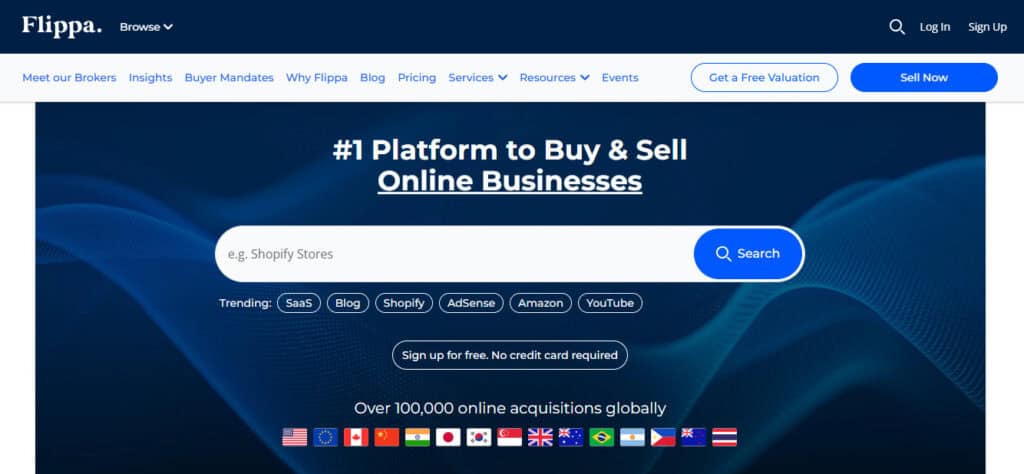
When it comes to the business model, Flippa is one of DealStream’s closest competitors. Unlike operations like Quiet Light and Website Closers, Flippa generally operates as a hands-off buy-and-sell platform rather than a full-service broker.
It’s currently the largest marketplace of its kind in terms of listing volume, with over 3 million registered users globally and getting over 1.3 million visitors per month. It hosts everything from starter sites selling for a few hundred dollars, up to established businesses going for seven- and eight-figure sums.
The biggest advantage of Flippa is massive exposure. With such a large number of regular users, you’ll likely have no problem finding interested parties, even if your business is in a small, specific niche. This is a double-edged sword, however. Because so many people browse Flippa’s listings, you may end up dealing with a lot of unserious offers (not to mention outright scams), especially since Flippa is free for buyers — which makes it much easier for scammers and tire-kickers to use.
Flippa’s fee structure is straightforward, and it can work out to be a decent value for smaller sales that brokers aren’t interested in. However, there are also upfront monthly listing fees, which means that you might end up spending money on a sale that doesn’t go through. Additionally, Flippa’s success fees are comparable to those of full-service brokers, so you could end up handing over a similar chunk of your sale proceeds for a much more limited service.
Ultimately, Flippa is great for reaching a large audience quickly, especially if your business is in a four- or five-figure range where paying a big broker commission might not be feasible. If you’re selling a small content website, a niche Amazon store, or a modest app, Flippa is a great marketplace to get it in front of eager buyers.
The DIY Route: Selling Your Business Yourself
There’s also the nuclear option: forgoing third-party assistance altogether and going it alone.
There are some circumstances in which this can be the right move, such as if:
- You have prior experience in brokering business sales yourself.
- You’ve already received an offer you’re happy with from a trusted buyer (such as an employee or a family member).
- The business is so small that a broker’s fee would eat up too much of the proceeds to make it worthwhile.
- You have enough time on your hands to deal with tire-kickers.
- You’re in partnership with an ownership team that’s well-positioned to broker a sale.
However, this is not a pathway I generally recommend.
Even if one or more of these factors apply to you, the DIY route will still be challenging. Selling a business is a complex process with many potential pitfalls, and doing it without professional help puts all the onus on you. You’ll need to handle valuation, marketing, screening buyers, due diligence coordination, negotiations, and legal paperwork all by yourself, and any one of these steps can be daunting if you haven’t been through it before.
Additionally, professionally brokered sales tend to fetch better prices, which means brokers often end up paying for themselves.
Choosing the Right Path for Your Sale
While DealStream has facilitated plenty of successful company sales, it’s not the provider I’d recommend for larger or more complex deals — especially for business owners without extensive experience in the sales process.
In these situations, my recommendation is generally Quiet Light.
Where platforms like DealStream and Flippa leave you to navigate inquiries, negotiations, and due diligence largely on your own, Quiet Light assigns you a dedicated advisor who shepherds your deal from initial valuation all the way through closing. This curated, high-touch approach means you’re not just getting a listing — you’re getting strategic guidance on positioning your business for maximum value, access to a vetted buyer network that eliminates most tire-kickers before they reach you, and expert negotiation support when it matters most.
For mid-market sellers who’ve spent years building their business, that level of personalized service and buyer quality control often makes the difference between a mediocre sale and one that truly reflects your company’s worth.