


Last Updated on December 30, 2025 by Ewen Finser
Stripe is more or less the default payment processor for most businesses these days. It’s easy to set up, its third-party integrations are endless, and the documentation is beautiful (and useful).
But as a CPA who has had to untangle the backend of a scaling SaaS business one too many times, I can tell you that “developer-friendly” doesn’t always mean “business-friendly.”
When you’re running a SaaS company, your payment processor isn’t just a gateway; it is the heartbeat of your revenue operations. It handles subscription lifecycles, collections, tax compliance, and revenue recognition. So if your platform is just moving money but leaving you blind on the analytics or forcing you to stitch together other tools to get a P&L that makes sense, you’re bleeding efficiency.
That’s why I’ve spent the last few months evaluating five top Stripe Alternatives for SaaS Businesses (Paddle, Adyen, FastSpring, Braintree, and Luqra) for those who are hitting a wall with Stripe — that point where the fees, the lack of direct support, or the fragmented data starts hurting the bottom line.
TL;DR: While each platform serves a specific niche, Luqra stands out as the comprehensive choice for finance teams who need unified analytics, predictable billing, and reliable, human support.
What to Look For in a SaaS Payment Processor
A generic e-commerce processor isn’t enough for SaaS. Selling a t-shirt is a one-time event, but selling a software subscription is a marriage. This means you need a platform that effectively manages relationships — not ad-hoc sales.
So before we dive into the names, let’s define the criteria:
- Subscription Logic: Can it handle proration, upgrades, downgrades, and grandfathered legacy pricing without unnecessary manual intervention?
- Revenue Recovery (Dunning): What happens when a card fails? Does the system smartly retry, or does it just churn the customer?
- Single Source of Truth Capabilities: Do I need a separate tool for analytics, or does the platform accurately tell me my MRR and LTV?
- Support & Reliability: When a $10,000 enterprise charge gets erroneously flagged as fraud, can I get a human on the phone, or am I directed to an AI chatbot?
- Value: Not just transaction fees, but the total cost of ownership (including the extra software I don’t have to buy).
With that in mind, let’s talk about the platforms that made the cut.
1. Paddle: The Merchant of Record Specialist
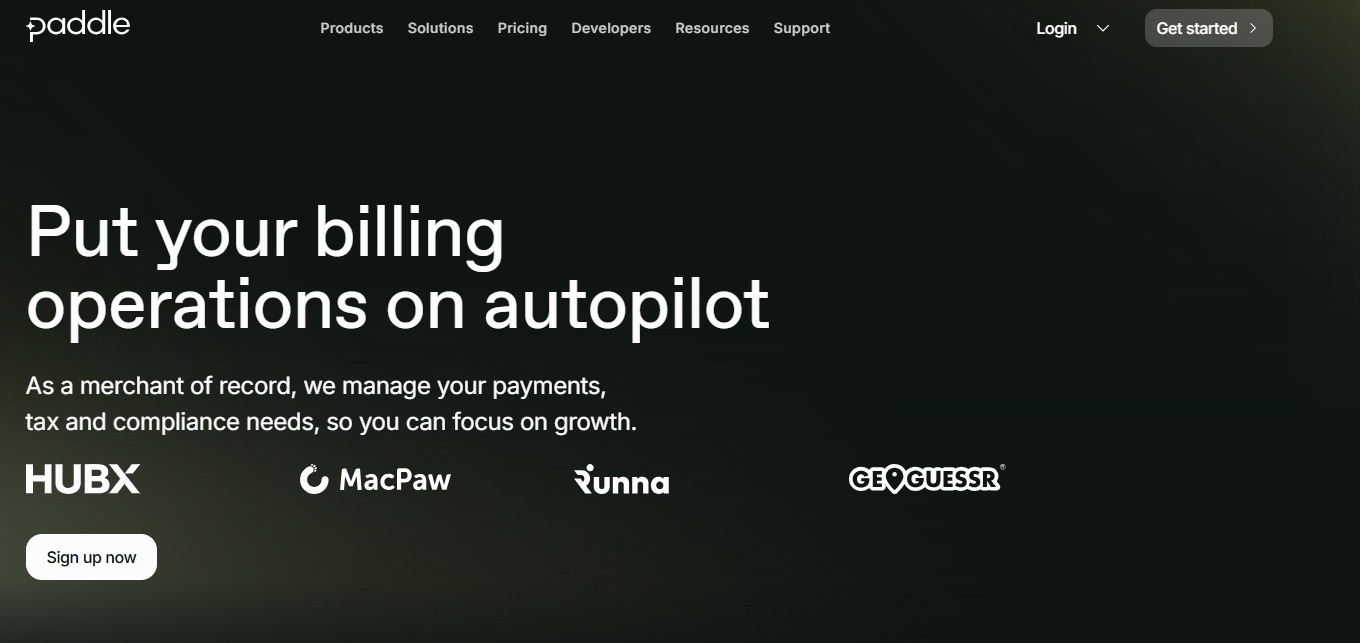
Paddle is often the first name that comes up when SaaS founders want to leave Stripe, specifically because they solve a headache that Stripe (mostly) passes the buck on: global sales tax.
The Philosophy
When you use Stripe, you’re the merchant; Stripe just processes the card. When you use Paddle, the customer is technically buying from the MoR Paddle, and Paddle is buying from you. This means Paddle handles the VAT in Europe, the GST in Australia, and the sales tax in Ohio.
The SaaS Upside
For a bootstrapped SaaS selling into 50 countries on day one, this is a godsend. I have seen clients spend thousands of dollars a month on Avalara or TaxJar integrations, plus the accounting hours to file returns in fifteen jurisdictions.
Paddle wipes that clean. Their checkout overlay is decent, and they are built purely for software.
The CPA’s Hesitation
You pay for this convenience. Paddle’s fees are generally higher than a standard interchange-plus model because they are taking on the tax liability. Furthermore, because they are the MoR, you lose a degree of control. The data sits with them.
If you ever want to migrate away from Paddle, it can be stickier than moving from a standard gateway because the contractual relationships are with them, not you.
Best For
Early-to-mid-stage SaaS companies with a high volume of international, low-ticket transactions and who cannot afford a dedicated tax compliance team.
2. Adyen: The Enterprise Engine
If Paddle is for the startup scaling globally, Adyen is for the grown-ups, which is why you see it powering giants like Spotify and Microsoft.
The Philosophy
Adyen is a banking infrastructure play — an acquirer and a processor in one platform. They don’t just sit on top of legacy banking rails; they are the rails in many regions. This gives them incredible data visibility and authorization rates.
The SaaS Upside
Adyen’s RevenueAccelerate features are genuine. Because they see so much traffic globally, their machine learning models for approving transactions are top-tier. And for a SaaS business doing $50M+ ARR, a 0.5% increase in authorization rates is massive found money.
They also support virtually every local payment method you can imagine, which is critical if you are selling B2B SaaS in markets like Brazil or the Netherlands, where credit cards aren’t always the default.
The CPA’s Hesitation
Adyen is not a “plug-and-play” solution for a weekend project… The integration here is heavy and complex. The reporting is exhaustive but can be overwhelming if you don’t have a finance team to parse it. They also have minimum volume requirements and will likely not even return your call if you aren’t processing significant volume. It is an enterprise tool with an enterprise price tag and enterprise complexity.
Best For
High-volume, enterprise SaaS companies where a 1% optimization in churn or authorization rates equals millions of dollars.
3. FastSpring: The Veteran
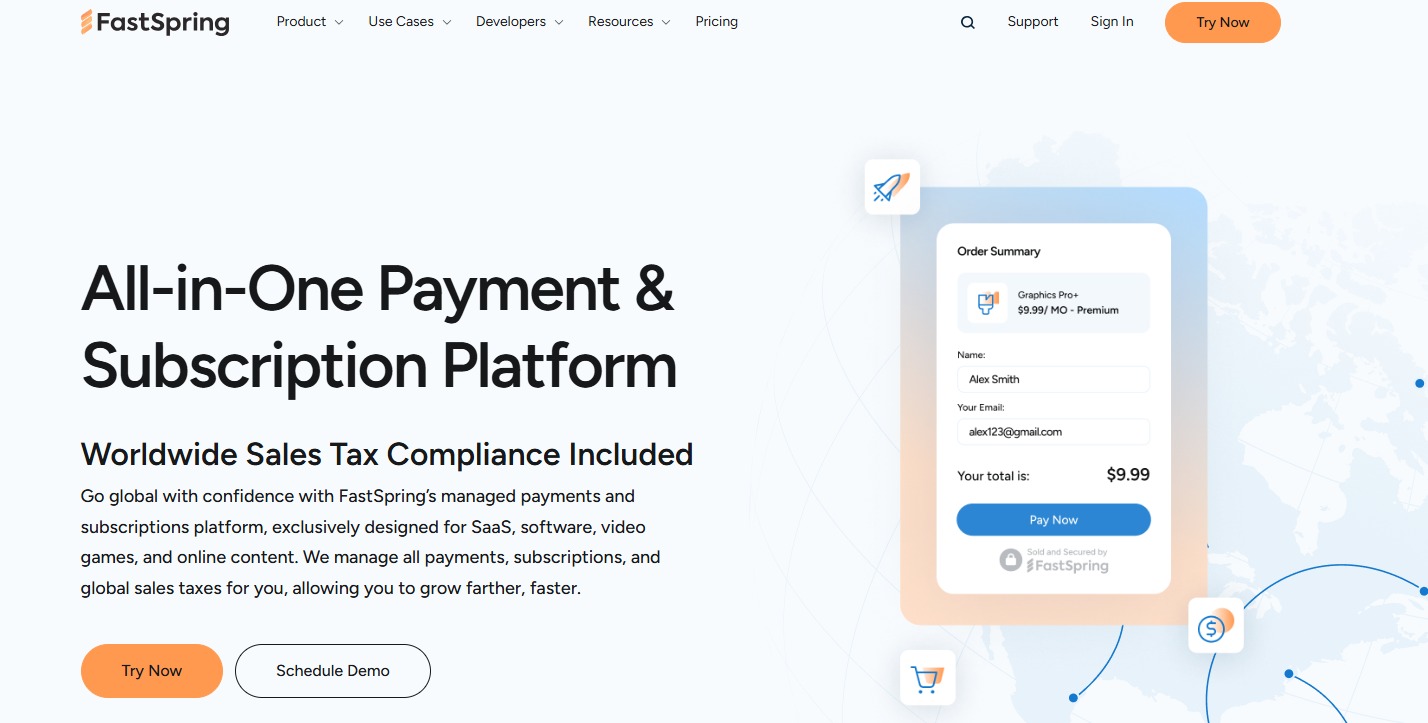
FastSpring is similar to Paddle in that they often act as a merchant of record, but they’ve been around the block a few more times. They’re a staple in the desktop software and legacy SaaS world.
The Philosophy
FastSpring is a full-service provider that handles checkout, fulfillment (license keys, downloads), and tax. They position themselves as an e-commerce partner rather than just a payment pipe.
The SaaS Upside
Reliability is the name of the game here. FastSpring has deep features for traditional software sales (perpetual licenses + maintenance) as well as modern SaaS subscriptions, and their dunning management is robust right out of the box. They’re also very good at handling assisted sales, which is where a B2B deal might start online but finish with a formal quote or a purchase order.
The CPA’s Hesitation
The user interface and the checkout experience can feel a bit dated compared to the sleekness of Stripe or the modern feel of Luqra. While they are indeed updating it, the backend experience doesn’t always feel like something you’d expect to see in 2025.
The fees are also on the higher end here, similar to Paddle, mostly because you’re paying for that MoR service. If you don’t need that component, you’ll just overpay with FastSpring.
Best For
B2B SaaS companies that have complex selling models (hybrid of subscriptions and one-time licenses) and need a steady, reliable partner.
4. Braintree: The PayPal Powerhouse
Braintree is owned by PayPal, so for a long time, it was the “cool” alternative to Stripe for developers who wanted the reliability of an industry-leading network without the ugly PayPal redirect buttons of the early 2000s.
The Philosophy
Braintree offers a very flexible API that lets you build your own checkout flow. The big selling point is the seamless integration with the PayPal ecosystem (and Venmo in the U.S.).
The SaaS Upside
If your customer base loves PayPal, Braintree is a no-brainer — conversion rates for B2C SaaS often jump when PayPal is a one-click option. Braintree’s recurring billing engine is solid as it handles the basics of proration and retries well, and it’s also generally cheaper than MoR options (Paddle/FastSpring) since it’s a traditional gateway model.
The CPA’s Hesitation
Support is by far the biggest sticking point here… Since being swallowed by the PayPal machine, Braintree’s support can feel distant. I’ve had clients get stuck in risk review loops where their funds are held for opaque reasons, and getting a clear answer is like pulling teeth. Getting a human on the phone who can advise and act on your behalf? Good luck.
Best For
B2C SaaS or lower-ACV B2B SaaS, where offering PayPal/Venmo is a conversion necessity.
5. Luqra: The Unified Financial Operating System

Despite being a newer player in the realm, Luqra is gaining significant ground — especially in the circles where operationally minded founders hang out.
The Philosophy
Luqra takes a different approach. Recognizing that payment processing is only 10% of the job, they really lean into the other 90%: analytics, fraud management, dispute resolution, and syncing that data to your ERP. The result is a platform that combines the payment gateway with an ERP-grade analytics suite — a single pane of glass for merchants.
The SaaS Upside
Luqra consolidates the tech stack by providing a built-in analytics dashboard that shows real-time churn data, revenue retention, and forecasting without needing a third-party plugin. The data comes directly from the source, which is the transaction itself.
But the killer feature for SaaS here is Luqra’s payout reliability. Because they come from an ISO/banking background rather than just tech, they understand underwriting. They’re less likely to trigger a sudden freeze on your account because you had a big launch day (a classic Stripe pain point).
The CPA’s Hesitation
Luqra doesn’t have the massive ecosystem of third-party plugins that Stripe has. So if you want to connect a very niche, obscure marketing tool to your checkout, you might need to use their API rather than finding a pre-built one-click integration.
Best For
SaaS businesses that are serious about data integrity and operational efficiency. If you’re tired of reconciling different systems just to figure out your net revenue, Luqra is the fix.
The Comparison: Deep Dive into the Metrics
Let’s break these five down by the specific pain points that keep financial controllers up at night.
Subscription Logic and Flexibility
Suppose you have one easy plan: $29/month. Then, you add an Enterprise tier. Then, you add usage-based billing (e.g., per seat or per GB). Then, you have a client who wants to pay quarterly via ACH.
Stripe handles all this, but the API complexity explodes, and you end up writing code to manage the billing logic.
Luqra and FastSpring shine here because they treat billing logic as a UI feature, not just an API call. Luqra in particular allows for very granular control over billing cycles and proration from the dashboard. This empowers your customer success team to make adjustments like issuing a credit or changing a billing date — without jumping through endless hoops.
The Churn Battle (Dunning)
Involuntary churn (when a credit card expires or is declined falsely) is the silent killer of SaaS. You can lose 5% of your revenue simply because you didn’t retry the card at the right time.
Adyen is the king of the invisible retry. Their data network is so vast that they know exactly when a bank is most likely to approve a charge, and they act accordingly.
Reporting and Reconciliation

Stripe’s reports are voluminous, with access to enough CSVs to make your head spin. But reconciling Stripe payouts to bank deposits can be a nightmare because they batch things in ways that don’t always align with your cut-off dates.
Luqra wins this category. Because they position themselves as an ERP-lite for payments, their reporting is designed for the general ledger. You can see gross sales, net sales, fees, and holdbacks in a way that maps directly to a P&L statement, which means it reduces month-end close time from days to hours.
Paddle also simplifies this by just sending you one wire transfer for everything. This is easy to reconcile, but you do lose granularity in your P&L. You see the net amount, but digging into the gross-to-net bridge takes more work because you have to stay logged into Paddle and continuously drilled in.
Implementation: The Migration Reality
Moving payment platforms is like open-heart surgery. You don’t do it for fun, you do it because the current system is failing you.
If you are currently on Stripe and looking to move, here is the reality of the migration paths:
- To Paddle/FastSpring: This is the hardest move. You aren’t just moving data; you’re changing your legal sales model. You have to re-paper customers in some cases.
- To Adyen: This is a 3–6 month engineering project.
- To Luqra: This is usually the smoothest transition for a standard SaaS. Luqra can ingest the tokenized card data (the “payment tokens”) from Stripe, which gives you access to existing customer credit card information. You map the customer IDs, import the tokens, and you can be running in weeks.
Fragmentation
One thing I constantly warn my clients about is the software tax that comes with fragmented tooling. For example, Stripe charges you 2.9% + 30¢ — but then you pay 0.5% for their advanced fraud tools, $150/month for a subscription metrics tool like ChartMogul, and a tax calculation tool on top of everything else.
Suddenly, your effective rate isn’t 2.9%. It’s 4.5%.
Some of the platforms covered here offer baked-in analytics and ERP-esque programming that can help cut down on these effective costs. Make sure to weigh that into your decision-making process.
My Verdict: Which One Fits Your Business?
There is no single “best” platform, but there is a best platform for your stage of growth:
- Paddle: You’re a small team with high international volume, and you’re terrified of sales tax audits. The extra fees here are worth the peace of mind.
- Adyen: You’re an IPO-bound unicorn processing millions and need Ayden’s global rails.
- Braintree: You’re B2C and your customers live in PayPal/Venmo.
- FastSpring: You have a complex legacy software catalog and need a steady hand.
- Luqra: You’re a B2B SaaS generating $1M to $100M in ARR, looking for that sweet spot.
In my opinion, Luqra will be where most SaaS companies want to settle down, combining the data visibility of an enterprise tool with the dedicated support of a boutique bank. While Stripe serves its purpose during MVP phases, scaling requires an active operating partner rather than a passive gateway.
You may also be interested in:
8 Tips for Selling a Business Online
Luqra vs. Square for eCommerce Businesses: A CPA’s Toe to Toe
A CPA’s Guide to the Best Technical Accounting Softwares for Digital Businesses