


Last Updated on March 18, 2026 by Ewen Finser
I’ve always had a bit of a bone to pick with the way accounting is typically sold to small businesses.
Most founders start out thinking they just need someone to do the taxes or keep the books clean, but I’ve seen time and again how that line of thinking leads to a major blind spot.
You have a bookkeeper who enters transactions. You have a tax pro who files your 1120-S once a year. But in between those two points, there is a massive, gaping void where all the decisions happen. Who is looking at your unit economics? Who is modeling out that next $500k inventory buy? Who is telling you that your profitable Q3 was actually a cash-flow nightmare hidden by accrual accounting?
Chances are, probably no one.
This is where platforms like Pillar Advisors come in. They aren’t your neighborhood tax shop, and they aren’t a cut-rate offshore bookkeeping factory. They are a fractional CFO and controllership firm designed to sit squarely in the middle of that blind spot. They provide a whole host of services, everything from bookkeeping to strategic long-term support.
Let’s talk about what they bring to the table when you need a bit more than data entry but don’t want to pay the full cost of a hire. Here is my Pillar Advisors Review:
The Problem: The Messy Middle of Scaling
Before we talk about what Pillar does, we have to talk about why they exist.
Most businesses go through three distinct financial stages:
- The Survival Stage: You keep track of things in QuickBooks Online (hopefully) or a spreadsheet (please don’t), either yourself or farming it out to a part-time bookkeeper for $500 a month. It’s basic, but it works because you can keep the whole business in your head.
- The Middle: You’ve hit $2M, $5M, or $10M in revenue, and suddenly, you have real problems. Your payroll is a monster, your inventory lead times are stretching, your bookkeeper is behind, and your tax CPA is too busy to return your calls about a pro-forma forecast.
- The Enterprise Stage: You hire a full-time CFO for $250k+ plus equity.
The messy middle is where most businesses die — not because the product is bad, but because the financial engine wasn’t built to handle the speed. You’re flying a jet with the dashboard of a Cessna.
Pillar Advisors lives in Stage 2, typically, but can offer solutions if you’re in Stage 1 or 3. Their pitch is essentially: “We give you a co-pilot and the jet’s dashboard without making you pay for the full-time salary of an airline captain.”
What Pillar Advisors Actually Does
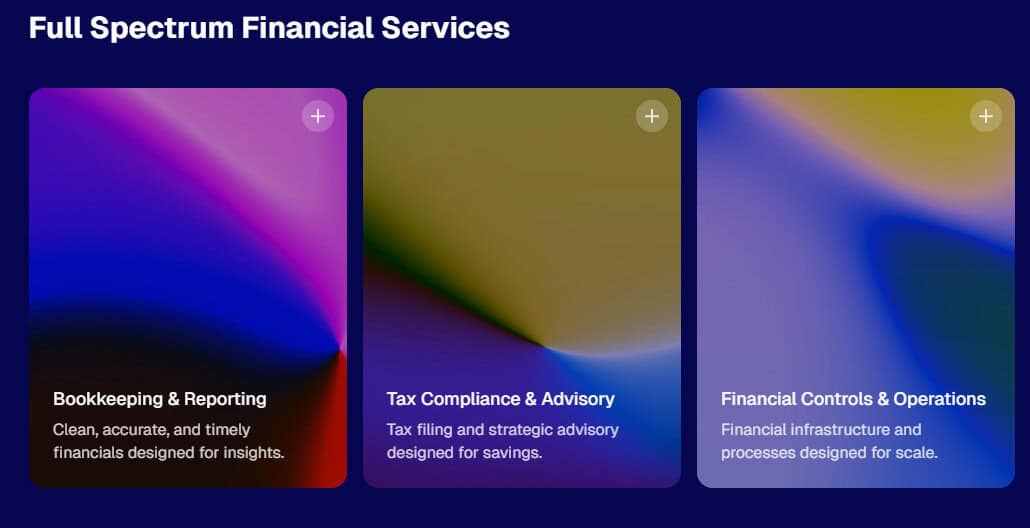
Pillar breaks their offerings down into a few core tenets, but the meat of the matter is their controllership, fractional CFO, and tax advisory services.
1. The Controllership

In the accounting hierarchy, the controller is the one who ensures the data is true. If the bookkeeping is the “what,” the controller is the “how” and “why.”
Pillar’s controllership layer focuses on financial controls and ops. This is the boring but vital work of building a fortress around your cash:
- AP/AR Workflows: You need to be sure you aren’t paying invoices twice and that you’re actually collecting from your customers on time.
- Month-End Close: In my experience, most SMBs don’t close their books until tax time. Pillar pushes for a disciplined month-end close so you have a source of truth by the 10th or 15th of the following month.
- Audit Readiness: Even if you aren’t being audited, you want to act like you are. Pillar builds the audit trail so that if a bank or a VC firm comes knocking, you aren’t scrambling to find receipts from 2024.
2. The Fractional CFO
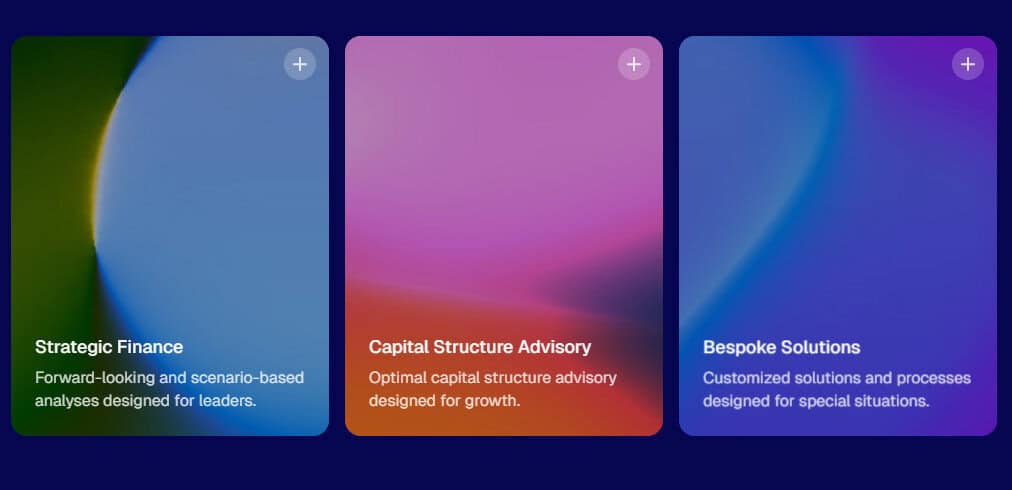
This is the strategic arm of a business. A good CFO, fractional or not, will look at prior results and infer what may happen in the future, and then throw in a bunch of if-then scenarios to help guide the business through a choppy period or help the business capitalize on opportunities that lie ahead.
As a CPA, I love this because it solves the “What if?” anxiety that keeps founders up at 2:00 AM.
- What if we lose our top 3 clients?
- What if we double our ad spend on Google?
- What if we move from a 30-day to a 60-day inventory cycle?
Pillar’s team uses modeling tools to build these what-if scenarios. They act as a fiduciary partner, which means they’re aligned with your bottom line, not just their billable hours.
3. Tax Compliance & Advisory
One of my biggest pet peeves is the tax gap that happens when your bookkeeper and your tax person don’t talk. You end up paying your tax CPA $400 an hour just to clean up the Ask My Accountant folder in QuickBooks.
Pillar integrates the tax strategy into the ongoing advisory. This means they are looking for R&D credits, state and local tax issues, and compliance throughout the year (not just in March).
Where Pillar Wins
The Wins:
- Holistic Integration: Pillar bridges the gap between the books and the strategy. You don’t have to be the middleman between your bookkeeper and your CFO anymore, which gives you back your time.
- Systems-First Approach: Pillar doesn’t just do accounting; they build accounting systems — which is huge for scalability. If you ever want to sell your business, having a system adds a massive premium to your valuation.
- Scale of Expertise: When you hire Pillar, you aren’t just getting one brain; you’re getting a network of CPAs and finance pros who have seen billions in value creation. If a weird tax nexus issue pops up, someone on their team has likely seen it before.
What to Watch For:
- Onboarding Friction: Moving to a firm like Pillar isn’t an overnight switch. If your books are a trainwreck, expect a 30–60 day cleanup and implementation phase. It’ll be painful but necessary.
- Not a Quick Fix: If you’re three weeks away from running out of cash, a fractional CFO can help you manage the crash… but they can’t perform miracles. The best time to hire a firm like Pillar is before the crisis, when you have enough runway to actually implement their advice.
- The Communication Loop: Like any fractional service, Pillar only works if you actually talk to them. If you treat them like a black box where you just send receipts and hope for the best, you’re wasting your money. You need to be in the arena with them.
Pricing: Is It Worth the Investment?
A full-time CFO might cost you:
- $225,000 salary
- $40,000 benefits/taxes
- 2% equity grant
That could potentially be a $300K/year price tag.
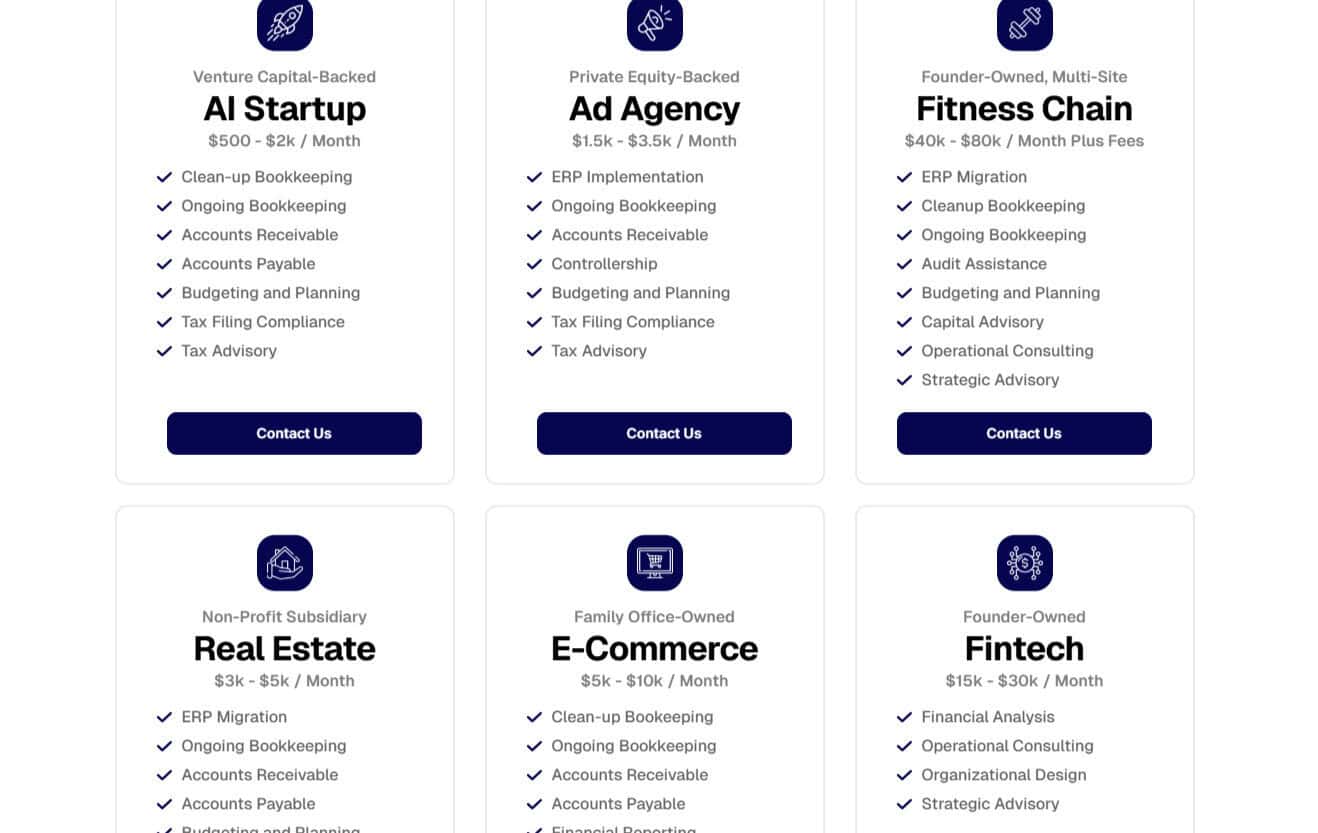
Pillar’s fractional model typically ranges from $2k to $12k+ per month, depending on the complexity. For a business doing $10M in revenue, paying $60k–$80k a year for an entire team (CFO, controller, and tech) is often a much better ROI than hiring one person who might leave.
The trade-off? You don’t have someone sitting in the office next to you 40 hours a week. But in the 2026 digital economy, do you really need that?
Who Is Pillar Advisors For?
Not every business needs a fractional CFO. If you’re a solopreneur doing $200k a year in coaching revenue, Pillar is probably not for you — you need a good bookkeeper and a tax advisor instead.
However, if you fall into one of these buckets, Pillar’s model starts to make a lot of sense:
- The VC-Backed Startup: You’ve raised a Seed or Series A. You have burn to manage and a board to report to, and you need to look professional before the next round. You need the white-glove service that can handle complex equity structures and Delaware C-Corp compliance.
- The Private Equity-Backed Roll-up: You’re acquiring smaller companies and need to standardize their financials yesterday. Pillar specializes in being the “one team” that integrates these disparate units into a cohesive reporting structure.
- The $5M–$50M E-commerce/Hybrid Brand: You have complex inventory, multi-channel sales, and your accounting guy is drowning in the reconciliation of Stripe fees and shipping costs.
- High-Growth Service Agencies: You’re scaling headcount fast and need to understand your realization rate and utilization before you over-hire and tank your margins.
Does Pillar Advisors Deliver on Fixing the Messy Middle?
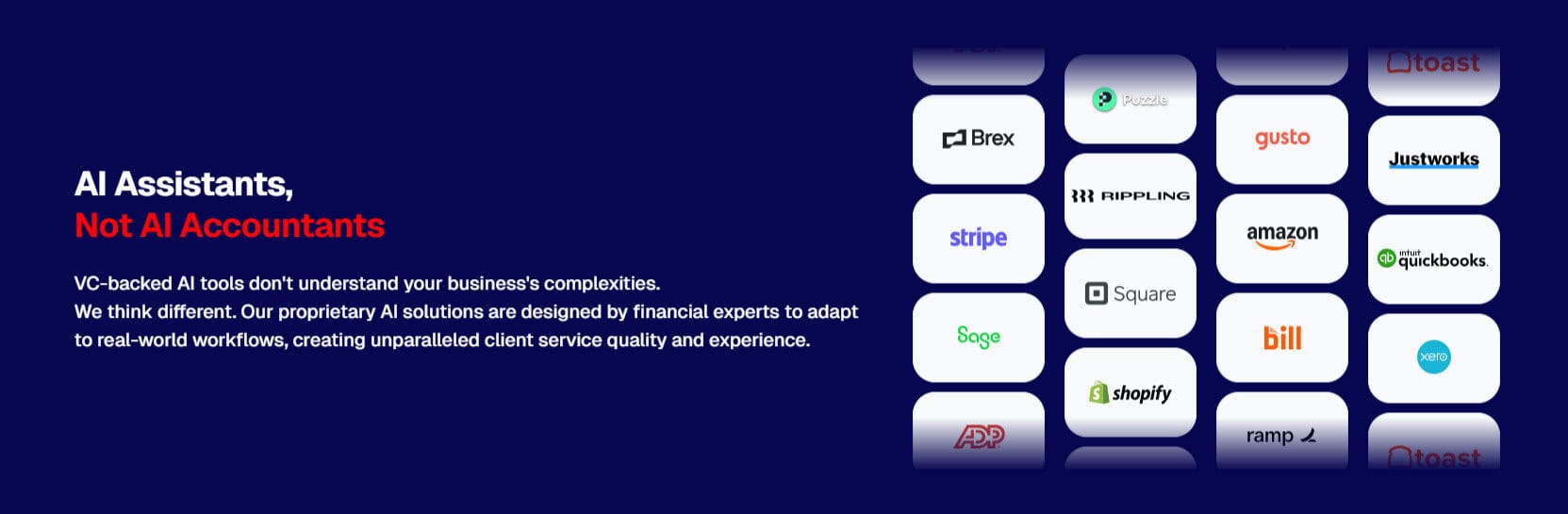
Pillar Advisors seems to have cracked the code on providing enterprise-grade financial leadership to growing businesses that aren’t yet enterprises. They focus on building a series of financial blocks that can be rearranged as your business grows, eliminating the data gap, and leveraging technology to automate low-value tasks like invoice ingestion and basic reconciliation.
They aren’t trying to replace the human element; they’re using technology to make the human element smarter. They’re building a stack that helps identify cash leaks and anomalies faster than a human could by staring at a spreadsheet.
If you’re a founder who feels like you’re winging it with your finances, or if you’re tired of the data gap between your marketing spend and your actual bank balance, it’s time to move beyond the basic bookkeeping model.
As a CPA, I’ve seen what happens when small workflow choices ripple into real costs. In the end, choosing the right financial partner impacts more than just compliance; it means protecting your bottom line and giving yourself the strategic engine you need to actually reach that next level.
And in my opinion, Pillar Advisors isn’t just a service; they’re a partner in the arena. And for the right kind of high-growth business, that partnership is worth its weight in gold.