


Last Updated on February 25, 2026 by Ewen Finser
There are a lot of business brokers out there, so trying to pick the right one can feel like an enormous chore. In truth, though, it’s pretty easy to disqualify brokers when you’re trying to narrow the field.
If a broker doesn’t have experience in your industry, forget about them. If their fees are too high, run.
You also need to ensure you’re looking at brokers that specialize in your segment of the market. A broker who specializes in $500k sales is not the person you want to trust with the sale of a $50mn company.
In this article, I’ve looked at the leading middle market business brokers (this is a rough categorization, but we’re thinking valuations of between $1mn – $25mn).
The middle market comes with unique challenges. Your company is too large for casual buyers, but smaller than what big investment banks target. So, it’s important to select a brokerage firm with a strong pedigree in this area.
Quiet Light
Around since 2007, Quiet Light has spent the last two decades establishing a name as a dynamic player in the boutique brokerage space. The company only hires brokers who have bought or sold online companies themselves, giving them an unrivaled level of hands-on experience.

Pros of Quiet Light
- Affordability: The brokerage charges competitive success fees; they’re capped at around 10% (many brokers in this space charge 15% or more).
- Expertise: With Quiet Light, you get personalized, high-touch service from brokers who genuinely understand your business model. Hands-on support and honest advice can be invaluable if you have no prior selling experience.
- Success rate: About 85% of Quiet Light listings sell within 3 months, which puts the firm well above industry averages in this regard. In total, Quiet Light brokers have helped to sell over 750 businesses (accounting for over $500 million in combined transaction value) in the digital space.
Cons of Quiet Light
- Online-first bias: Quiet Light’s services are tailored to online business owners, so if you’re selling a traditional brick-and-mortar company, you might be better off with a broker who specializes in that vertical.
- Selective listing criteria: Because Quiet Light maintains high standards for listings, very small or declining businesses may not qualify.
What’s the Verdict?
If you’re selling an online company for $25mn or less, Quiet Light is probably the best brokerage firm you could hire.
Empire Flippers
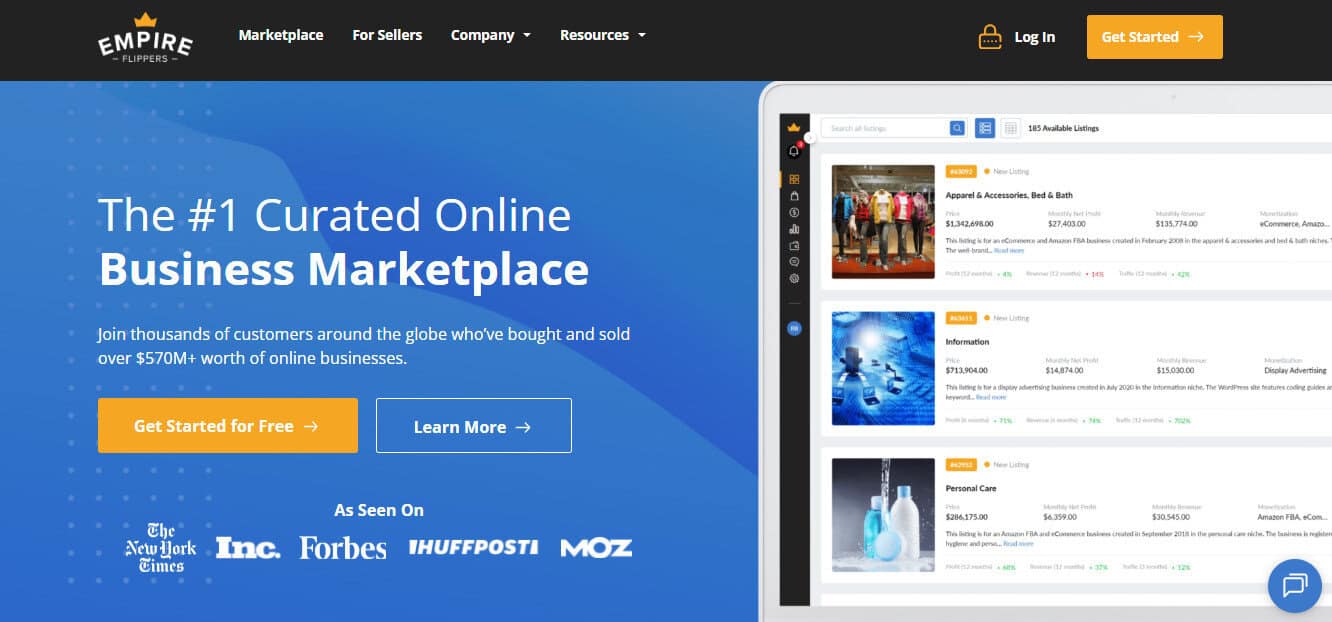
Empire Flippers is not a “full-service” brokerage in the way, say, Quiet Light is. It leaves a lot more to sellers and buyers to figure out between themselves.
As a seller, you’ll submit your business to the Empire team to be considered for listing. They’ll subject your financials, traffic, and other data to intense scrutiny during their vetting process, ultimately accepting just 9% of listings. Yes, 91% of the companies that apply to be listed on Empire Flippers get rejected.
From there, interested buyers must show proof of funds and pay a deposit to unlock detailed information about your listing.
Pros of Empire Flippers
- Massive buyer network: Your listing gets exposure to thousands of vetted buyers worldwide. The strict vetting process means higher-quality listings and smoother due diligence.
- Migration and escrow support: This isn’t available on every listing platform, and it can reduce post-sale headaches significantly.
- Broad experience: Empire Flippers has facilitated strong sales across many online business models (content sites, Amazon FBA stores, SaaS, etc.).
Cons of Empire Flippers
- Limited support: Empire Flippers is a marketplace, not a brokerage firm; while it does offer support, you won’t get the same one-on-one broker relationship that you might expect from a boutique firm like Quiet Light.
- Cost: Empire Flippers’ commission fees are on the higher side at up to 15%. Considering EF doesn’t provide true broker-level support, I think this is hard to justify.
- Strict vetting criteria: Empire Flippers’ selection process is a double-edged sword for sellers. If you make the cut, it lends your listing a lot of credibility; if you don’t, though, the whole process may feel like wasted time and effort.
What’s the Verdict?
As a midmarket seller, I’d talk to a full-service brokerage before signing up with Empire Flippers. I think there’s no substitute for expert support during a seven-figure business sale, especially if you haven’t been through the process before.
Acquire.com
Acquire is somewhat similar to Empire Flippers in terms of its methods. It’s primarily a self-serve marketplace with built-in tools (such as for valuation, buyer interaction, escrow, and letters of intent) to streamline the deal process.
It’s geared in particular towards SaaS companies, app developers, and other tech startups in the low-to-mid market range ($500k – $15mn).

Pros of Acquire
- Huge buyer reach: Over 500,000 entrepreneurs are on Acquire.com, which means your listing could get a huge amount of attention there. Tech-focused businesses often get multiple inquiries quickly, especially if they have recurring revenue.
- Built-in escrow and legal document templates: These can simplify closing significantly for first-timers.
- Optional “concierge-style” service: For larger SaaS deals, Acquire offers an elevated advisory service that provides a dedicated team to assist the seller (for an added fee, of course).
- Competitive success fees: Acquire charges a success fee of just 6% on completed sales of companies with asking prices over $1mn. This is a lot lower than what you’ll find on other listing platforms.
Cons of Acquire
- Hands-off approach: The DIY approach isn’t for everyone. On Acquire, you’ll largely be managing the sale process yourself – responding to buyer questions, scheduling meetings, and negotiating terms. If you’re not experienced, you may find this daunting.
- Lower vetting standards: While Acquire.com does verify buyers and vet listings to some extent, it’s a more open marketplace than Empire Flippers. You might have to deal with a lot of casual inquiries.
- Tech-focused: Acquire’s primary niche is SaaS and tech startups. If you’re selling, say, an e-commerce brand or a content website, you can still list it on Acquire, but the platform’s investor pool tends to lean toward tech/software businesses. This could result in a slower sale.
- Listing fees: Sellers of companies with asking prices of $1mn or more must pay $100 a month in listing fees. Because its closing fees are competitive, this could still represent a good deal; however, if your company sits on the site for months without attracting a buyer, you’ll have effectively wasted hundreds of dollars.
What’s the Verdict?
If you’re selling a tech or SaaS startup that could benefit from exposure to Acquire’s niche pool of buyers, it could be worth listing there. However, for companies outside these verticals, I’d recommend looking elsewhere for sale support.
BizBuySell
BizBuySell is the largest online marketplace for buying and selling businesses of all kinds, making it a key player in the mid-market space. It’s a listing platform that hosts over 65,000 active business-for-sale listings every year.
Using BizBuySell as a seller is akin to using a real estate MLS for a property; you or your broker post an online listing with an asking price, summary, and contact info, and then field inquiries.

Pros of BizBuySell
- Unmatched reach and volume: If you want to cast the widest possible net for potential buyers, BizBuySell delivers. Its website reportedly receives over 3.5 million visits every month.
- Extensive broker network: BizBuySell has an extensive network of business brokers; the company can even help you find a local broker if you decide you need one. This route offers the possibility of a hybrid approach involving both a listing platform and a broker.
- Strong track record: Over 100,000 successful business sales have happened via BizBuySell; statistics like these speak for themselves when it comes to efficacy.
Cons of BizBuySell
- Low curation: This is the unfortunate, if inevitable, flip side of massive volume. BizBuySell does not vet listings much, so quality varies widely. Serious buyers know this, so you’ll need to work harder to make your listing stand out and to prove your financials during due diligence.
- Lack of hands-on support: BizBuySell won’t provide hands-on help in negotiation or deal structuring. Many sellers of mid-market businesses choose to pair BizBuySell with a broker or advisor for this reason.
- Listing fees: Like Acquire, BizBuySell charges listing fees; these start at $65.95 per month on a six-month term. Again, this could potentially be a waste of money if your listing goes nowhere.
What’s the Verdict?
BizBuySell is a powerful tool for exposure, but it’s best for those willing to handle (or outsource) the actual sales process beyond the initial buyer introduction. If you’re going down this route, it could be easier to just go with a full-service broker.
Acquisitions Direct
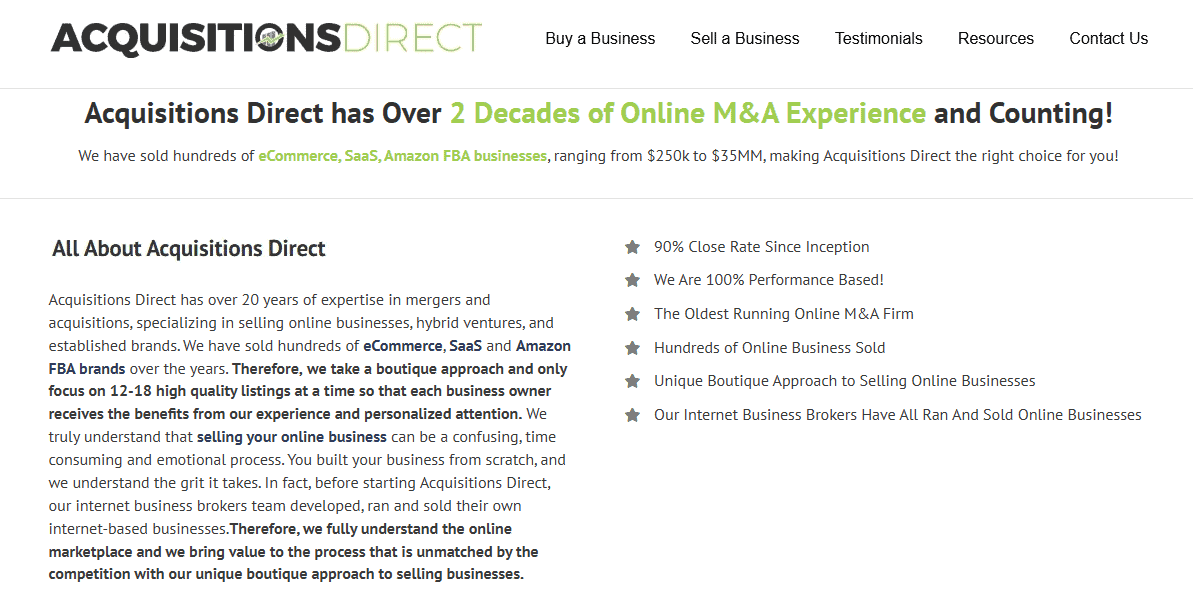
Acquisitions Direct is a boutique internet business brokerage that caters specifically to online businesses worth between $250k – $30mn.
AD takes its “boutique” status seriously, maintaining a very lean portfolio. Its brokers typically handle only 12 to 18 listings at a time, so each client gets extensive attention. The firm exclusively represents sellers (its brokers don’t do buy-side searches), so it’s laser-focused on delivering value for sellers.
Pros of Acquisitions Direct
- Specialized expertise in online businesses: Since they only handle e-commerce sites, Amazon FBA businesses, SaaS, content sites, etc., AD brokers are well-versed in the metrics and factors that matter in these valuations.
- Seller-focused service: Because Acquisitions Direct has a small client load, it’s always in a position to provide boutique-level attention. As a seller, you’ll likely appreciate that all stages (valuation, marketing, buyer screening, negotiations, escrow) are coordinated for you – it’s a comprehensive service.
- High success rate: Acquisitions Direct boasts an overall lifetime close rate of 90%.
Cons of Acquisitions Direct
- Lower visibility: Being a small boutique, Acquisitions Direct may have less public visibility than larger platforms – some buyers might not flock to their site the way they do to, say, Empire Flippers or BizBuySell.
- Selectivity: Acquisitions Direct can be very picky when deciding which companies to take on. Unless yours is an interesting and potentially lucrative proposition, there’s no guarantee of a listing here.
What’s the Verdict?
Acquisitions Direct does a lot of things well, but I’d personally prefer a broker with a broader network. If you restrict yourself too much when searching for buyers, you could be leaving great offers behind.
Business Exits
Business Exits is a top-tier brokerage firm geared toward the higher end of the mid-market segment. Founded in 2013 by Jock Purtle (an entrepreneur who sold his own online business and then started brokering others), Business Exits has quickly grown into a leading broker for companies in the $1mn – $25mn+ valuation band.
Business Exits offers a white-glove brokerage service. If you list with the firm, you’ll get a dedicated deal team to handle your sale.

Pros of Business Exits
- Comprehensive, high-touch service: Business Exits provides end-to-end support, which is crucial if you’re selling a larger mid-market business that has more complex operations or financials.
- Hands-on experience: The team’s entrepreneurial background means they relate to owners and can present your business story in the best light. They are aggressive about actively finding the right buyer, rather than just waiting for inquiries.
Cons of Business Exits
- Larger-cap focus: Business Exits typically focuses on larger mid-market deals. If your business is on the lower end (around the $500k mark), the firm may not be as eager to take it on (it prefers companies with at least $2mn in annual revenue). For smaller deals, you might get less attention or even be referred elsewhere.
- Intense process: Because Business Exits operates with a high level of involvement and outreach, the sale process can feel intense – you’ll be having frequent meetings, preparing documents, and discussing strategy regularly.
- Slower sales: Business Exits tends to take more time over sales than other, similar brokerages. This may or may not be a big deal for you, depending on your goals, but it’s worth keeping in mind.
What’s the Verdict?
Business Exits provides a stellar service for a lot of companies, but its average deal size is a little too high for it to be considered a true mid-market specialist. The firm is also slower than others when it comes to getting sales over the line, which will be a concern for many sellers.
Which Is the Best Middle Market Business Broker?
I always advise entrepreneurs seeking their first exit to work with a full-service broker if possible. There’s simply no substitute for that level of support
Unfortunately, not every full-service broker is interested in doing deals at the middle market level. If they’ve got plenty of work coming in on bigger sales, they’re not going to bother with seven-figure listings.
For this reason, among many others, I think Quiet Light is the pick of the firms I’ve discussed here. You won’t find another white-glove broker that truly specializes in the mid-market segment, or a firm that provides top-class guidance for such reasonable rates of commission.