

Last Updated on March 12, 2026 by Ewen Finser
AI-assisted search has become the newest layer of discovery on the internet. Users are less likely to click through “blue links” appearing on the first page of Google results because they’re getting summarized answers and recommendations in the AI Overview, or in an LLM platform like ChatGPT or Perplexity.
That’s created a serious challenge for brands (now) competing for visibility in those spaces, but many recent platforms have emerged to help measure and influence how companies appear in AI-generated responses.
Unfortunately, most “AI visibility tool comparisons” miss the real difference between platforms, and that’s what I’m going to address here.
Key Takeaways
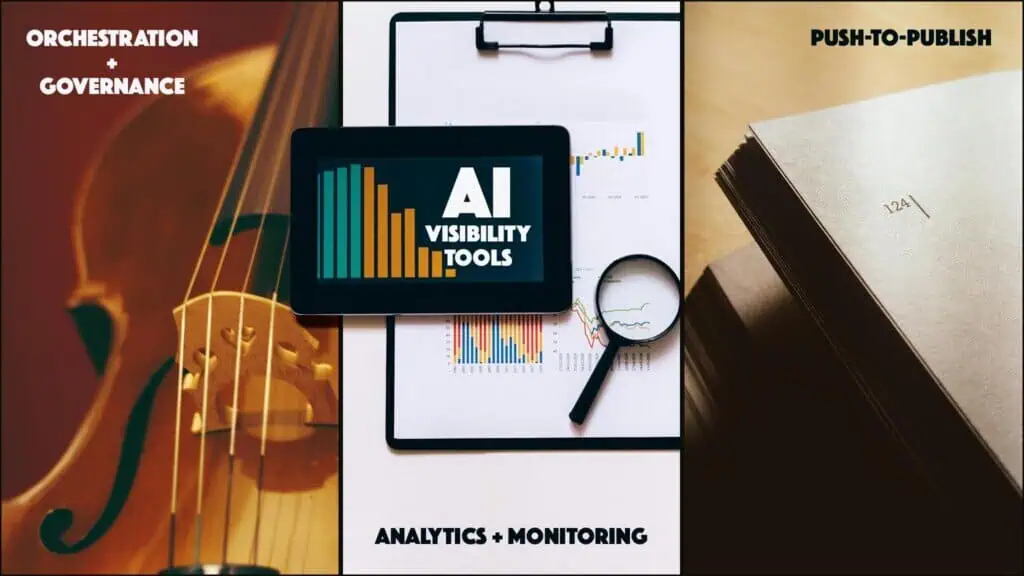
- AI visibility platforms are built primarily for one of three things: monitoring, publishing influence, or orchestration and governance.
- If you’re trying to figure out which one is “best” for your organization, consider AI visibility platforms based on their underlying approach, rather than feature checklists, and choose what your team needs most.
The table below presents the Best AI Visibility Platform Comparison for platforms currently available, organized by their approach.
Approach | Platform | Core Functions | Best For |
Orchestration & Governance | Emberos | Strategy orchestration, prompt prioritization, forecasting and validation of lift, cross-team coordination | Organizations treating AI visibility as a strategic channel, needing narrative governance and impact measurement |
Brand AI | Brand narrative monitoring, brand governance, content alignment | Companies needing control over how their brand is described by AI systems | |
Evertune | Narrative monitoring, brand reputation oversight, influence gap identification | Companies managing brand reputation and positioning | |
Analytics-Heavy | Profound | Prompt testing, brand mention tracking, competitor analysis | Enterprise marketing teams tracking performance at scale |
Rankscale | Visibility scoring, competitor benchmarking, AI readiness analysis | SEO teams evaluating their content ecosystem for AI search | |
Scrunch AI | AI answer monitoring, brand sentiment analysis, misinformation detection | Brands concerned with accuracy and reputation in AI search results | |
Peec AI | Prompt-level monitoring, citation tracking, competitor benchmarking | Teams needing granular insights into AI response visibility | |
Hall AI | Brand mention monitoring, citation tracking, competitor benchmarking | Teams tracking how their brand is framed in AI-generated answers | |
Push-to-Publish | Brandlight | Citation ecosystem analysis, source influence mapping, content opportunity discovery | SEO and PR teams influencing sources referenced by AI systems |
AirOps | AI-assisted content pipelines, programmatic workflows, publishing automation | Content teams scaling production across large topic areas | |
Relixer | Automated content generation and publishing | Organizations building large informational content libraries | |
Writesonic | AI content generation, marketing copy, article production, SEO optimization | Small to mid-sized marketing teams scaling content quickly | |
Waikay | Monitoring, action planning, structured content generation | Teams executing SEO or large content expansion strategies |
If you’re not sure where to start, I’ll break down the three main approaches to AI visibility, the best platforms within each, and how to choose between them.
AI Visibility Platforms Have Three Main Approaches

Since AI-powered search is still relatively new (at least compared to old-school search-engines and SEO), AI visibility tools have not really evolved along the exact same path. They tend to take three distinct approaches, although there is often some overlap:
- Monitoring platforms track where and how brands appear within AI responses (using heavy analytics and treating visibility as a measurement problem)
- Publishing and optimization platforms ideate, generate, and even distribute content that’s optimized for AI search (addressing visibility as a content supply issue)
- Strategic orchestration platforms coordinate strategy and measure the impact of those efforts (approaching visibility as a strategic operating layer that connects monitoring, influence, and governance)
A lot of these tools will feel kind of similar to one another when you start browsing through feature checklists because most offer some combination of prompt tracking, brand monitoring, or even content optimization features.
But when you’re trying to evaluate AI visibility tools (or make a choice between them), you really need to look beyond feature lists and examine their underlying philosophies.
Orchestration & Governance AI Visibility Tools

A small (but growing) set of platforms goes beyond basic monitoring, treating LLM visibility as an operational domain that involves strategy, coordination, governance, and measurable (verifiable) outcomes.
In practice, that means orchestrating across several layers: monitoring AI responses, tracking prompt search volumes and prioritizing the ones that matter most to a brand, as well as coordinating optimization updates that will influence those responses, and then validating whether these efforts actually improved things.
AI visibility tools that fall under this umbrella include:
The core idea behind this approach is that visibility within LLMs is not just a marketing (or even a vanity) metric. Strategic brand surfacing and sentiment in AI-powered search environments require governance similar to SEO, brand reputation, and content operations.
Orchestration and governance platforms typically focus on capabilities like:
- Visibility strategy across prompts and channels
- Governance of brand messaging in AI responses (and strategizing informational or narrative shifts if need be)
- Prioritization of high-impact queries/prompts
- Workflow orchestration
- Validation of visibility improvements
And in one case, platform capabilities even include forecasting (with 75%+ accuracy). Emberos provides AI visibility monitoring and strategy (fix packs, automated to apply changes), predicting the ROI of potential visibility improvements and later verifying the results after they’re implemented.
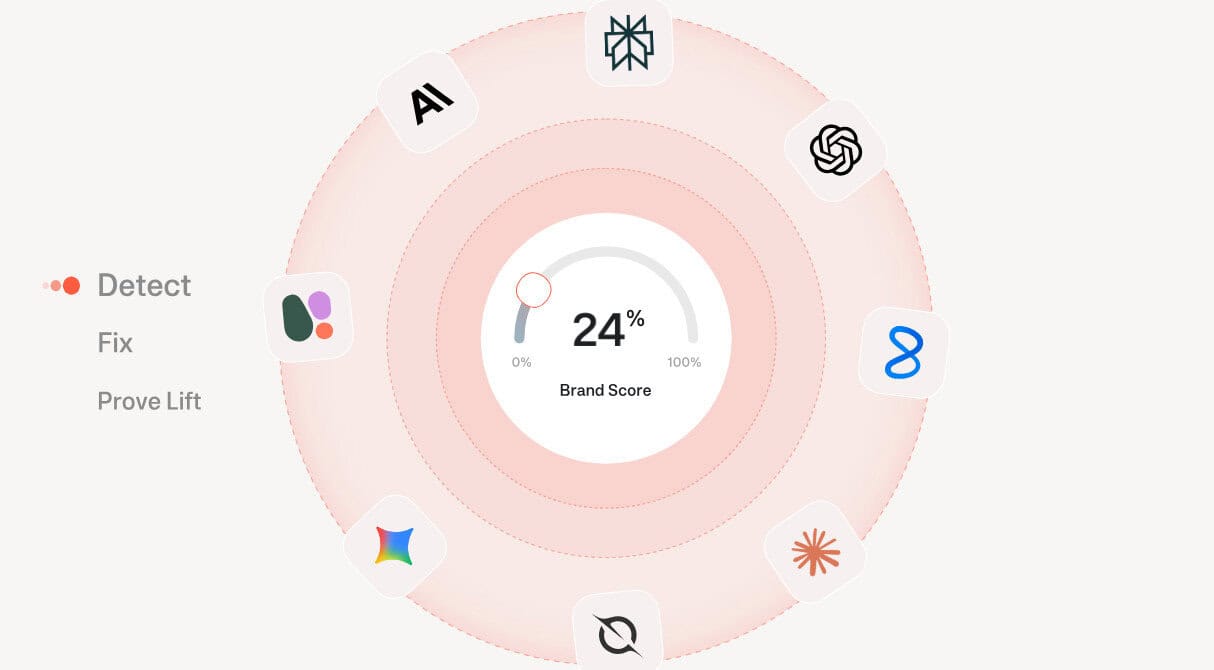
As of this writing, Emberos is the only orchestration and governance AI visibility platform that can predict lift and tie visibility improvements directly to financial KPIs.
LLM visibility is influenced by multiple channels; third-party content (and citations), PR coverage, product documentation, and structured data can all affect whether a brand appears in answers.
Monitoring tools can reveal positioning and publishing tools can increase content production, but orchestration platforms coordinate those activities and measure whether they’re actually moving the needle.
I think that this strategy is going to become the most vital part of AI search stacks, if it isn’t already.
Analytics-Heavy Monitoring AI Visibility Tools

The largest category of AI visibility platforms focuses on monitoring and measurement. The philosophy: in order to influence the way a brand appears in AI-generated answers, they first need to understand where and how they currently do.
Which makes a lot of sense, and for many teams, these kinds of tools serve as the first layer of understanding AI search performance. Barring the more enterprise-level platforms in this category, they’re often very beginner-friendly.
AI visibility platforms that focus primarily on monitoring and analytics include:
These all answer some of the most critical visibility questions, like:
- Is my brand being mentioned at all?
- Where are competitors appearing instead of my brand?
- Is AI describing my brand in a positive (or negative, or neutral) light, and what exactly is it saying?
- What high-intent user queries are triggering mentions of my brand?
More than half of Google searches end without a user clicking through to any website. A brand mention or recommendation in an AI overview, featured snippet, or LLM platform is often the only exposure they get. At the same time, AI-driven visitors are a lot more valuable compared to traditional organic traffic because they’ve already been “sold” by the AI’s conversational guidance before they even set foot (or mouse) on your site.
Analytics and monitoring platforms typically focus on signals like:
- Brand mentions
- Citation sources
- Share of voice and competitor benchmarking
- Recommend frequency
- Sentiment analysis
- General visibility trends
Analytics platforms are great for identifying gaps and tracking progress over time, but most do not have mechanisms or workflows in place to strategize, optimize, or influence improvements.
Even so, analytics-heavy tools provide a vital baseline measurement layer. Without reliable monitoring, brands have little-to-no visibility into whether optimization efforts are even working, or how their brand compares against competitors in AI-driven search spaces.
Monitoring platforms are an important part of a broader AI visibility stack, but influencing outcomes still requires additional strategies that involve content, authority signals, and coordinated messaging across multiple channels.
Push-to-Publish Optimization AI Visibility Tools

This group approaches AI visibility from a different angle, influencing mentions, citations, and recommendations through content production and distribution. Push-to-publish platforms are designed to help teams produce AI-optimized content at scale to increase the likelihood of surfacing in LLMs.
Push-to-publish AI visibility platforms include:
The logic behind this approach is pretty straightforward and makes sense on the surface. AI systems generate answers by gathering information from multiple sources on the web, right? So the more authoritative, structured, and widely-distributed a brand’s content is, the more likely it is to be included when AI models are constructing responses.
(At least that’s the idea.)
Push-to-publish platforms typically focus on capabilities like:
- AI-assisted content generation
- Structured content designed for AI retrieval/citation
- Automated publishing workflows
- Scalable content operations across large topic sets
For a lot of teams, these tools become content engines that help them produce and distribute at a scale that would be difficult (if not impossible) to achieve manually.
But there are also limitations to consider here. More content does not automatically result in greater AI visibility, even if it’s optimized to the teeth.
Without measurement, authority signals, or strategy, accelerating volumes of AI-generated content can dilute efforts rather than improve them. For this reason, I think that push-to-publish platforms are most effective when they’re used alongside analytics and orchestration tools that guide content efforts with meaningful data-driven insights.
How To Decide Which Approach (Or Platform) Is Best For Your Brand

One of the biggest challenges is determining which category of tool actually solves the problem your team is facing, especially because their primary approaches are designed for very different stages of AI visibility maturity.
I think it’s best to start by considering exactly what your organization needs most right now, whether that’s insight into visibility, content scaling and coverage, or coordination and lift.
If You Need to Understand Your Current Visibility
Organizations and brands that are just beginning to explore AI visibility should start with analytics-heavy monitoring platforms because they answer some of the most foundational questions:
- Are we appearing in AI-generated answers at all, and what information are LLMs sharing about us?
- Which of our competitors are being recommended over (or instead of) us?
- What prompts or topics are driving most of our brand exposure?
Like I mentioned earlier, this info is a baseline measurement layer and it establishes a good starting point for any optimization initiative.
If Your Challenge is Content Coverage
Organizations that already know where they want to appear in AI-powered answer environments but are struggling to produce a volume of content to influence the results will want to consider push-to-publish platforms.
These make it easier to create and deploy content at scale, which (theoretically) can increase the chances that a brand’s information will be included as mentions, citations, or recommendations.
That said, push-to-publish tools are going to be most effective when the content strategy is being guided by measurement and priorities, so these are best paired with an analytics-heavy platform if visibility metrics aren’t already built in.
If You Need Governance and Orchestration
Finally, when AI visibility becomes more strategically important or governance over the narrative is a priority, a platform that coordinates and connects monitoring, prioritization, strategy, execution, and lift verification is essential.
Orchestration and governance AI visibility platforms treat it as an ongoing operational process that:
- Begins with understanding which prompts (questions) are influencing customer decisions.
- Strategizes how AI visibility can be optimized.
- Integrates optimizations into workflows for deployment.
- Measures how efforts are improving visibility over time.
Without this kind of coordination, efforts to influence AI visibility can become fragmented, and lift measurement is MIA.
Most Brands Will (Eventually) Use More Than One Layer
Just as SEO developed to include analytics platforms, technical optimization tools, and content production systems, I think the AI visibility landscape is likely going to develop a similar layered tech stack.
Reason being, all these different tools solve different parts of the problem.
Over time, organizations are going to combine analytics tools to measure how AI’s referencing their brand, publishing tools to expand their content, and orchestration platforms that’ll coordinate strategy and validate impact.
The ecosystem is still evolving and the current tooling reflects that. To be honest, I have a feeling the AI ecosystem will continue to keep evolving, the same way SEO did (and is). But understanding where a given tool fits into a broader stack makes it a lot easier to evaluate platforms and build a meaningful strategy no matter when you enter the game.
Closing Thoughts
No single category of tool solves the entire AI visibility challenge. Monitoring platforms provide insight, publishing platforms expand content, and orchestration tools coordinate strategy and implementation and measure business impact.
Every approach addresses very different pieces of the puzzle.
For most brands and organizations, the best path forward starts with understanding which capability their current strategy is missing and choosing the platform that aligns with their visibility goals.