


- What to Look For in Massage Booking Software
- Fresha (Best for Small Clinics That Need Exposure)
- GlossGenius (Best for Clinics That Need Simplicity)
- ClinicSense (Best for Part-Time or New Solo Practitioners)
- Mindbody (Best for Clinics That Offer Classes and Group Sessions)
- Boulevard (Best All-in-One Massage Booking Software)
- How to Decide Which Massage Software Is Right for Your Practice
- Final Thoughts on Choosing the Best Massage Booking Software
Last Updated on April 7, 2026 by The Digital Merchant Team
A potential client lands on your booking page after a stressful day. With tight shoulders and a screaming lower back, they’re looking for relief in the form of a massage, ASAP. But your booking system is confusing, glitchy, or requires creating yet another account, and so, impatient, they click away.
As a massage practitioner, you face unique pressure. When checkout is clunky at a barbershop or salon, clients are usually more willing to shrug it off. But massage is meant to be a serene and deeply personal experience. Your clients expect pure tranquility from the moment they land on your website to final payment.
There can also be contraindications. Pregnancy, recent injuries, physical therapy— there are concrete guidelines about what’s safe. Your booking software needs to handle this intelligently so clients can truly self-book without accidentally scheduling inappropriate services.
Different massage booking softwares solve different problems for different practice sizes and growth goals. By the end of this guide, you’ll have a solid idea of which might be right for your practice.
What to Look For in Massage Booking Software
Before diving into the specific platforms, let’s talk about the five make-or-break details that matter most.

1. Self-Booking
First, you need seamless self-booking with zero friction. The ideal setup here is usually no-login booking where clients don’t have to create accounts or remember passwords. The interface should always feel intuitive and calming, including on mobile.
2. Digital Forms and Waivers
Second, forms and waivers are non-negotiable. You need health history intake forms, liability waivers, and customizable forms for different services. The best systems automatically send forms at the right time, whether that’s after booking specific services or just before first appointments.
3. Customizable Booking Rules
Smart booking rules matter more for massage than almost any other service. Can the system prevent clients from booking contraindicated services? Or set up service sequencing in the ideal order? What about flagging clients whose bookings require staff approval? This feature protects your clients and you in terms of liability.
4. Client Notes and Charts
Detailed client notes tied to every profile are a must-have. You’ll want to have fields for pressure preferences, allergy tracking (fragrance-free oils, lavender sensitivity), specific sore spots, and full treatment history. When regulars book, your massage software should make their preferences easily accessible.
5. Packages and Memberships
Offering packages and memberships is where massage businesses make consistent money. Your software should make recurring client packages, prepaid sessions, and predictable appointment cadences simple. If setup feels complicated, you’ll likely avoid it— and that means you’re leaving money on the table.
Lastly, with all of these features, HIPAA compliance isn’t optional. Your software needs secure client data storage and compliant record retention. It’s smart to remember the golden rule: “Good, fast, or cheap… pick two.”
If a platform claims to be incredibly affordable, super easy, and packed with features, you should be skeptical. With that said, let’s dig into the best massage booking software platforms available today.
Fresha (Best for Small Clinics That Need Exposure)
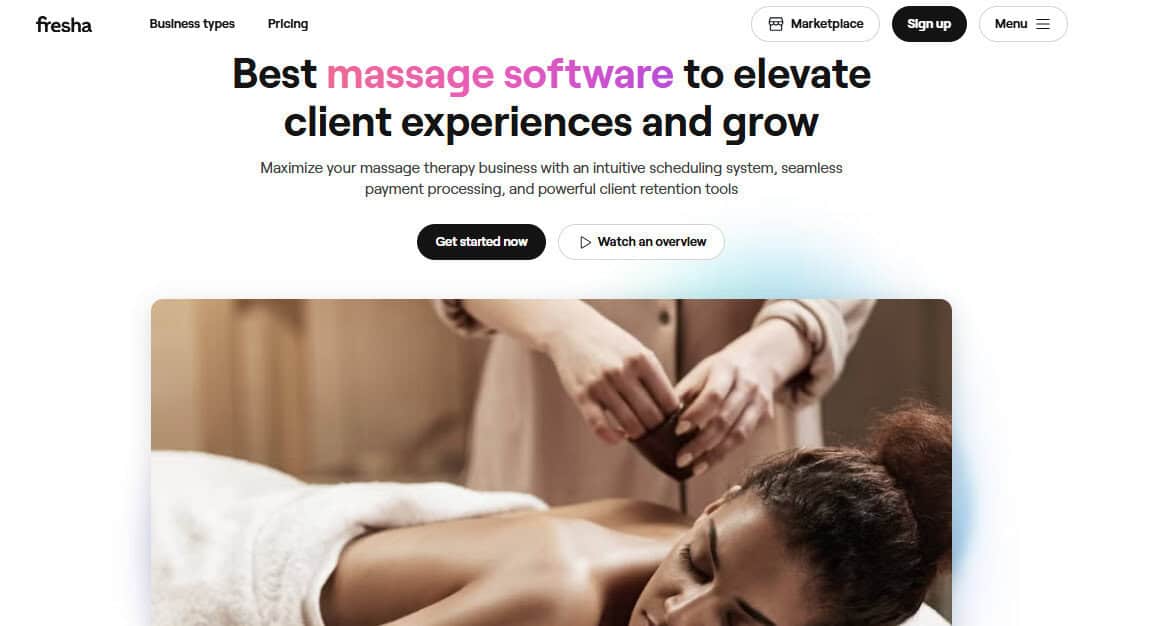
Fresha has built a solid reputation as an affordable option with genuine marketplace exposure, thanks to the included Fresha marketplace. The marketplace charges a one-time 20% commission (minimum $6) when new clients discover you through Fresha, but returning clients cost nothing!
Starting at $19.95 monthly for solo practitioners, it’s one of the most budget-friendly comprehensive platforms available. For clinics with multiple practitioners, the Team plan costs $14.95 monthly per bookable member. Processing fees are 2.79% + $0.20 online, 2.29% + $0.20 in-person.
Now, even though Fresha wasn’t originally designed for massage clinics, its features do align quite well. For example, you can create customizable intake forms that trigger when a specific service type is booked. HIPAA compliance is included from the base tier up, which is a must-have.
I would say the marketplace is Fresha’s strongest feature.
When potential clients search for a massage in your area, your practice appears in the results with a direct booking link. For newer practitioners who are still building clientele, that organic discovery drives bookings in exchange for a reasonable commission.
Pros:
- Very affordable for solo/small teams
- Access via web browser or mobile access anytime
- Marketplace drives new client discovery organically
- HIPAA compliance is included without premium pricing
Cons:
- Locked into Fresha payment processing
- 48-hour email support response on basic plan
- 20% marketplace commission on new clients can add up
Best For:
Fresha is ideal for solo massage therapists and small studios (up to 15 providers) needing affordable software with built-in marketplace exposure. Or if you’re building clientele and need discovery beyond your own marketing, Fresha delivers that through the marketplace, no social media expertise required.
GlossGenius (Best for Clinics That Need Simplicity)
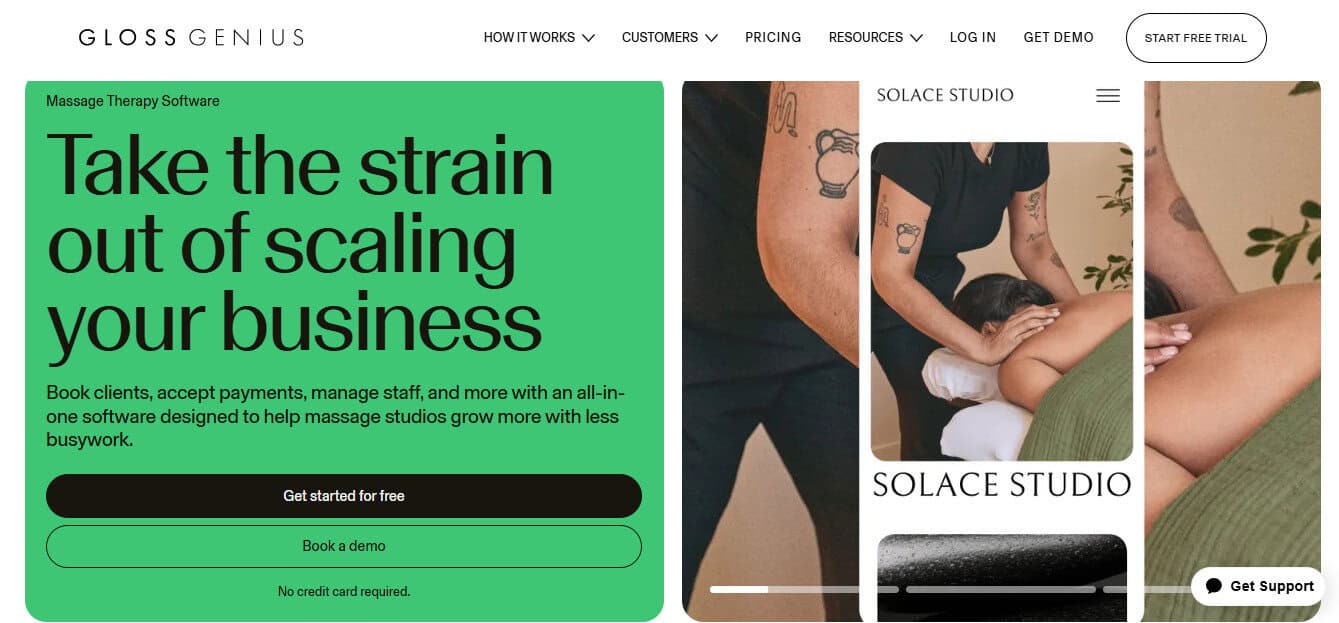
GlossGenius has earned a devoted following, and fans often state one reason: it’s beautiful. The platform genuinely looks and feels premium, which matters when your brand is built on luxurious experiences.
In terms of pricing, the Standard tier starts at $24 monthly with an annual contract, or $28 monthly otherwise. Gold runs $48 annually/$56 monthly. Platinum is $148 annually/$168 monthly.
All plans include flat 2.6% payment processing with no hidden fees, which is currently among the industry’s lowest.
In regard to features, the must-haves are present here. You can choose from form templates or build custom forms, and set them to trigger automatically by service or appointment type. Plus, the no-login online booking means your clients can schedule themselves without creating accounts.
I would say the client-facing booking experience is where GlossGenius shines. If your brand provides premium, high-end experiences, your booking page with GlossGenius will perfectly reflect that quality.
Pros:
- Easy for less tech-savvy staff to learn
- Free data transfer when switching platforms
- Flat 2.6% processing (transparent, no hidden fees)
- Stunning design for brand-conscious practitioners
Cons:
- Gold plan caps at 9 team members
- Some settings aren’t 100% customizable
- App-only management (only calendar via web browser)
- No website widget; online booking happens through GlossGenius’s URL
Best For:
GlossGenius is ideal for solo massage therapists and small studios who value beautiful design and want something simple that less tech-savvy staff can easily use. If your brand positioning is premium and you want your online booking to reflect that quality, GlossGenius delivers polished aesthetics at a reasonable price.
ClinicSense (Best for Part-Time or New Solo Practitioners)
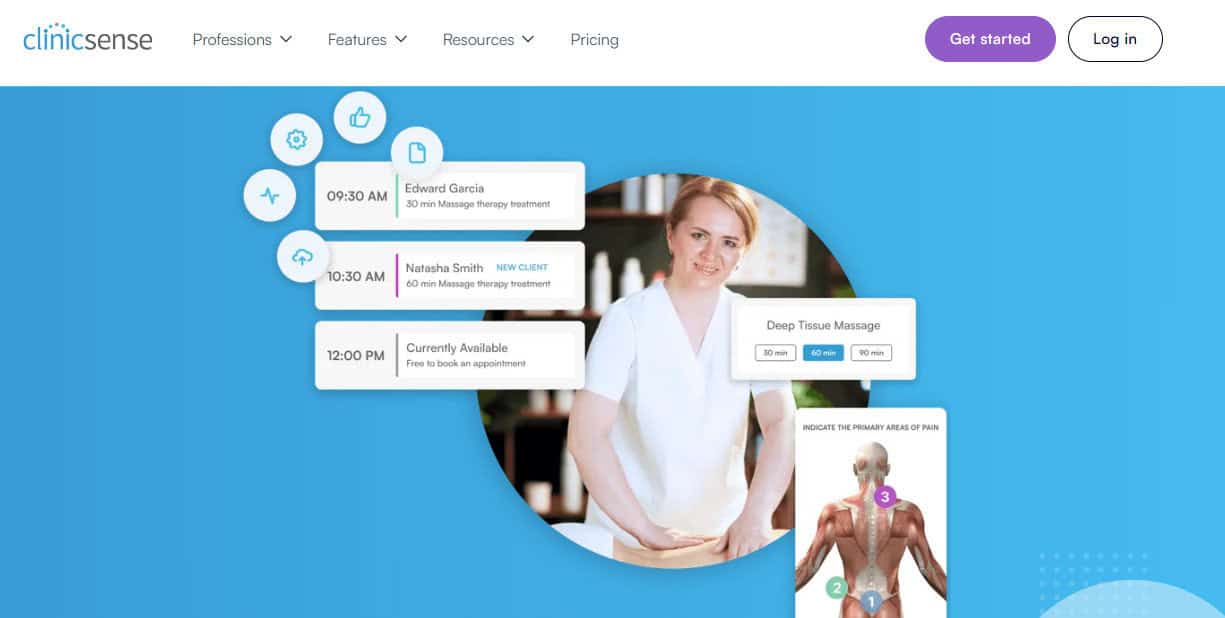
ClinicSense is the massage-specific platform specifically designed for solo practitioners and growing wellness clinics, rather than adapted from salon software like other platforms. That focus is obvious in almost every feature!
But first, let’s talk about cost. The Lite tier runs $39 monthly (up to 20 appointments, 0 office staff). Standard costs $69 monthly (200 appointments, 5 office staff). Premium is $99 monthly (unlimited appointments, 15 office staff). Additional practitioners cost $20 monthly each.
All tiers include a 14-day free trial with no credit card required, which is a nice detail.
Now, as for those features I mentioned. The form creation here is the best I’ve seen so far. Every tier includes unlimited custom forms and five standard templates to get you started:
- Client Contact
- Health History
- Reason for Visit
- Consent & Policies
- Health Conditions
You can customize these templates or build entirely new forms, then set rules for when clients receive each one.
The booking rules allow you to block specific clients online, require pre-payment, and customize which services are bookable online versus phone-only.
However, you can’t automatically prevent contraindicated service combinations, so you will still have to manually audit your bookings now and then.
ClinicSense also includes customizable SOAP note templates, No Show Guard for automatic no-show charges, and a seamless website booking integration that’s designed to be easy to set up.
Pros:
- Knowledgeable customer support
- Seamless website integration via code snippet
- Reports designed to simplify quarterly and year-end taxes
- Form creation and automation are incredibly customizable
Cons:
- Vacation/sick day blocks are clunky
- Pricing scales poorly for multi-practitioner clinics
- Limited reporting compared to other massage platforms
- Users tend to outgrow it once they start optimizing revenue
Best For:
ClinicSense is really ideal for solo practitioners and small clinics who want to stay small and not maximize revenue or scale, or those who just need something to handle the basics exceptionally well. It’s also perfect for part-time practitioners or anyone getting established who needs customizable, simple form management.
Mindbody (Best for Clinics That Offer Classes and Group Sessions)
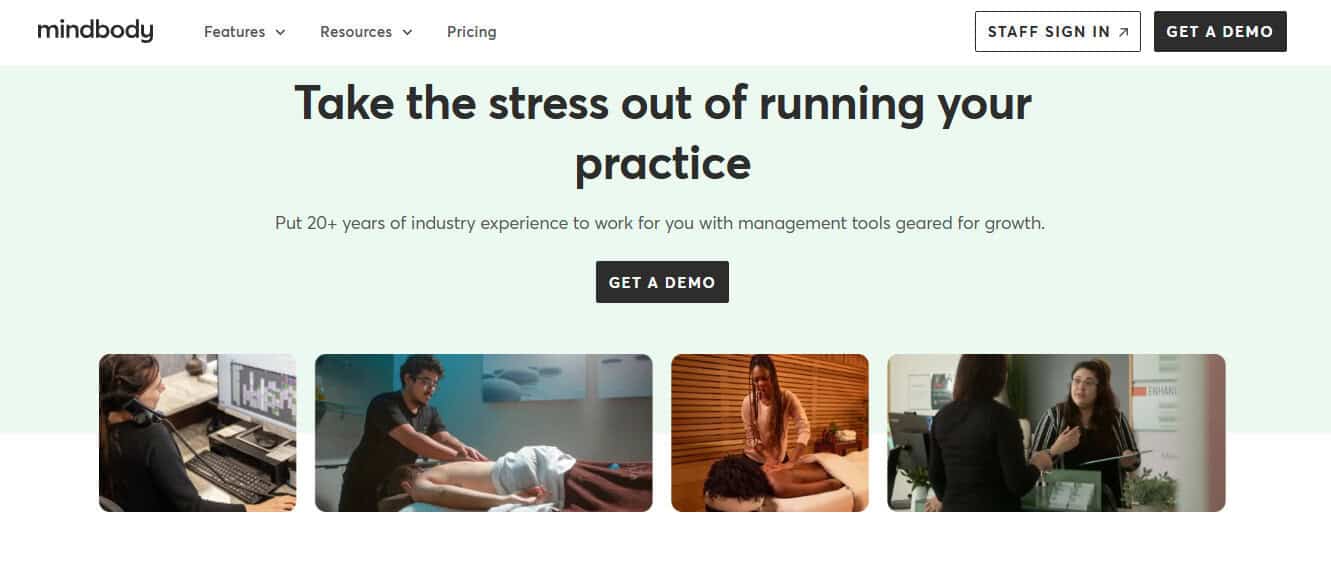
Mindbody launched in 2001 and has gone on to become one of the most established names in wellness software, though it’s better known for fitness studios than massage. That crossover functionality is actually Mindbody’s biggest strength.
The Starter plan begins at $99 monthly per location. Any of the higher tiers (Accelerate, Ultimate, Ultimate Plus) require contacting sales for quotes. You’ll pay 2.99% + $0.30 processing per transaction with no additional monthly fee, which can add up to real savings over time.
As for features, the Mindbody Explore marketplace provides access to millions of potential clients, much like the Fresha marketplace.
Where Mindbody excels is in handling appointments and classes seamlessly. If your practice offers group workshops or online classes alongside appointments, Mindbody’s class booking is sophisticated, reliable, and proven.
It also integrates with Shopify, Groupon, and common payroll systems to further maximize your revenue!
But I have to call out that with this platform, forms and waivers are scattered across the interface rather than centralized — which is confusing, to say the least, especially for a massage clinic.
Pros:
- Extensive third-party integrations
- No monthly payment processing fee
- Massive marketplace for client discovery
- Sophisticated class and appointment crossover functionality
Cons:
- Interface feels dated and clunky
- Required 12-month contract commitment
- Customer support quality declined (long waits)
- Advanced reporting is locked behind higher tiers
Best For:
Mindbody is a unique platform, and it’s best for unique massage clinics offering workshops, classes, or group sessions alongside individual appointments. If you’re diversifying income with group stretching, online meditation, or educational workshops, Mindbody’s crossover functionality delivers that capability, as well as marketplace exposure.
Boulevard (Best All-in-One Massage Booking Software)
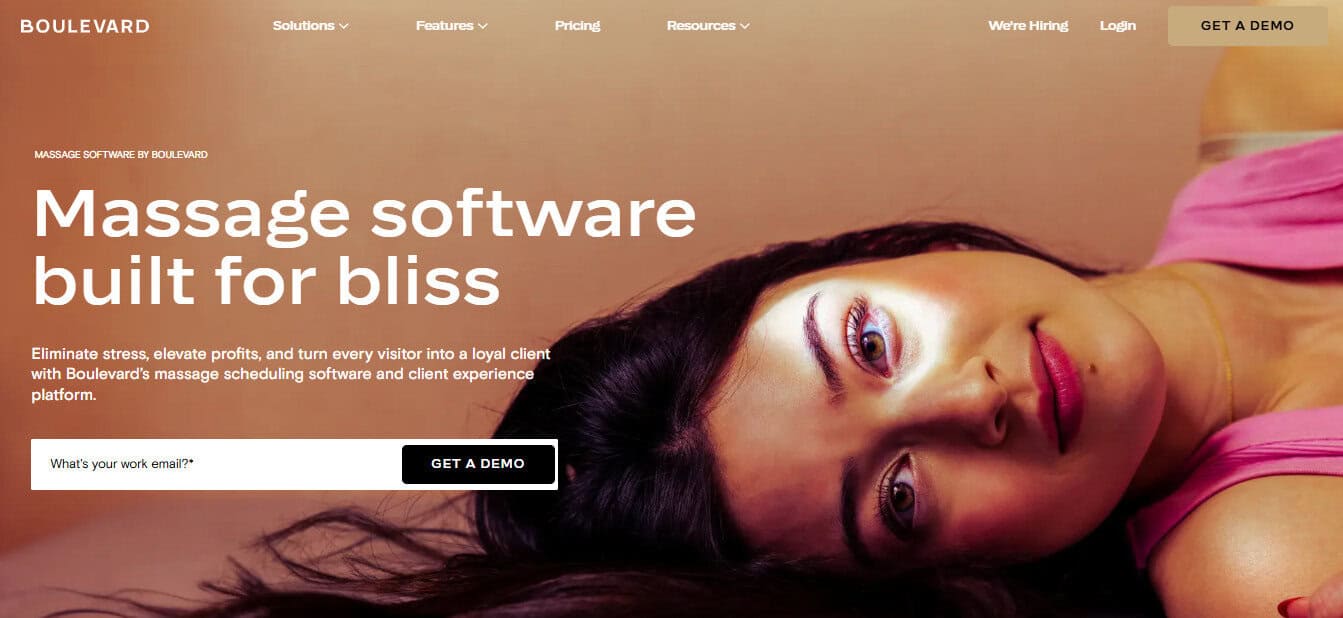
Boulevard launched in 2016 specifically for salons, spas, and massage clinics, and similar to ClinicSense, that purpose-built approach shines through in every feature. First things first, though, know that Boulevard is a premium, all-in-one option, rather than basic and low-budget:
- The Essentials tier runs $176 monthly (up to 5 providers)
- Premier costs $293 monthly (unlimited providers)
- Prestige is $410 monthly (unlimited providers)
- Enterprise pricing is custom and requires a discovery call with the Boulevard team
But you really get what you pay for, including a drag-and-drop form builder with customizable triggers by service type or client preferences.
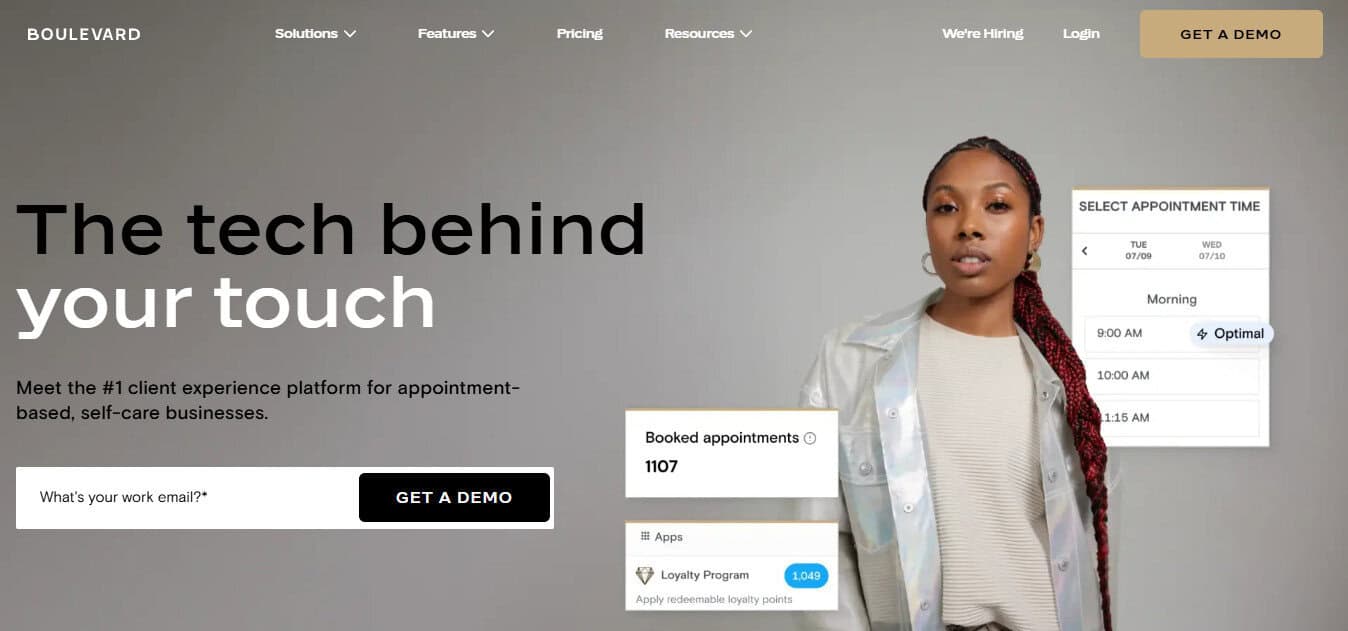
Boulevard was built for real stylists, salon, and spa owners. It handles booking, checkout, and smart scheduling the way busy salons actually work. It even handles marketing, from rebooking reminders to targeted emails and texts, plus it fills open spots with waitlist requests, without the scrambling.
Another one of my favorite features is that the system auto-populates client data everywhere! So, when clients update phone numbers or allergies, for example, those changes appear everywhere automatically— you don’t have to go digging through the client profile to find them.
The biggest thing to understand about Boulevard is that everything lives on one platform: your booking, POS, marketing automation, inventory, payroll, reports, staff schedules, memberships, and more.
Plus, the platform is fully HIPAA compliant from the base tier up, which is always important to know.
Pros:
- Purpose-built for salons, spas, and massage clinics
- Membership/package creation and management are easy
- All-in-one solution that eliminates the need to pay for multiple platforms
- Precision Scheduling uses AI to maximize booking revenue and prevent awkward gaps
Cons:
- Higher pricing than basic options
- No free trial (request a demo by contacting Boulevard)
- May be more complex than part-time practitioners need
- Some features are tier-locked, like deposits and resource scheduling
Best For:
Boulevard is best for massage clinics that are focused on building a brand and treating their practice as a long-term business. If you prioritize having an intentional customer experience and want software to help you grow, Boulevard provides those deep strategic capabilities.
How to Decide Which Massage Software Is Right for Your Practice
Choosing the best massage booking software for your practice’s specific needs comes down to three factors:
- Your growth trajectory
- Your current client acquisition needs
- You and your team’s technical comfort level
Consider starting with Fresha if you’re budget-conscious and need marketplace exposure to find new clients. The 20% commission can sting, but returning clients cost nothing, and the marketplace does genuinely drive new bookings.
You may want to look into GlossGenius if you’re solo-to-small (up to 9 providers) and value beautiful design that even your less tech-savvy staff can use. But think about whether the cost of the premium client experience makes sense for your specific clientele.
ClinicSense can be a good option if you want to stay small and need excellent form management without complexity. It’s particularly ideal for part-time practitioners or those taking the first steps in getting established.
Mindbody may be the right fit if you offer classes or workshops alongside appointments. Plus, if you’re diversifying with online classes or livestreaming of any kind, Mindbody’s crossover functionality is well-built for that.
Boulevard will likely be the best place to start if you’re treating massage as a serious business, from marketing to budgeting and forecasting. For building brands, creating intentional experiences, and scaling beyond just your hands-on work, Boulevard provides every strategic tool you could ever imagine.
Final Thoughts on Choosing the Best Massage Booking Software
As you research these platforms, remember the five key features that matter most for massage booking software that we covered earlier.
You’ll want: seamless self-booking, robust intake forms for safety, detailed client notes for personalized care, the ability to manage memberships and packages easily, and smart booking rules to prevent contraindicated services. Everything else builds from there!
So, what’s your next step? I suggest you start with demos or trials of your top two choices. Pay attention to how forms work, whether booking rules prevent unsafe service combinations, and if the client-facing experience maintains the tranquility your clients expect.
All in all, the best massage booking software will help you deliver exceptional, personalized experiences while protecting your schedule and income…rather than adding more complexity to an already demanding practice.