


Last Updated on February 18, 2026 by Ewen Finser
If you’re looking to buy an established SaaS business, there are generally two routes you can go down: online marketplaces and business brokers.
So let’s go over these two options and discuss where you might use each one, including the potential pitfalls you may encounter as a buyer.
How Buying a SaaS Business Works: Marketplaces vs. Brokers

Online Marketplaces
Online marketplaces are like Zillow, but for the purchase and sale of companies. Here, sellers make listings, post them on the platform, and field buyer inquiries themselves. The listings typically show basic information (revenue, profit, niche, etc.) and a short description; in order to access the finer details, you’ll generally have to sign an NDA.
It’s more or less a DIY process when it comes to due diligence and negotiations. The marketplace may provide tools like messaging, data rooms, or integrated escrow services to facilitate the sale, but you’re still going to have to do a lot more work to get the deal done than you would if you were using a broker.
Business Brokers
A broker acts as a personal guide and intermediary in the acquisition process. They primarily represent sellers in SaaS transactions, but they also often assist buyers. As a buyer, the biggest advantage they offer you is the higher-quality companies they typically provide access to.
Though the particulars of the service vary a bit from one firm to the next, brokers typically pre-qualify buyers, market listings to buyers, coordinate negotiations between buyers and sellers, and handle the technical aspects of closing (escrow, due diligence, etc.). So, as a buyer, the broker you choose to use will have a bearing on how difficult the process is for you; for example, some will require detailed checks before allowing you to contact sellers, while others won’t.
Brokers vs. Marketplaces: Which Should You Use?
There’s no one answer that’s always true here. If you’re buying a business, you’ll find that the buying experience is quite different across these two mediums, and you should choose whichever best suits your goals.

Advantages of Buying Through a Brokerage:
- Better companies: Sellers of high-quality companies typically prefer to work with brokers, so deals like these are often unavailable on marketplaces.
- Less work: Brokers generally look after escrow and closing requirements. If you’re buying on a marketplace, you may need to arrange these yourself (alongside the vendor).
- Less competition: Sellers are more likely to take you seriously if you’re partnered with a good brokerage firm. You won’t have to fight dozens of other buyers for attention, like you would on a buy-and-sell platform.
- Expert guidance and process management: Good brokers are experts in business sales, and they can best advise you throughout the process.
Advantages of Buying Through a Marketplace:
- Lower sale prices: A good broker’s goal is to get the seller the best price (their commission depends on it). And since sellers use brokers to advocate for higher prices, it’s often easier to pick up good deals as a buyer when there’s no broker involved.
- Small or simple deals: If you’re looking for a smaller company, a marketplace is likely the best place to go. Many offer plenty of listings in the four- to five-figure range.
The main takeaway is the quality of the companies available to you as a buyer. More serious sellers tend to prefer brokerages, so the general standard of their stock is much better. However, marketplaces offer you a much lower barrier to entry in most cases.
The Best Brokers for Buying SaaS Businesses
There are dozens of great brokerages out there, but I recommend finding one that specializes in SaaS since they’re active in the space, understand the business model, and work with plenty of other SaaS buyers/sellers.
Here are three firms that fit the bill.
Quiet Light

Quiet Light is my top pick when it comes to SaaS brokers because it only hires brokers who have bought or sold at least one online business themselves. The team therefore has a deep understanding of the goals and pain points of SaaS founders and buyers, which is invaluable during sales processes.
Additionally, Quiet Light is much more reasonably priced than a lot of its chief competitors. It caps commissions at 10% of sale value (commissions of up to 15% are unfortunately common in the space). This means it’s much easier for both buyer and seller to emerge with a good deal on a transaction.
Overall, Quiet Light provides a very hands-on, advisory-led approach, with access to a curated list of sale-ready SaaS businesses.
FE International
FE International is a highly respected M&A advisory firm that specializes in online businesses — particularly SaaS companies on the larger side ($10M+). The firm has completed over 1,500 deals totaling over $50 billion in value since its inception in 2010, and it has offices in multiple financial hubs and a global network of buyers that includes private equity firms, family offices, and strategic corporate buyers.
FE International is often best for SaaS businesses that are larger or more complex — think seven or eight-figure valuations or companies with lots of moving parts. Unfortunately, commissions are reportedly on the high side, at up to 15% (it doesn’t list fee rates publicly). For larger sales, this is going to alienate some founders and limit your options to a degree as a buyer.
Just note that FE’s buyer list is rather exclusive; unless you come to the table with a strong reputation (and deep pockets), you probably won’t get a look inside.
Website Closers
Like FE International, Website Closers specializes in the large-cap segment of the market, frequently brokering SaaS deals worth north of $50M.
Website Closers operates using a franchise model, with offices and brokers across several regions. This gives the platform a broad reach and the ability to provide more localized or industry-specific expertise when needed.
Like FE International, Website Closers doesn’t list its fee schedule publicly; however, anecdotal evidence suggests that it usually tends to work out cheaper than FE International. So you may find a better selection of companies here, but you’ll also find the same exclusivity issue: unless you’re in a position to partake in big deals, Website Closers won’t have any time for you.
Best SaaS Marketplaces
There are several popular online marketplaces where you can find SaaS businesses listed for sale, letting you browse multiple opportunities and handle deals more directly.
Acquire.com
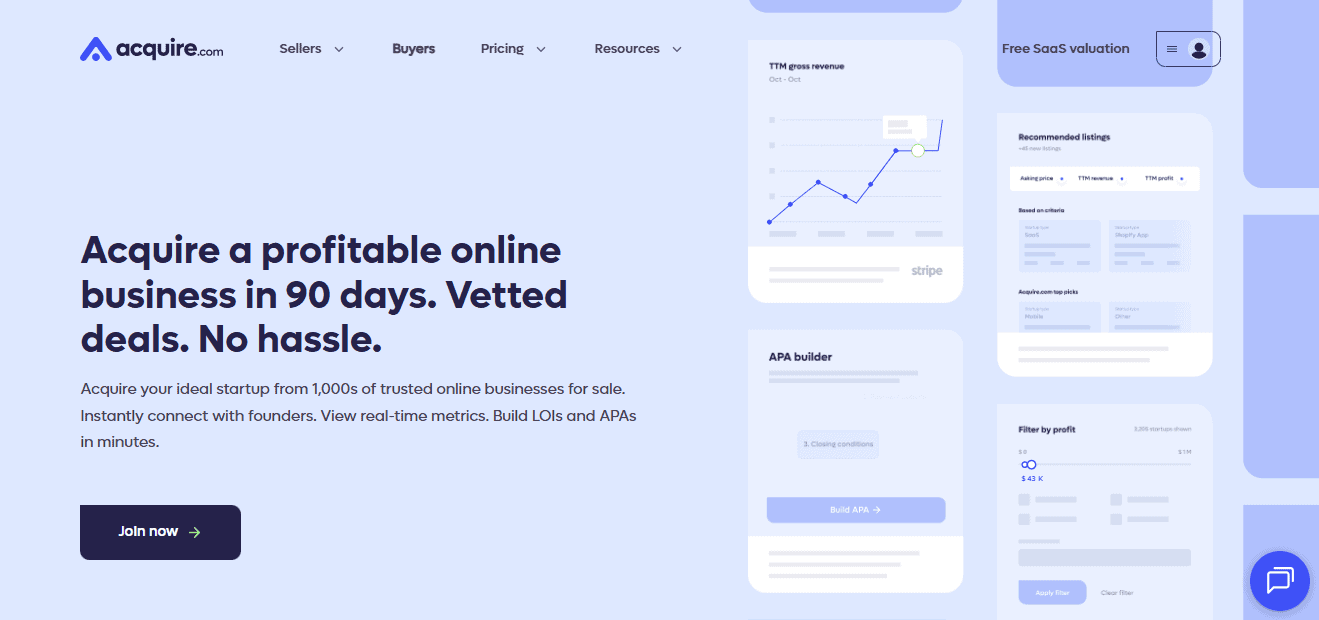
Acquire specializes in the sale of SaaS and tech startups. It’s a relative newcomer to the market, having been founded in 2020 under the name MicroAcquire. However, the platform has grown massively in that time, having facilitated the sale of over 2,000 startups with a combined value north of $500M.
Because it’s so specialized, Acquire is my main recommendation for a SaaS marketplace if that’s how you’re seeking to do business.
Flippa
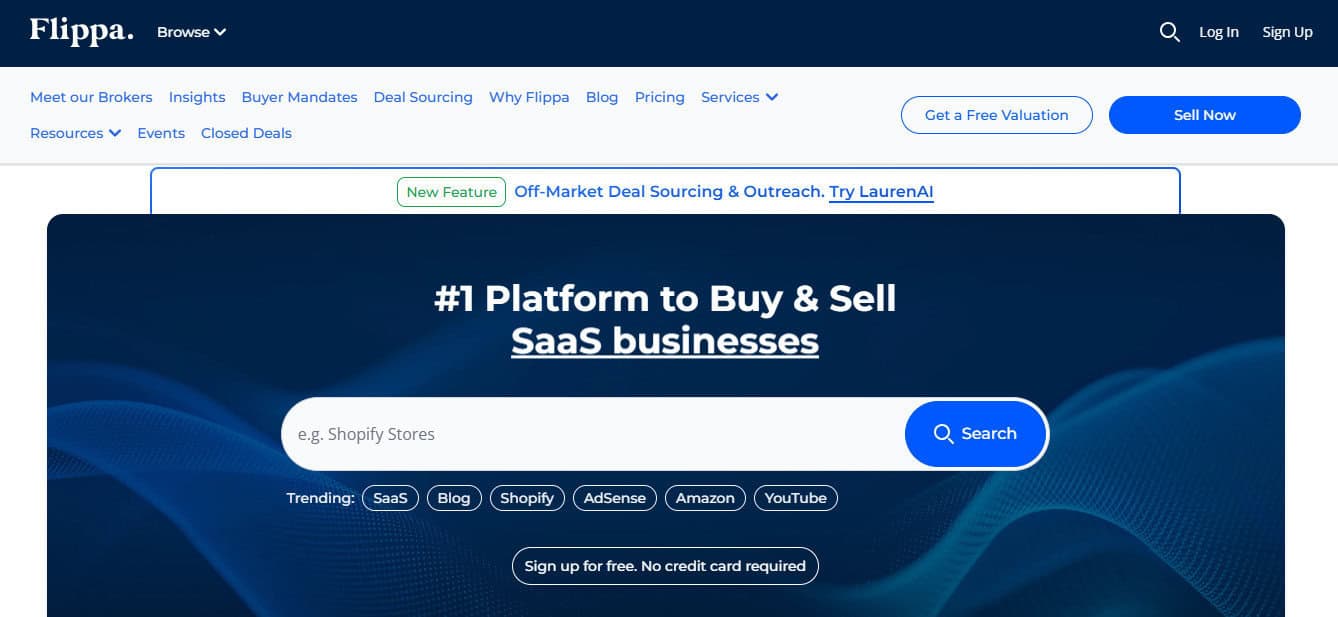
Flippa is one of the original online business marketplaces, and it remains a popular place to buy and sell SaaS businesses, content sites, e-commerce stores, apps, domains, and more. It has the widest range of listings you’ll see anywhere, featuring everything from tiny starter sites selling for a few hundred dollars, all the way up to multi-million dollar businesses.
If you’re looking for a company in the latter category, I’d recommend forgetting about Flippa; most serious sellers at that level will go with a broker. However, if you’re trying to acquire a four- or five-figure SaaS business, this could be the place for you.
Just be aware that Flippa does very little in terms of buyer vetting, which means seller trust is low.
Choosing the Right Path for Your SaaS Acquisition
Both brokers and marketplaces can lead you to a successful SaaS business purchase, but they serve different needs. I personally default towards recommending a broker; you should only go down the marketplace route if you know what you’re doing, or if you can’t find a suitable broker to work with.
In my opinion, Quiet Light is the best partner for a SaaS acquisition, especially if you’re looking for a company worth between $500K–$25M.